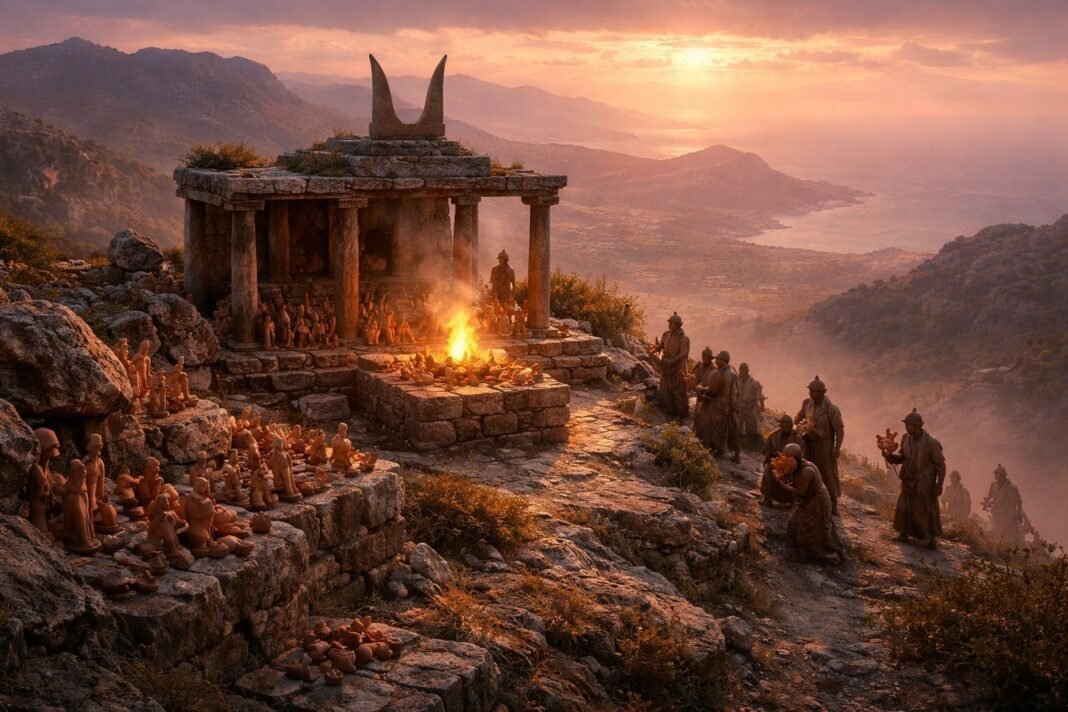
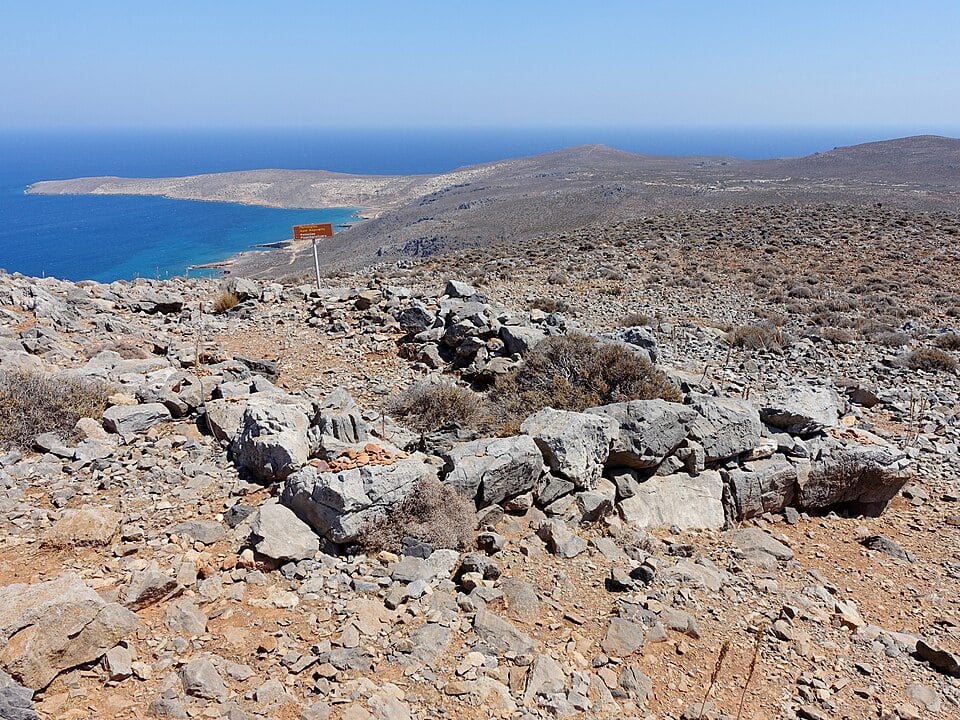
Perched atop the windswept summits of Greece’s largest island, Crete, the remains of sanctuaries are among the earliest and most remarkable traces of Minoan civilization in European prehistory. Long before the Olympian pantheon came to dominate the religious imagination of the Ancient Greek world, the Minoans, Europe’s first great Bronze Age civilization, had already developed an elaborate tradition of worship sites set at very high altitudes.
This practice left a lasting imprint on the island’s rugged terrain, transforming Crete’s mountains into a continuous spiritual landscape shaped by ritual, belief, and elevation.
The rise of Minoan peak sanctuaries
Archaeological evidence indicates that the emergence of these Minoan sanctuaries on the peaks of mountains began around 2000 BC, a period that closely aligns with the construction of the great palaces and trade centers at Knossos, Phaistos, and Malia. Scholars have long observed that this timing is unlikely to be coincidental. It is widely believed that the Minoan ruling elite deliberately incorporated these striking Cretan mountain summits into both their political and religious life, using the island’s natural topography to reinforce authority over surrounding communities. Mount Juktas rises dramatically to the south of Knossos and remains visible from great distances across the surrounding plain.
This makes it perhaps the most evocative example of the phenomenon. By consecrating such prominent peaks with sanctuaries, Minoan leaders effectively transformed Crete’s landscape into a shared religious map, ensuring that even the most remote farmer or shepherd could look toward the horizon and perceive the divine order embodied by their rulers. Archaeological evidence recovered from these sanctuaries offers a remarkably close window into the religious life of ordinary Minoans who lived more than three millennia ago. Excavations across multiple sites have yielded thousands of terracotta figurines depicting human forms, animals, and, most significantly, isolated representations of human limbs and body parts.
The sanctuaries and votive healing rituals of the peaks
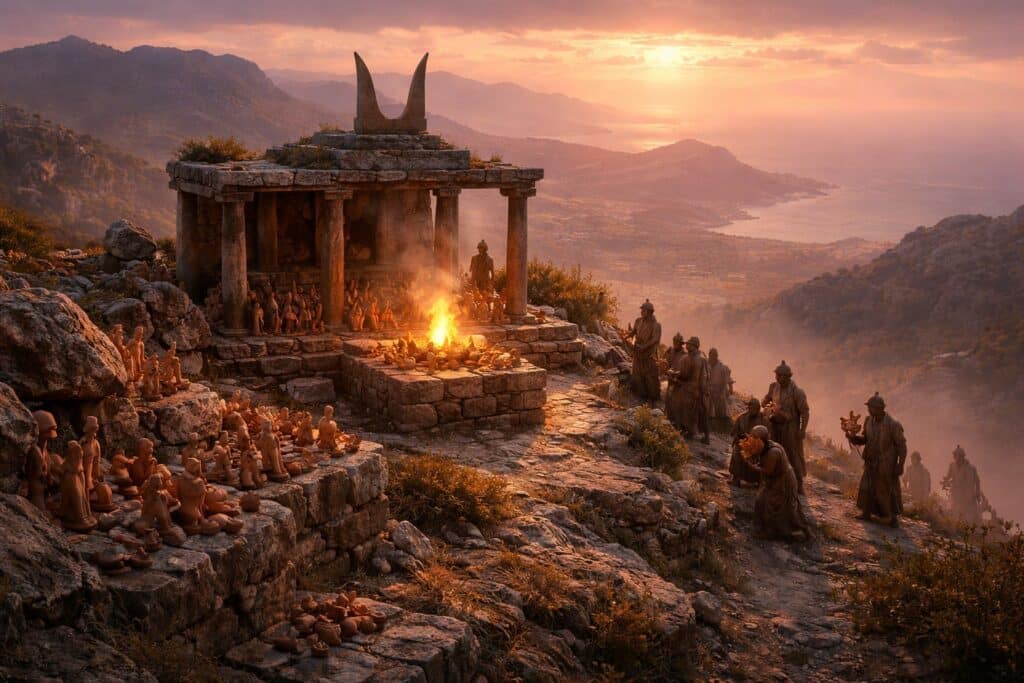
The interpretation of these objects as votive offerings has been advanced most notably by archaeologist Alan Peatfield, whose extensive fieldwork at sites including the sanctuary at Atsipadhes Korakias has greatly deepened our collective understanding of the Minoan obsession with mountain peak sanctuaries. These clay anatomical votives appear to reflect a practice of supplication closely tied to healing and the physical well-being of the faithful. Worshipers suffering from injury or illness or seeking divine intercession on behalf of ill relatives and friends would walk all the way to these mountain summits and deposit these objects as a petition to the divine. This could also be an expression of gratitude for a cure already received.
The extraordinary effort involved in such acts of devotion should not be underestimated. These were pilgrims who carried their offerings up steep and treacherous slopes to deposit them in large communal bonfires. The resulting accumulations of ash, animal bone, and ceramic fragments form the dense stratigraphic deposits that have allowed archaeologists to reconstruct these rituals in such detail. Among the most compelling aspects of the peak sanctuary tradition of the Minoans is its remarkable longevity and the evidence it provides for deep continuity in the Aegean world.
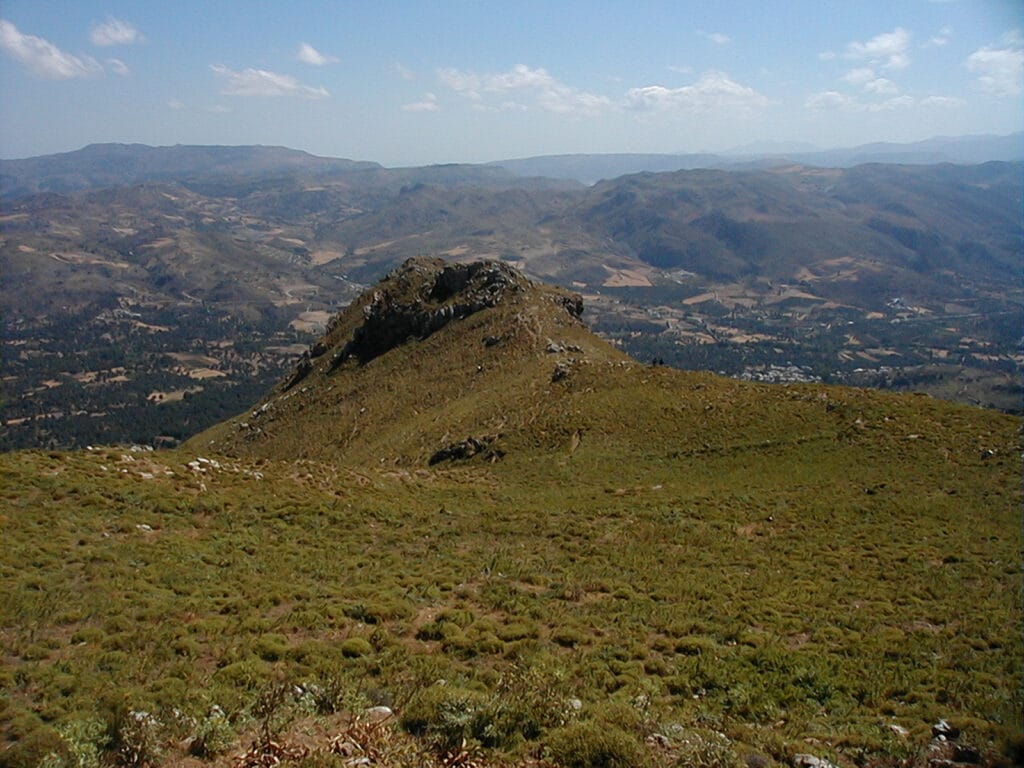
Although the Minoan civilization collapsed dramatically around 1450 BC, the significance of mountain summits in the religious life of ordinary people did not disappear with it. Traces of this enduring reverence for mountains can still be seen across Greece today, where whitewashed chapels dedicated to the Prophet Elijah, Profitis Ilias, crown the same elevated peaks once climbed by Bronze Age worshipers with their clay offerings.
The association between Elijah and mountaintops in Greek Orthodox tradition has often been interpreted by historians and folklorists as a Christianization of much older, pre-Greek and proto-Greek religious customs. While the theological framework shifted entirely from paganism to Christianity, the underlying logic—the impulse to seek the divine at the highest available point—appears to have persisted across more than four thousand years of Greek history.