
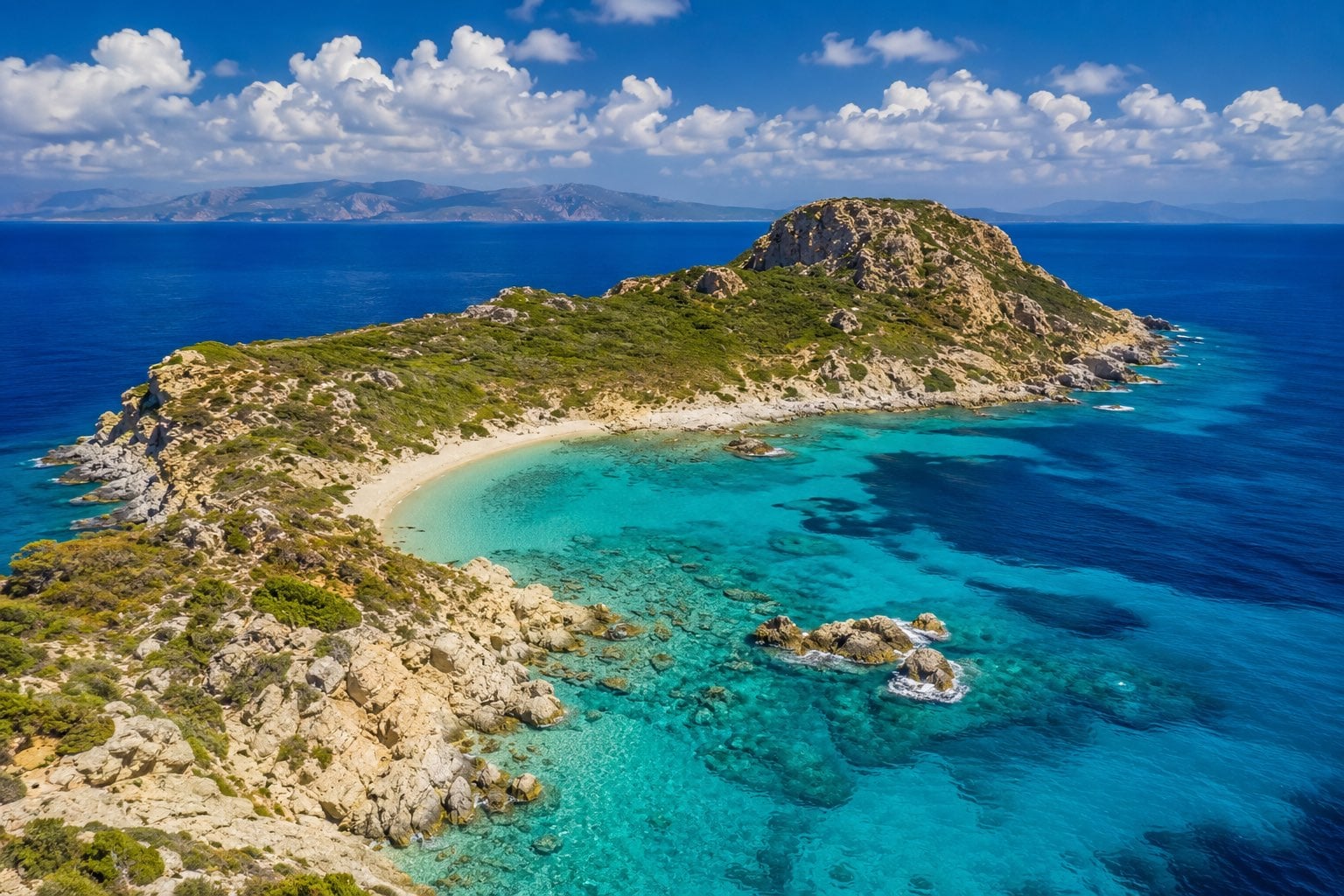
Greece is home to more than 6,000 islands and islets, many of them little known even to Greeks themselves. From remote specks of land in the Aegean to tiny inhabited communities that receive only a handful of visitors each year, the country has no shortage of hidden destinations waiting to be discovered.
Perhaps that is why so many people believed Psimythos was real.
In the summer of 2024, a fictional Greek island captured the imagination of social media users and quickly became one of the most talked-about “destinations” on the internet. The island, called Psimythos, appeared to be exactly the sort of secret paradise that has been a well kept secret. There was only one problem. Psimythos did not exist.
The Greek Island Everyone Was Talking About
What began as a joke on Greek social media rapidly evolved into a nationwide phenomenon. Users started posting photographs supposedly taken on the island, shared fictional travel tips, recommended nonexistent beaches and tavernas, and even discussed ferry routes to a place that could not be found on any map.
As thousands of people joined in, Psimythos developed a surprisingly detailed identity. The island acquired an imagined history, local traditions, and even recurring online references that made it appear increasingly authentic to anyone unfamiliar with its origins.

The phenomenon highlighted a reality unique to Greece. With hundreds of inhabited islands and countless lesser-known destinations scattered across its seas, the idea of a hidden island that most people had never heard of seemed entirely plausible.
Unlike many internet hoaxes, however, the creators of Psimythos were not attempting to deceive people for profit or spread misinformation. The island was part of a collective joke that invited users to participate in creating an imaginary destination.
People still search for Psimythos today
Yet the story resonated far beyond social media and it still has people looking for Psimythos till today.
Years later, people continue to search online for information about Psimythos, often wondering whether the island is real and where it can be found, discovering only afterwards that the island was never there at all. The continued fascination reflects the enduring appeal of Greece’s islands, many of which have become symbols of escape, simplicity, and natural beauty for travelers around the world.
The rise of Psimythos also demonstrated how easily digital communities can create shared myths in the modern age. Through thousands of posts, comments, and images, a place that had never existed briefly became part of Greece’s cultural conversation.
In a country famous for legendary islands such as Santorini, Mykonos, Corfu, and Crete, it is perhaps fitting that one of the most memorable island stories of recent years involved a destination that existed only in the imagination.

Perhaps that is precisely why the story remains so memorable. Unlike most viral destinations, Psimythos could never be ruined by crowds, overdevelopment, or overtourism. It is your personal imaginary paradise in Greece and nobody can take it away.


