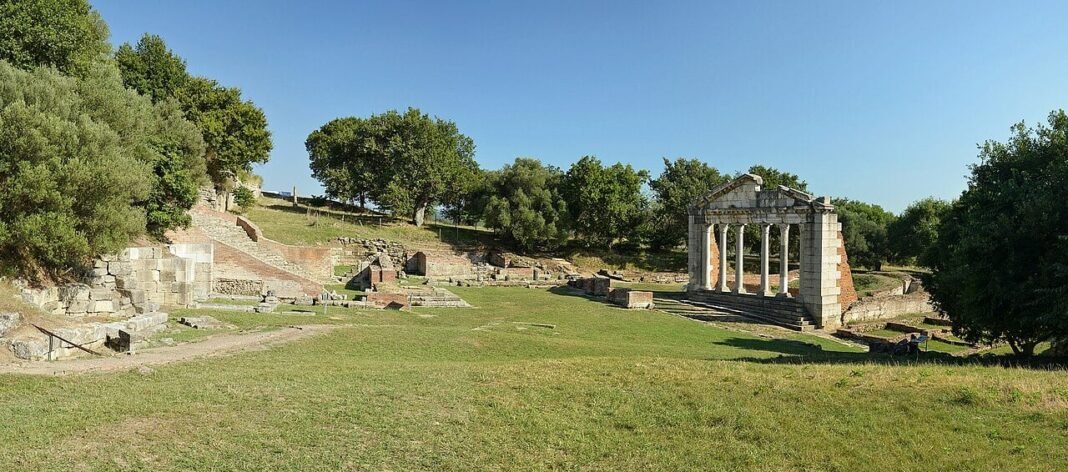

A carved stone linked to a board game in the ancient Greek city of Apollonia (Greek: Ἀπολλωνία ἐπὶ Ῥυνδακῷ) is offering researchers a rare glimpse into leisure, strategy, and daily life in a city that once stood on the shores of modern-day Lake Uluabat in northwestern Turkey.
The study, led by Gonca Gülsefa and published in the Nevşehir Hacı Bektaş Veli University Journal of Social Sciences, examines a Nine Men’s Morris game board that was later reused in the fortification walls of the ancient city of Apollonia ad Rhyndacum.
Researchers say the find is more than a simple gaming artifact. It provides evidence that residents of the city took part in a board game tradition that stretched across the Mediterranean world and survived for centuries.
A game board hidden in a city wall
The artifact was discovered in the western section of Apollonia’s fortification wall, which surrounds part of the ancient settlement now known as Gölyazı, near Bursa. The wall contains many recycled stone blocks taken from older buildings, a common practice during the Late Roman and Byzantine periods.
Among those reused materials, researchers identified a rectangular marble block measuring 77 centimeters (30.3 inches) long, 38 centimeters (14.9 inches) high, and 41 centimeters (16.1 inches) deep. The stone’s upper surface had been carefully polished, while its sides were left rough.
Most importantly, the polished surface contained a carved pattern of concentric squares connected by lines. The design matches the classic layout of Nine Men’s Morris, one of the world’s oldest known strategy board games.
Researchers noted that the board appears to have been intentionally created for gaming before being incorporated into the city wall. Heavy wear on one side of the stone suggests it may have seen extensive use before builders repurposed it as construction material.
One of history’s oldest strategy games
Nine Men’s Morris, known by different names across regions and periods, belongs to a category of games that rely on strategy rather than chance.
Unlike race games that use dice, success in Nine Men’s Morris depends entirely on planning and tactical decisions. Two players each control nine pieces and take turns placing them on the board. The goal is to create rows of three pieces, known as “mills.”
Vatikan 344 Amphorası MÖ 540
İlyada destanında geçen iki büyük savaşçı ve arkadaş Akhilleus ve Aias oyun oynuyor. Akhilleus 4-3 önde. pic.twitter.com/d6vzbfza3V— arkeofili (@Arkeofili) April 14, 2017
Forming a mill allows a player to remove one of their opponent’s pieces. Once all pieces are placed, players move them along the board’s lines while trying to create additional mills and limit their opponent’s options. A player wins by reducing the opponent to only two pieces or by blocking all possible moves.
Researchers say such games offer valuable evidence about everyday life in ancient societies. While archaeology often focuses on wars, rulers, and monuments, gaming artifacts reveal how ordinary people spent their free time and interacted with one another.
A game that crossed continents
The exact origins of Nine Men’s Morris remain uncertain. Some scholars have suggested that early forms of the game may date back as far as ancient Egypt, around 1400 B.C.
Over time, the game spread widely across different cultures and regions. Archaeological examples have been documented at sites throughout Anatolia and the Mediterranean, including Gordion, Marathon, Stratonikeia, Klaros, Aphrodisias, Amorium, Pergamon, and İznik.
The Apollonia example adds another important piece of evidence to that wider story. Researchers say it confirms that the game was known in northwestern Anatolia and likely formed part of local social life during the Roman period and beyond.
More than entertainment
The study also explores the possibility that some Nine Men’s Morris boards carried symbolic meanings in addition to their gaming function.
A carved Nine Men’s Morris board reused in the walls of ancient Apollonia is shedding new light on everyday life in Roman-era Anatolia.
Researchers say the stone game board shows how strategy games connected communities across the Mediterranean for centuries. pic.twitter.com/l0qZE7e0Vr
— Tom Marvolo Riddle (@tom_riddle2025) May 29, 2026
Similar geometric patterns have been found carved into churches, tombstones, and walls across Europe. Some scholars have linked the squares and circles of the design to ideas about order, eternity, and cosmic balance.
The research further notes parallels with Central Asian Turkic traditions, where the number nine held cultural and religious significance. While the Apollonia board was primarily a gaming surface, researchers suggest it may also reflect broader cultural connections that extended beyond the Mediterranean.
Evidence of daily life in ancient Apollonia
Researchers conclude that the Apollonia game board represents an important example of ancient gaming culture and social interaction.
Its careful craftsmanship indicates it was originally produced for recreational use rather than construction. Its later reuse in the city wall preserved a rare piece of evidence about how people spent their leisure time.
The artifact also highlights how games traveled through trade, migration, military movements, and cultural exchange. Across centuries and across regions, Nine Men’s Morris remained a shared form of entertainment that connected communities throughout the ancient world.
For Apollonia, the stone board offers a reminder that the city’s history was shaped not only by politics and architecture, but also by the everyday activities of the people who lived there.