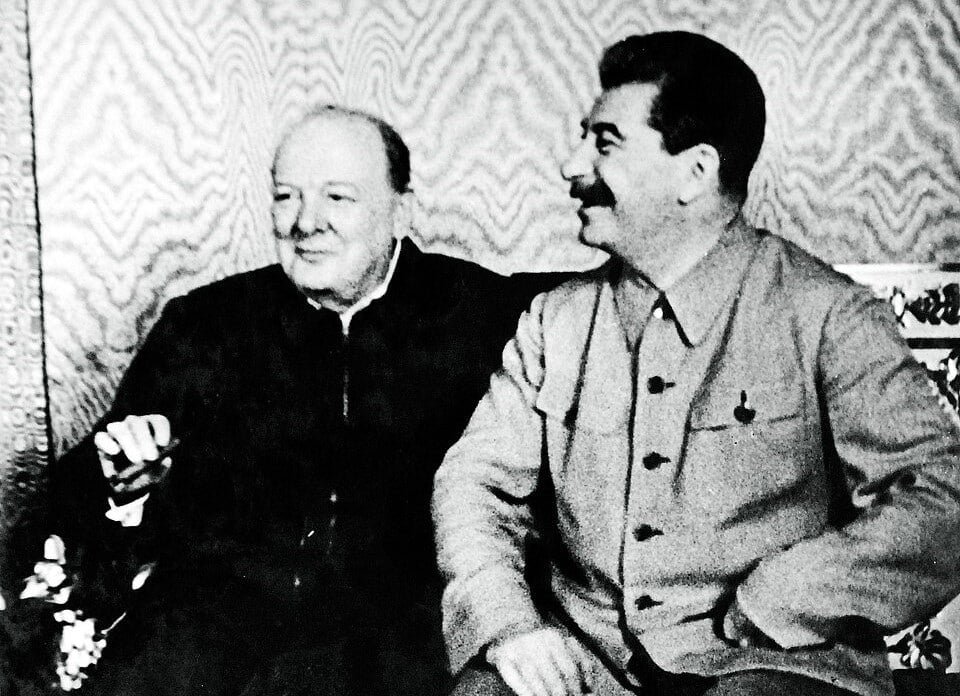
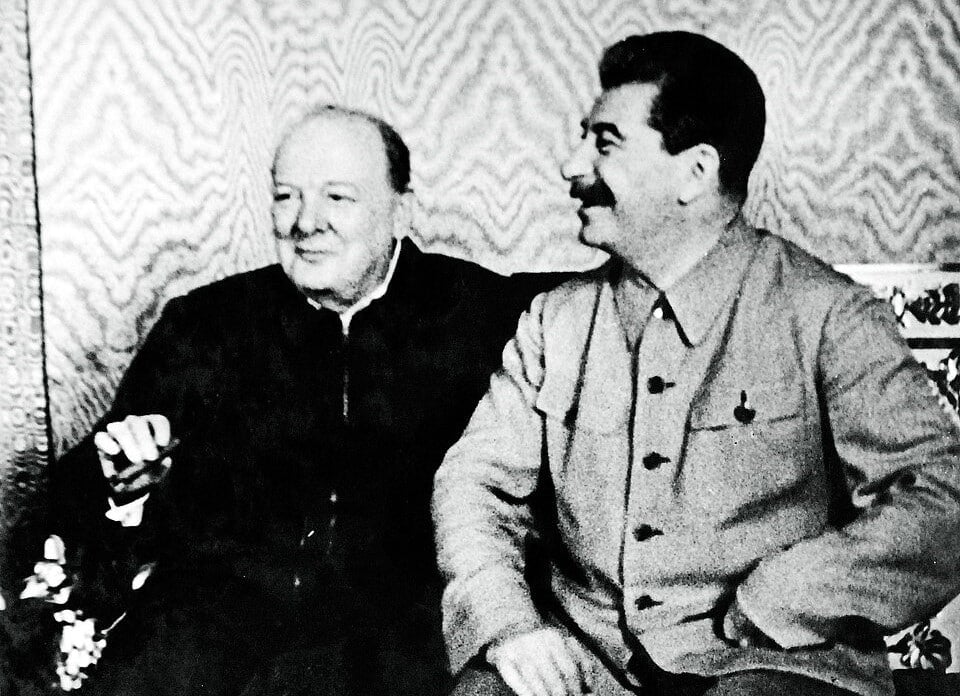
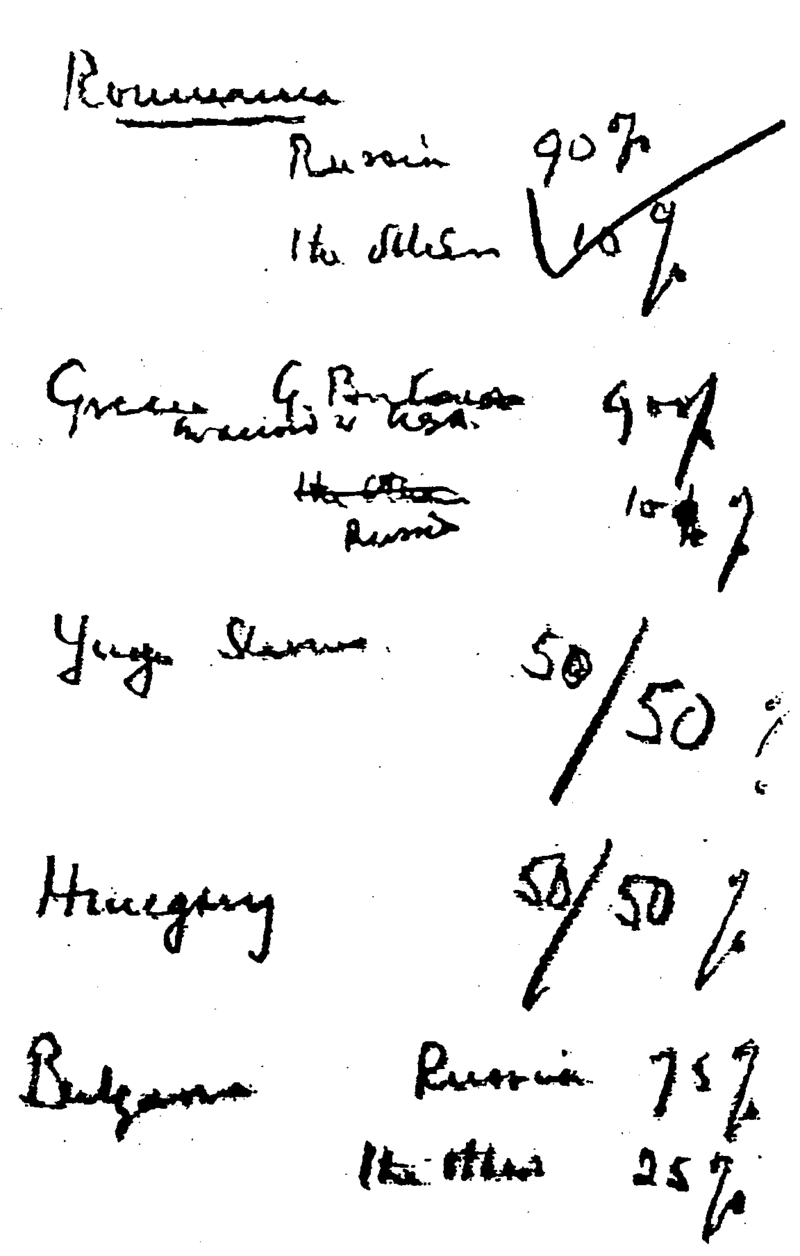
For nearly eighty years, a single, stained half-sheet of paper has served as the conventional shorthand for the Cold War’s origins in the Balkans. The story, popularized by Winston Churchill in his memoirs, is dramatic: on the night of October 9, 1944, in a smoke-filled Kremlin study, Churchill impulsively scribbled a list of countries and percentages—Romania: Russia 90%, Greece: Great Britain 90%, Yugoslavia 50/50—and slid it across the table. Stalin allegedly ticked it with a blue pencil, and just like that, the fate of millions was sealed. However, history, as revealed by contemporary minutes and secret diaries, is far more complex and significantly less cynical than Churchill’s self-serving narrative.
The Anatomy of a Non-Deal
When historians examine the actual British records of that October 9th meeting, the legendary percentage agreement vanishes. The official British notetaker recorded no percentages, no paper, and no blue pencil. Instead, the minutes describe a far more cautious and vague diplomatic understanding: Britain requested the “first say” in Greece, mirroring the Soviet Union’s “major interest” in Romania. Crucially, even this was not a new development. Three days before Churchill arrived in Moscow, Stalin had already ordered Bulgarian forces to withdraw from Greek territory, effectively abandoning any territorial ambition in the region to consolidate control over Bulgaria itself.
By the time the foreign ministers, Anthony Eden and Vyacheslav Molotov, sat down the following day to haggle over percentages for other Balkan nations, Greece was already absent from the negotiation table. The half-sheet was not a master blueprint for the post-war world; it was, at best, a retrospective receipt for a decision Stalin had already made based on his own strategic calculations.
The Open Door and the Silence of Moscow
Following the German withdrawal in autumn 1944, Greece existed in a vacuum of power. For five critical weeks, as the Red Army stabilized its position in neighboring Bulgaria, the door to Greece was effectively open. Soviet forces were only one country away, and their local Bulgarian allies had begun transferring regional authority to the Greek Communist resistance, known as EAM/ELAS. Despite this, no Soviet tanks rolled across the border.
When civil war erupted in Athens in December 1944, pitting the Greek Communists against British-backed forces, the silence from Moscow was deafening. While the Greek Communist leadership desperately appealed to Stalin for aid and intervention, they were met with indifference. Stalin viewed the Greek Communist attempt to seize power as a tactical folly, explicitly telling his own allies that he would not sacrifice the broader global balance of power to save a doomed insurrection in a country he had effectively ceded to the British sphere of influence.
Permission Without Commitment
From 1946 to 1949, the Greek Civil War intensified, yet it remained a proxy conflict defined by Stalin’s policy of “permission without commitment.” Stalin allowed the Greek Communists to pursue their revolution, providing minor logistical support through Yugoslavia and Bulgaria to keep the conflict alive, but he never authorized a full-scale Soviet intervention. He was happy to let the Western powers bleed resources and political capital in Greece, but he was terrified of provoking an all-out war with the United States and Britain over a territory he deemed strategically secondary.
This reality became clear during the dramatic Kremlin meeting on February 10, 1948, where Stalin chided the Yugoslav and Bulgarian leadership for their independent meddling in the Greek conflict. While later memoirs would have us believe he flatly ordered the uprising stopped by shouting, “We have no navy,” the contemporary records paint a more pragmatic picture. Stalin was constantly weighing the risks, refusing to commit his own resources while simultaneously ensuring that no one else could escalate the conflict to a level that might force his hand.
The Truman Doctrine and the Final Curtain
By February 1947, a bankrupt Britain formally handed the responsibility of Greece to the United States. President Harry S. Truman’s subsequent address to Congress, which birthed the Truman Doctrine, framed this transition as a desperate fight against the “chain reaction” of Soviet aggression. Yet, American intelligence documents from the same period reveal a starkly different internal assessment: the U.S. military command believed that the Soviet Union possessed neither the desire nor the resources to launch a major war, and that a Soviet invasion of Greece was so unlikely it barely warranted consideration.
Ultimately, the Greek Civil War ended in 1949 not because of a grand deal at a desk in the Kremlin, but because the Soviet tap was turned off. After the fallout between Stalin and Tito, and following a series of military failures, the Greek Communist movement collapsed. The surviving fighters were shipped off to the Soviet Union, and the map of Europe remained as Stalin had decided it would be five years earlier.
Conclusion: The Persistence of the Myth
Why does the myth of the half-sheet persist? Because it makes the brutal realities of the Cold War seem like a simple, orderly, and manageable affair. It allowed Churchill to cast himself as a master diplomat and Stalin to appear as a man of his word. In reality, the fate of Greece was decided by cold, calculated silence. Stalin never invaded Greece because he never wanted it badly enough to pay the price of a global war. The half-sheet was real, but it mattered far more to the man who wrote it than to the man who ticked it.