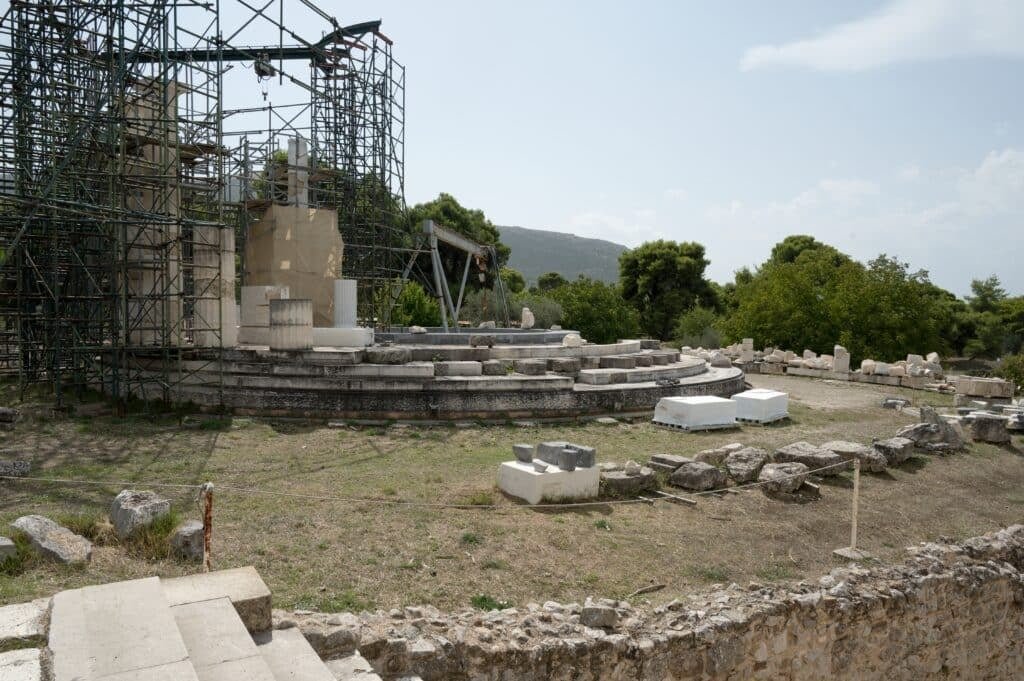
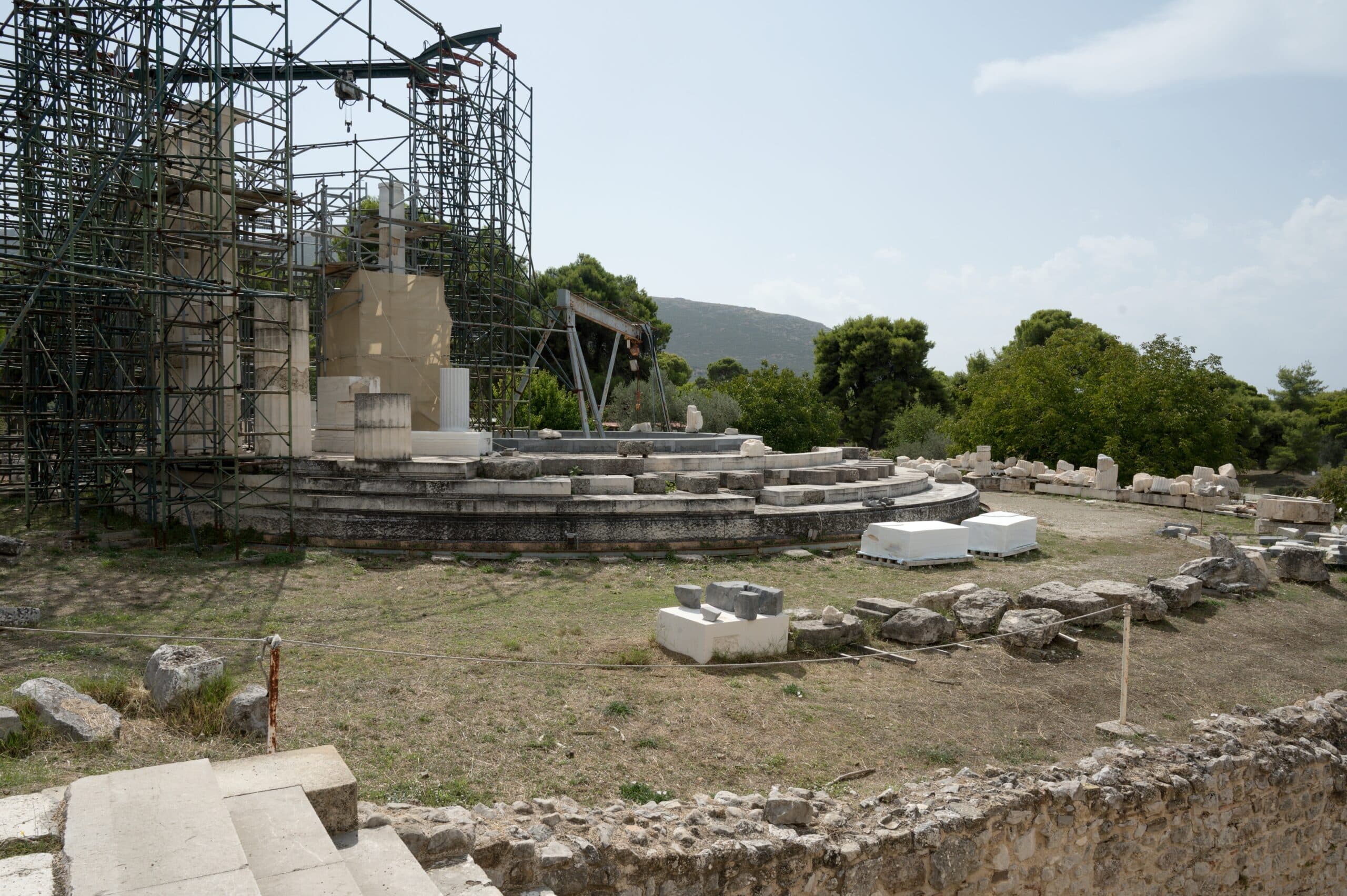
The circular Tholos at Epidaurus has one of the sanctuary’s most puzzling features: beneath its floor, concentric walls form narrow underground passages. Archaeologists can describe that structure in detail. Explaining exactly what happened inside it is harder.
The building stood in the Sanctuary of Asclepius, the healing god, in the Argolis region of the Peloponnese. Also called the Thymele, it belongs to the fourth-century BC monumental complex recognized by UNESCO. Its unusual foundations have prompted interpretations involving the god’s underground associations, sacred snakes and the sound of music.
Recent excavation research adds a separate piece of evidence: an earlier building with a basement occupied the area before the circular monument. That finding strengthens the case for a long religious history at this location without settling every question about the later Tholos.
What survives beneath the circle
In a 2018 Bryn Mawr Classical Review assessment, archaeologist Margaret M. Miles examined a study proposing an acoustic function for the building. The Tholos had an outer Doric colonnade and an inner Corinthian one. Beneath it, three inner rings of foundations created passages roughly 2 meters high and 0.65 meters wide.
The reviewed study tested how the underground construction might affect sound. Its authors argued for a connection with musical performance and healing.
Miles also discussed practical objections to other explanations. The absence of waterproofing argues against a water reservoir. Narrow passages complicate the idea of processions underground. A heavy stone over the central opening makes routine access from above difficult to envisage. The architectural evidence places limits on possible uses, even where it does not identify one certain answer.
An older sacred building
A 2025 account of University of Athens excavations by Vassilios Lambrinoudakis, Evangelos Kazolias and Alexandra S. Sfyroera summarizes work undertaken from 2015 to 2022. Their evidence places cult activity on the plain in the eighth to seventh centuries BC, earlier than the chronology traditionally assigned to the sanctuary’s beginnings there.
The findings include an early Archaic building surrounded by columns, with a basement cut into the rock, in the area of the later Tholos. The researchers consider it alongside other early sacred features, including a well and altars elsewhere in the sanctuary.
The discovery of the older building in 2020 and the broader excavation account now allows that discovery to be considered within the sanctuary’s early development, rather than as an isolated architectural curiosity.
Healing, worship and restoration
UNESCO’s description places the Tholos within a complex that also included the temple, sleeping hall, baths, athletic facilities and theater. Those different buildings served a sanctuary where religious practice and care for the sick developed together.
The Argolis Ephorate’s account explains the practice of incubation: worshippers slept in a sacred setting hoping for a dream connected with Asclepius and healing.
The Tholos is still undergoing restoration and future plans include making the earlier structure more intelligible to visitors.