The distinctive scent surrounding an ancient Egyptian mummy is offering new insight into burial practices that date back thousands of years. Researchers say the mummy scent, once dismissed as a byproduct of decay, is in fact a rich chemical record.
The aroma contains compounds that reveal what embalmers used and when the bodies were prepared, shedding light on ancient Egyptian traditions long hidden from view.
For decades, identifying the ingredients in embalming balms required invasive methods. Scientists often had to cut into linen wrappings, risking permanent damage to fragile remains. The material then had to be dissolved in chemicals for testing, limiting how often such studies could be done.
That challenge has now been eased by researchers at the School of Chemistry at the University of Bristol. The team developed a technique that studies the air around a mummy instead of the body itself. By sampling gases released from the remains and their containers, the method avoids direct contact and preserves the integrity of the artifacts.
Chemical analysis unlocks ancient Egyptian mummy scent
The researchers analyzed 35 samples taken from balms and bandages linked to 19 mummies. Together, the remains span more than 2,000 years of history.
Using a technique known as HS-SPME-GC/Q-TOFMS, the team isolated chemical fingerprints present in the surrounding air. The system works by separating molecules so scientists can identify the substances used in embalming.
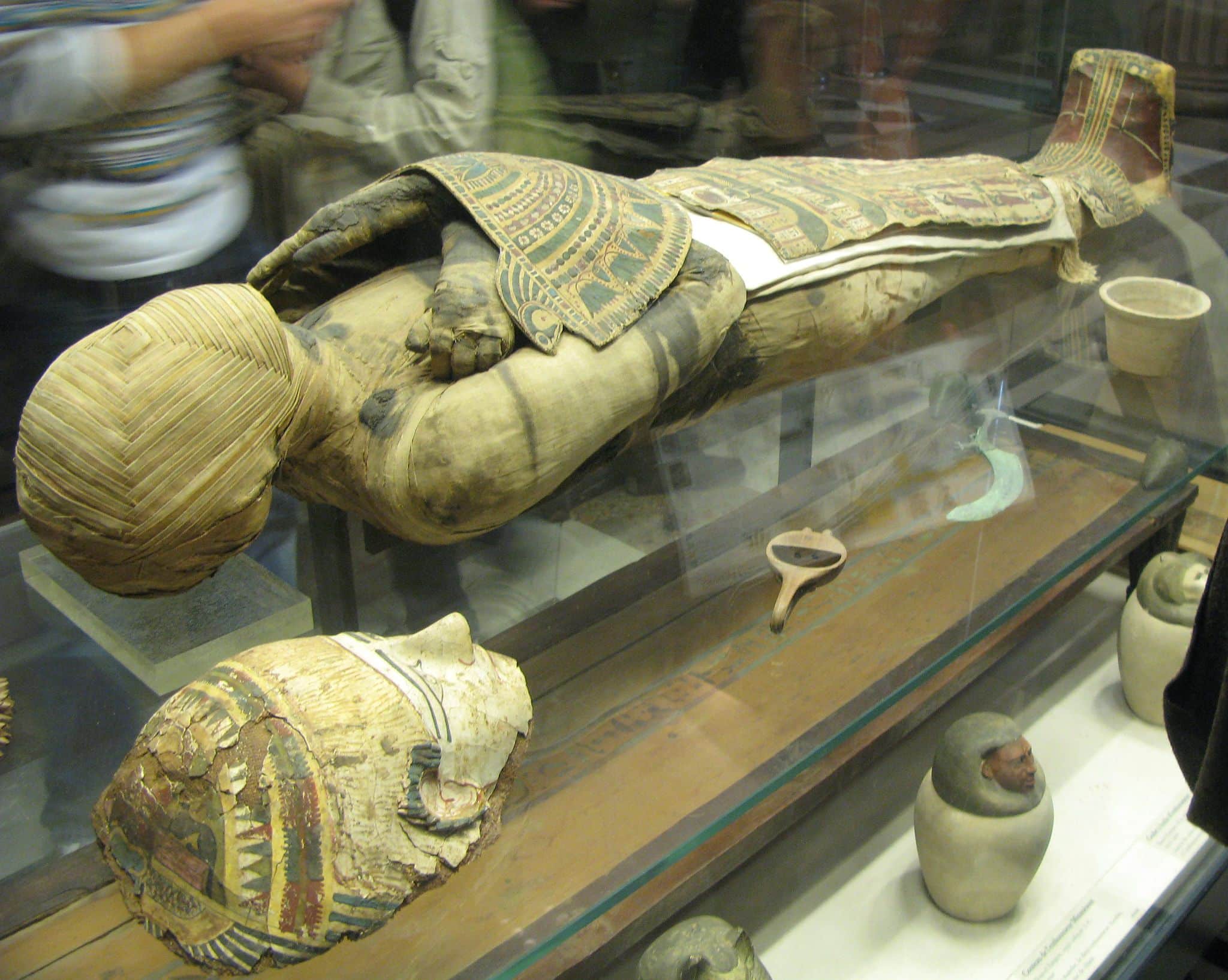
The analysis uncovered 81 volatile organic compounds. These fell into four main groups: fats and oils, beeswax, plant resins and bitumen. According to the study published in the Journal of Archaeological Science, the chemical makeup varied by historical period.
Earlier mummies showed simpler formulas dominated by basic fats and oils. Later mummies contained more complex mixtures, often featuring costly resins and bitumen.
Airborne clues expose secrets of ancient Egyptian embalming
Researchers also found differences within individual bodies. The head sometimes carried a different chemical profile than the torso. This suggests embalmers applied distinct mixtures to specific body parts, likely reflecting specialized treatment of organs or regions.
The team explained that analyzing volatile compounds provides a quick and sensitive way to screen ancient embalming materials. Curators and scientists can gain meaningful data while leaving the remains untouched, making the approach especially valuable for museum collections.
Still, the researchers cautioned that the technique works best as an initial step. In some cases, traditional sampling may still be required for detailed study. Even so, the mummy scent linked to ancient Egyptian burial practices is proving to be a powerful tool for understanding the past without damaging it.