
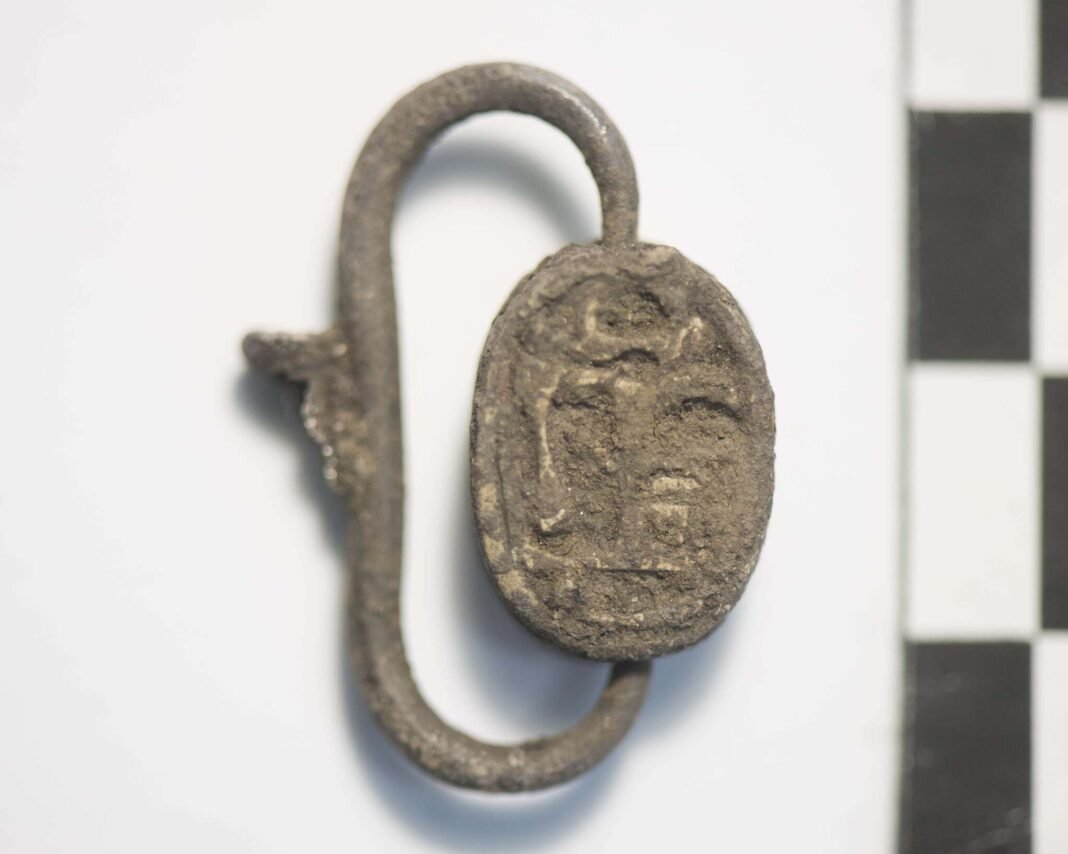

Archaeologists excavating the Nuragic complex of Ruinas in Sardinia have identified an unusual find far from its cultural homeland: an ancient Phoenician scarab seal carved from steatite. The object was uncovered in the mountainous heart of Sardinia, a region better known for fortified Nuragic towers than for foreign luxury goods.
The site lies near Arzana, where excavations focus on a village built around a large stone nuraghe. The surrounding terrain, part of Barbagia di Ollolai within Ogliastra, is steep, isolated, and defensible. Researchers say that the setting makes the discovery especially significant.
Evidence points to a Phoenician origin
Specialists attribute the scarab to the Phoenician world based on its material, shape, and engraved signs. Steatite was commonly used in the eastern Mediterranean to produce small but durable seals. The object is dated to the Iron Age and likely originated in the region of modern-day Lebanon, centuries after the construction of the nuraghe itself.
The seal was found inside domestic rooms of the settlement rather than in a ritual or burial context. Archaeologists say this detail suggests everyday use. The scarab was part of daily life, not a ceremonial curiosity.
A tool of identity and authority in the ancient world
In Phoenician society, scarab seals carried both symbolic and practical meaning. They were often worn as amulets for protection. At the same time, they functioned as personal seals used to mark clay or wax. Each impression was unique, tied to an individual’s identity, authority, or property.
No two scarabs were alike. This individuality explains the wide variation seen among the thousands known from the ancient Near East and Mediterranean.
Conservation work focuses on hidden details
The artifact is now undergoing conservation and scientific analysis in the laboratories of the Archaeological Superintendency. Researchers are using non-invasive techniques to stabilize the stone and examine its surface.
Once conservation is complete, specialists will study the finely cut hieroglyphic symbols in detail. The inscription may preserve a personal name, a religious phrase, or a marker of power.
The Ilienses and Sardinia’s mountain societies
The Ruinas site lies in territory traditionally linked to the Ilienses, a Nuragic population also known as the Ioleos and later as the Diagesbei. Ancient authors described them as among the island’s earliest inhabitants. The Roman geographer Pomponius Mela referred to them as the oldest people of Sardinia.
Archaeologists say the Ilienses occupied wide areas of central and southern Sardinia during the second millennium BCE. Their lands stretched from the Campidano plain to the Tirso River, with strongholds concentrated in the interior.
Material traces of far-reaching connections
Archaeological evidence shows these inland communities were not isolated. Fragments of Mycenaean and Aegean pottery have been found inside major nuraghes, including Nuraghe Antigori and Nuraghe Arrubiu. Copper ingots shaped like oxhides, likely imported from Cyprus, have also been recovered across central and southern Sardinia.
Local goods traveled outward as well. Sardinian gray pottery, produced in the Iliense area during the 13th and 14th centuries BCE, has been identified at distant sites, such as the palace of Knossos and Cannatello.
Debates over identity and wider Mediterranean roles
Some scholars argue that the Ilienses played a central role in Nuragic Sardinia. The archaeologist Giovanni Ugas has suggested a possible link between them and the Shardana, one of the Sea Peoples mentioned in Egyptian records.
The theory remains debated, but researchers agree that the archaeological record shows sustained contact across the Mediterranean.
A small object with a long journey
The Ruinas scarab likely traveled more than 2,000 kilometers by sea and land before reaching an inland village. Archaeologists say it reflects the movement of merchants, craftsmen, or specialists who carried goods, skills, and symbols between the Levant and the western Mediterranean.
Further study will determine how the seal was used and when it fell out of circulation. Once the analysis is complete, the find will be formally presented to scholars and the public, and authorities will decide where it will be displayed.
For researchers, the scarab provides clear evidence that even Sardinia’s most remote Nuragic communities were part of extensive Mediterranean exchange networks, connected to worlds far beyond the island’s mountains.


