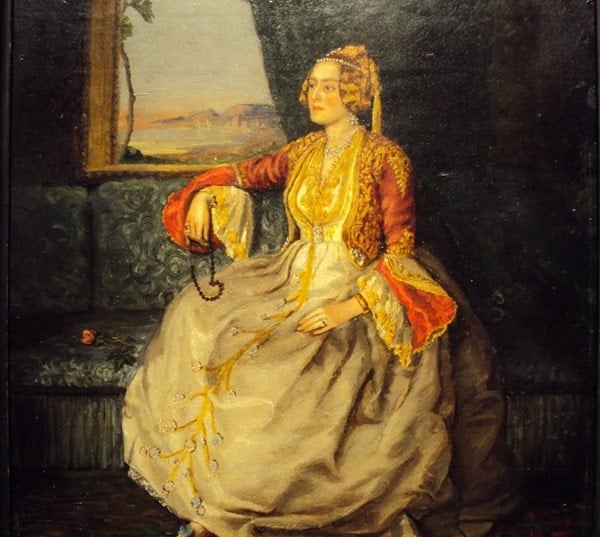
The French aristocrat and a fervent Philhellene, Sophie de Marbois, is best known by her title of nobility, the Duchess of Plaisance, and became a legendary figure in Athens during the formative years following the Greek War of Independence.
In Greece, she is better known as the Duchess of Plakentia and the name is synonymous with Mount Penteli and northern Athens. However, this is not a Greek word. It is the Hellenized version of the Latin Placentia (the Italian city of Piacenza). The Duchess held the French title Duchesse de Plaisance, but the Greek people of the 19th century adapted the phonetics into the name we know today. It has struck a permanent chord in the Greek language, evolving from a foreign title of nobility into the name of a major Athenian district and transport hub.
Duchess of Plaisance: A life of transition
Born Sophie Barbé-Marbois on April 2, 1785, in Philadelphia, USA, she was the daughter of Marquis François Barbé-Marbois—a prominent statesman during the First French Empire and the Bourbon Restoration—and Elizabeth Moore, daughter of the Governor of Pennsylvania, William Moore.
At age 19, Sophie married General Anne-Charles Lebrun, an aide-de-camp to Napoleon I. In 1824, the year her husband inherited the title of Duke of Plaisance, the couple separated without ever officially divorcing. Now the Duchess of Plaisance, she departed for Italy with her only daughter, Eliza, accompanied by the poet and Philhellene Casimir Delavigne.
Delavigne’s passion for the Greek cause deeply influenced the Duchess. In 1830, she decided to travel to Greece, a nation then taking its first steps as an independent state.
Contributions to Greece

The Duchess contributed significantly to the young nation’s development:
- Education: She founded a girls’ school, first in Aegina and later in Nafplio.
- Media: She financed the second edition of the Hellenic Chronicles of Missolonghi.
- Philanthropy: She donated vast sums to charity and supported the villagers of Penteli, where she had acquired land.
Initially a supporter of Ioannis Kapodistrias (the first Governor of Greece), she later became a fierce critic. Upon hearing of his assassination while she was in Florence, she even published a pamphlet defending his killers. In 1834, she returned to Greece permanently, establishing herself as a leading figure in Athenian high society.
Tragedy and eccentricity
In 1836, her daughter Eliza suffered a nervous breakdown after her fiancé, Elias Katsakos Mavromichalis, died of cholera in Munich. Shortly after, Eliza contracted tuberculosis—then an incurable disease—and passed away in Beirut in 1837.
The loss shattered the Duchess. Refusing to bury her daughter, she had the body embalmed and kept it in a room in her temporary residence near Athens’ Koumoundourou Square. Following this, her behavior grew increasingly eccentric. She developed her own religious creed—a blend of Judaism and Islam—and became increasingly reclusive. Her grief turned to bitterness in 1846 when her home caught fire, cremating her daughter’s remains. Her health also declined due to dropsy, which physically transformed her.
Architectural legacy

The Duchess used her immense wealth to build several landmark estates in Athens and Penteli, designed by her close friend, the architect Stamatis Kleanthis. Fearing a prophecy that claimed she would die once her home was finished, she left many of her projects intentionally incomplete:
- Villa Ilissia: Built between 1840 and 1848 on the banks of the Ilissos River, this was her winter residence. Today, it houses the Byzantine and Christian Museum.
- The Castello της Rododafnis: Located in Penteli, this Gothic-style mansion remained unfinished for years.
- Maisonnette, Plaisance, and Tourelle: A series of smaller houses and guesthouses in the Penteli area.

Sophie de Marbois died on May 2, 1854, at the age of 69. She was buried in a classical-style tomb designed by Kleanthis near her “Maisonnette” in Penteli, leaving behind a legacy of mystery, philanthropy, and architectural beauty.