

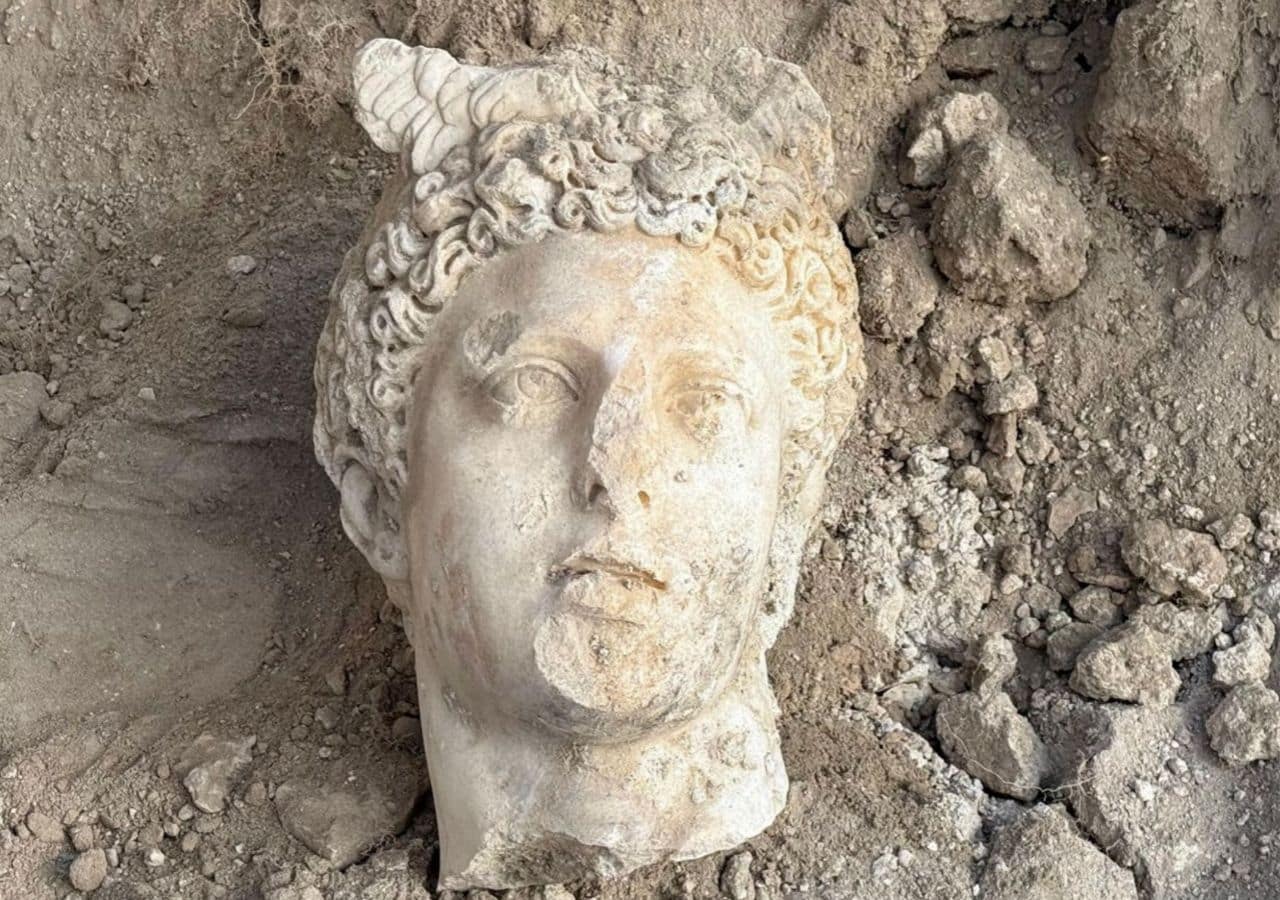
Archaeologists have unearthed a marble statue head believed to represent the ancient Greek god Hermes during excavations at the ancient Greek city of Laodicea (Greek:Λαοδίκεια) in modern-day Turkey. The find, located near the eastern entrance of the Bouleuterion, offers new insight into how deities like Hermes were integrated into civic life in Greco-Roman era cities.
Experts say the sculpture, carved from white Dokimeion marble known in antiquity for its purity and strength, dates back to the mid-2nd century CE. The piece displays fine detail, with soft curls, defined eyes, and a small wing motif on the head, all traits associated with the messenger god Hermes. Researchers link the stylistic elements to the influence of Praxiteles, a renowned sculptor from classical Greece.
Statue of ancient Greek god Hermes reflects artistic and cultural values
The discovery is considered a standout example of the Hermes Andros type, a sculptural style admired across the Mediterranean for its balance and realism. Its presence in a public council building reflects the symbolic value of Hermes as a figure tied to communication, transition, and public order—qualities central to civic spaces.
Celal Şimşek, head of the Laodicea excavation team, explained that the statue likely had a symbolic function. He noted that Hermes represented commerce, diplomacy, and travel, making his image fitting for a structure tied to governance and public affairs.
Laodikeia Antik Kenti’nde Sanatın Zarafeti Gün Yüzüne Çıktı
Bakanlığımız himayelerinde yürütülen Geleceğe Miras Projesi kapsamında, Laodikeia Antik Kenti’nde sürdürülen kazı çalışmalarında dikkat çekici bir buluntu gün yüzüne çıkarıldı.
Bouleuterion (Meclis Binası) ve… pic.twitter.com/116L7wFRd5
— Kültür Varlıkları ve Müzeler Genel Müdürlüğü (@kvmgm) December 31, 2025
The ancient city of Laodicea, once a key urban center in the Lycus Valley, held strategic importance as a crossroads for trade and agriculture. Its wealth from textile production and commerce funded large-scale building projects, including theaters, temples, and administrative complexes.
Archaeologists explained that finds like the Greek god Hermes statue provide strong evidence of how economic prosperity supported art and architecture in the Roman provinces.
Cultural and economic importance of Laodicea
Laodicea also holds religious and cultural significance. It was one of the Seven Churches of Asia mentioned in early Christian texts, while still preserving strong ties to classical traditions. Buildings like the Bouleuterion and Prytaneion served both administrative and symbolic roles, representing the city’s identity and values through their design and decoration.
Following the discovery, conservation experts began preserving and documenting the artifact to protect its condition and context. Excavations at the site continue under the Geleceğe Miras (Heritage for the Future) Project, led by Turkey’s Ministry of Culture and Tourism. The initiative emphasizes sustainable heritage practices and public access to archaeological knowledge.
Researchers believe the statue deepens the understanding of artistic production in Anatolia and reinforces Laodicea’s status as a culturally vibrant city.


