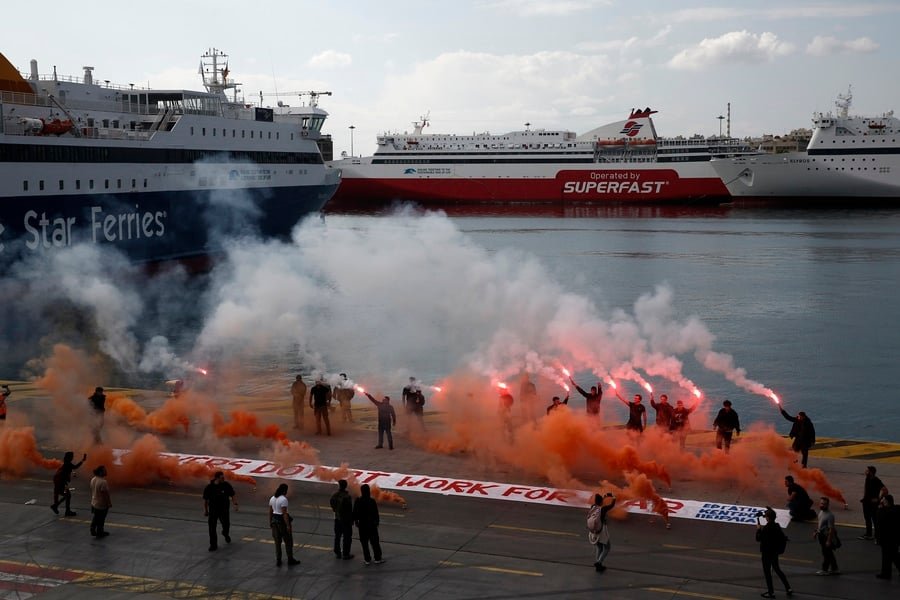
Ferry services to the Greek islands were suspended and cargo operations were disrupted at Piraeus on Friday, October 30, as dockworkers and seafarers joined international protests against arms shipments. About 3,000 workers participated in the walkout at the Greek port serving Athens.
The wider mobilization involved 113 ports in 22 countries, and participation ranged from full-day strikes to shorter work stoppages and demonstrations, with the extent of disruption varying between ports.
Greek seafarers demand stronger safety protections
PENEN, the Greek merchant seafarers’ union, called a 24-hour strike at Piraeus, Rafina, Lavrio, Patras, Igoumenitsa, Elefsina and Rio–Antirrio. In its announcement, the union linked the action to the dangers facing crews caught in conflicts in the Middle East, the Red Sea and the Black Sea.
The union called for seafarers and ships to be kept out of war zones and demanded stronger protections for workers’ health, safety and employment rights. It also said rising prices had eroded wage increases and criticized excessive working hours and unpaid overtime.
Access to medical personnel aboard vessels crossing conflict areas was another demand raised during the mobilization. The safety concerns accompanied broader calls for higher wages and improved working conditions.
International campaign targets military shipments
The protests grew out of the Istanbul Declaration, adopted by participating port unions in May 2026. The declaration opposes the use of ports to move weapons, ammunition, military equipment and troops to war zones, as well as their conversion into military bases.

It also calls for collective agreements that provide meaningful wage increases, secure jobs, shorter working hours and pension protections. Each union was left to determine the form of action appropriate to its circumstances.
The International Transport Workers’ Federation backed the mobilization, calling on governments and employers to protect workers’ right to refuse military cargo without retaliation. Its statement also linked the protests to demands for better working conditions and opposition to increasing automation.
Campaign group No Harbour for Genocide estimated that the action could delay approximately 52,000 containers carrying $2.8 billion in goods. The figures describe projected cargo disruption, not established financial losses, and the actual impact had not been independently verified.