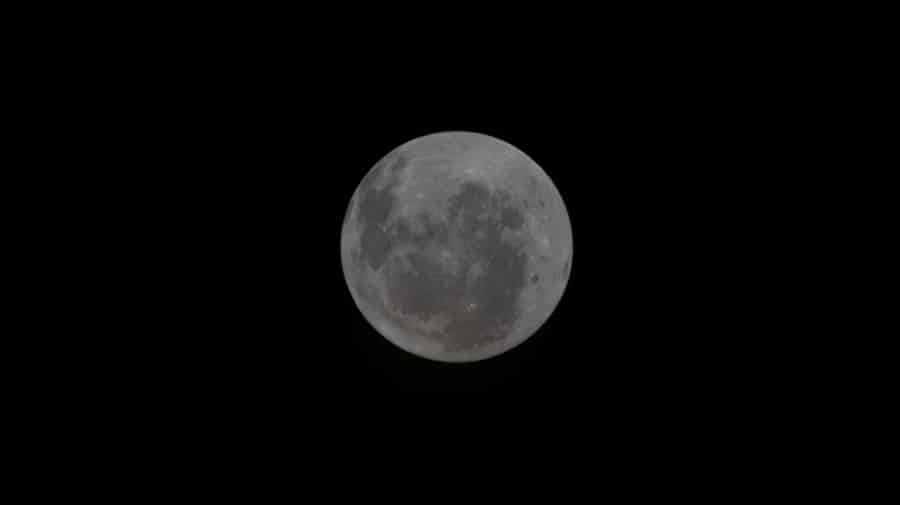
As the Orion spacecraft, named Integrity, reached its closest lunar approach, the four-person Artemis II crew became the first humans to witness the Moon’s far side since 1972.
NASA has released striking high-resolution imagery from Flight Day 4 (April 5), capturing a rare “Blue Marble” perspective where the Earth appears in near-eclipse while the Moon remains fully illuminated—a view impossible to see from our home planet.
One last look at Earth before we reach the Moon.
This view of the Earth was captured on April 5, the fourth day of the Artemis II mission, from inside the Orion spacecraft. The four astronauts will reach their closest approach of the Moon tomorrow, April 6. pic.twitter.com/z2NJUGWkKc
— NASA (@NASA) April 5, 2026
The crew—Commander Reid Wiseman, Pilot Victor Glover, Mission Specialist Christina Koch, and CSA Astronaut Jeremy Hansen—spent the day conducting critical scientific observations.
POV: You’re flying by the Moon.
This visualization is designed to show you what exactly the Artemis II astronauts will see outside their window during their lunar flyby.
Here, the seven-hour visualization is compressed into 28 seconds. ⬇ (1/4) pic.twitter.com/2OMAy37oht
— NASA Solar System (@NASASolarSystem) April 5, 2026
The dark side of the Moon as seen by the Artemis crew
Commander Wiseman described the experience as “good gracious, mind-blowing,” noting the stark contrast between the bright white lunar highlands and the deep gray maria of the near side. A major scientific highlight of the flyby was the direct human observation of the Orientale Basin.
History in the making
In this new image from our @NASAArtemis II crew, you can see Orientale basin on the right edge of the lunar disk. This mission marks the first time the entire basin has been seen with human eyes. pic.twitter.com/iqjod6gqgz
— NASA (@NASA) April 5, 2026
This massive, 577-mile-wide multi-ring impact crater is located on the Moon’s extreme western limb and is rarely visible from Earth. While robotic probes have mapped it, Mission Specialist Christina Koch confirmed it was “absolutely breathtaking” to see the entire bullseye-shaped structure with the naked eye.
To support these observations, scientists at Mission Control in Houston integrated Orion’s live trajectory with data from the Lunar Reconnaissance Orbiter (LRO). This allowed the crew to identify geological features like the Grimaldi and Glushko craters in real-time.
As Orion continues its free-return trajectory, the mission is on track for a Pacific Ocean splashdown on April 10, marking a definitive leap forward in NASA’s goal to return humans to the lunar surface.
Related: Beyond the Horizon: The Space Frontiers of 2026