
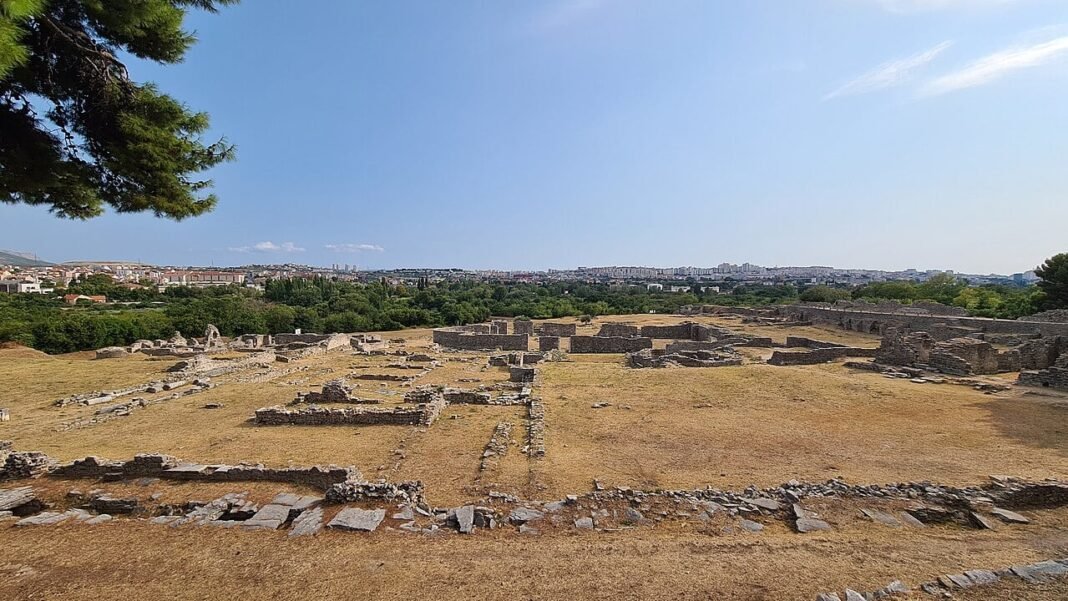
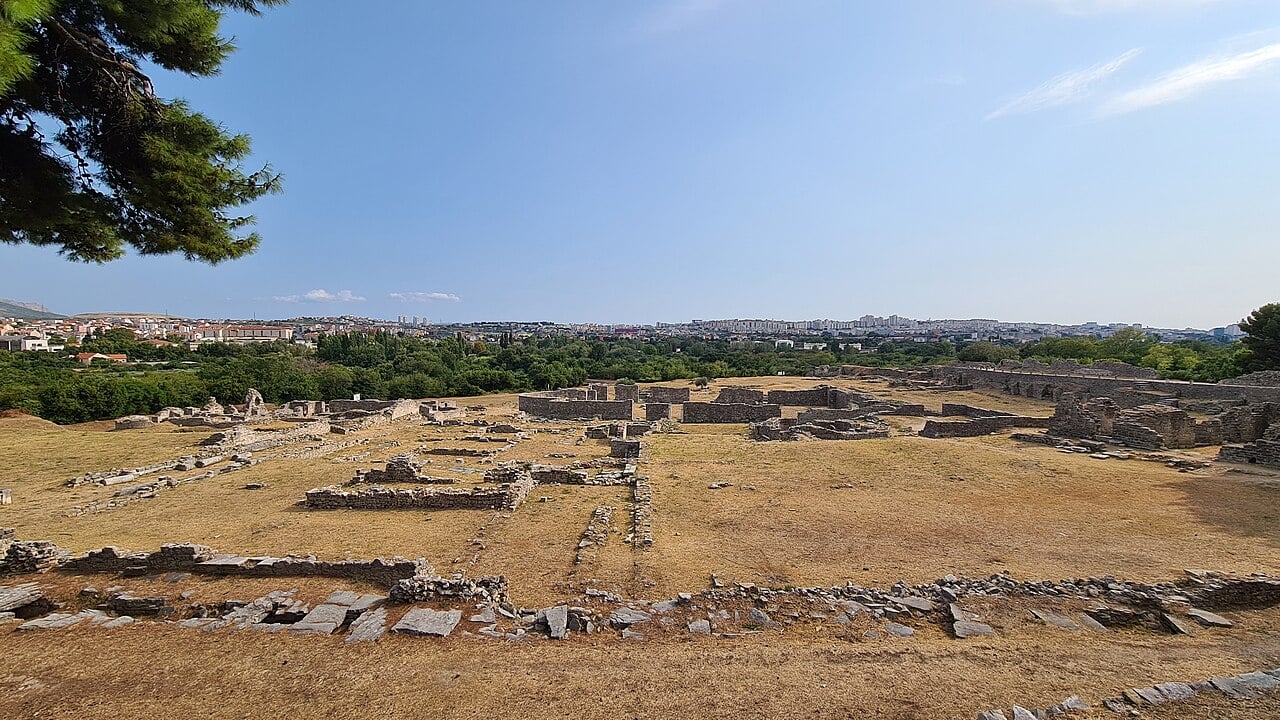
Archaeologists working at the Ancient Greek city of Salona (Greek: Σάλωνα), Croatia, have uncovered a 2,000-year-old underground tunnel hidden beneath the city’s Roman amphitheater, revealing new details about how one of the Adriatic’s most important ancient cities operated behind the scenes.
Located near Split, Salona was once the capital of the Roman province of Dalmatia and one of the largest cities of the late Roman Empire. At its height, it was home to tens of thousands of people and briefly served as the last seat of the Western Roman Empire in the late fifth century. Today, its ruins form Croatia’s largest archaeological park.
Conservation work uncovers buried pavement
Current conservation efforts focus on the northern seating area of the amphitheater, one of the most prominent structures still standing at Salona. Teams are cleaning and reorganizing the stone tiers, a slow and precise process aimed at stabilizing the monument while preserving original material.
During the work, researchers uncovered and documented a stretch of ancient pavement buried beneath layers of soil for decades. The surface had not been visible since earlier excavations and provides fresh evidence of how the amphitheater was laid out and accessed during Roman times.
According to the Archaeological Museum in Split, the pavement helps clarify circulation routes within the arena and improves understanding of how spectators, performers, and staff moved through the space. Officials said such discoveries show that even long-studied sites like Salona can still yield important new information.
Iron clamps reveal Roman engineering skill
At the western entrance to the arena, known as the porta pompae, conservation teams removed accumulated soil and collapsed stone. Beneath the debris, archaeologists discovered iron clamps embedded deep within the masonry.
The clamps once held massive stone blocks together during construction. Nearly 2,000 years later, they remain in place and continue to perform their original structural function. Archaeologists said the find offers rare, physical evidence of Roman builders’ understanding of weight, pressure, and durability.
Archaeologists working at the ancient city of Salona in Croatia have reopened a 2,000-year-old underground tunnel once used to remove dead gladiators and animals from a Roman amphitheatre. The find offers rare insight into how Roman arenas functioned behind the scenes. pic.twitter.com/zmhs05XDjs
— Tom Marvolo Riddle (@tom_riddle2025) February 25, 2026
The precise placement of the clamps allows researchers to trace the construction logic of Roman architecture. Experts say such details help explain how large public buildings like amphitheatres were designed to endure centuries of use, neglect, and natural decay.
Gate of Death tunnel reopened after centuries
The most significant discovery came with the reopening of a 90-metre-long underground corridor extending south from the Porta Libitinae. Often called the “Gate of Death,” the passage was used to remove wounded or dead gladiators and animals from the arena.
The gate takes its name from Libitina, associated with burial and funerary rites. The corridor played a hidden but essential role in the daily operation of the amphitheatre, allowing spectacles to continue while shielding audiences from the arena’s darker realities.
Inside the tunnel, archaeologists found large amounts of waste, rubble, and discarded material accumulated over time. Much of it resulted from irresponsible human activity long after the Roman period. Conservation teams carefully cleared the passage, separating reusable stone for future restoration work.
Researchers said reopening the corridor restores a key part of the amphitheatre’s original circulation system and sheds light on how Roman entertainment venues operated behind the scenes.
Protecting a fragile archaeological legacy
Experts working at Salona stress that no stone is insignificant. Each block forms part of a wider architectural system. As part of the ongoing works, archaeologists have prepared an excavation for a ramp designed to regulate unauthorised access and help prevent vandalism, which officials say poses an increasing threat as visitor numbers grow.
Further conservation of the northern seating area is planned, alongside continued archaeological research. Although open to visitors, Salona is not a recreational park. It is one of Croatia’s most important archaeological sites and a vital source of knowledge about Roman life along the Adriatic coast.


