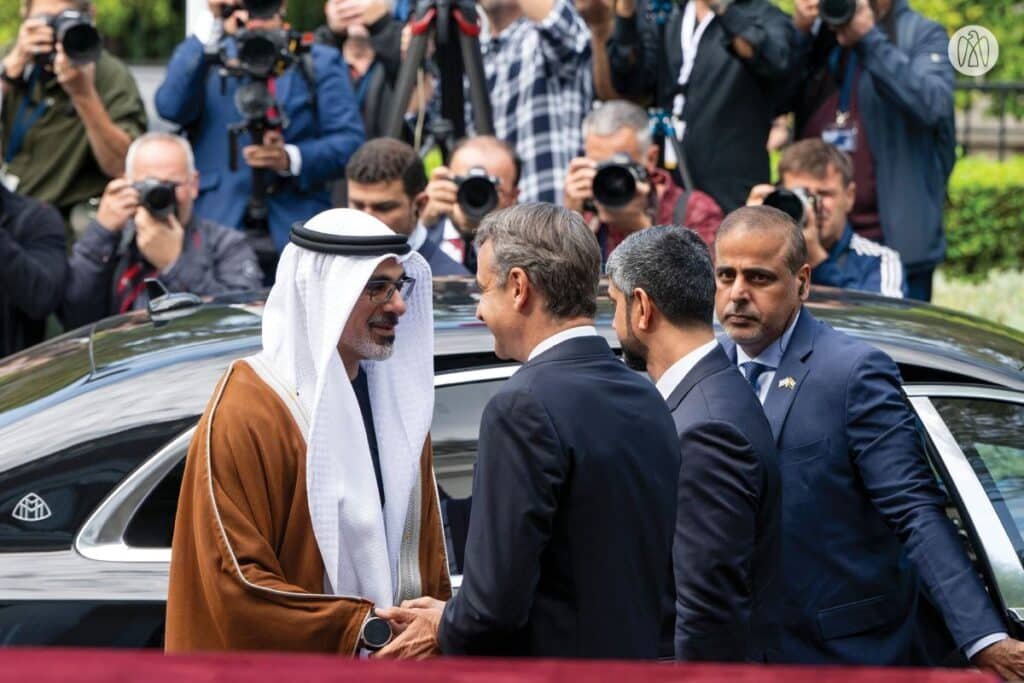
The United Arab Emirates has announced its intention to invest an additional €15 billion in Greece. It was announced on October 22, during a visit to Athens by Abu Dhabi’s Crown Prince, Sheikh Khaled bin Mohamed bin Zayed Al Nahyan.
Athens has welcomed the pledge. But videos shared on social media warn that one part of it, data centers, could drain scarce water and push up electricity bills. Here is what has been announced, and how far those fears hold up.
What the deal includes
The new money is to be channeled through the two countries’ joint investment initiative, which was launched in May 2022 with a value of €4 billion.
UAE Minister of Foreign Trade Thani bin Ahmed Al Zeyoudi said the additional capital would go to energy, hospitality, artificial intelligence, technology, industry and infrastructure over the next five to eight years.
Separately, the two countries announced 18 memoranda of understanding, agreements and commercial partnerships worth €12.75 billion.
Neither figure amounts to signed contracts for specific projects. Abu Dhabi’s media office described the €15 billion as an intention to invest, and much of the €12.75 billion consists of memoranda rather than finished deals.
Where data centers come in
The first concrete step came from Masdar, Abu Dhabi’s state-owned renewables company, which already owns Greece’s Terna Energy. Masdar is buying a solar project of more than 550 megawatts from Lightsource bp. Masdar says the plant will be operating by the end of 2026, gain battery storage and help meet demand “driven by AI and digital infrastructure.” The deal still needs regulatory approval.
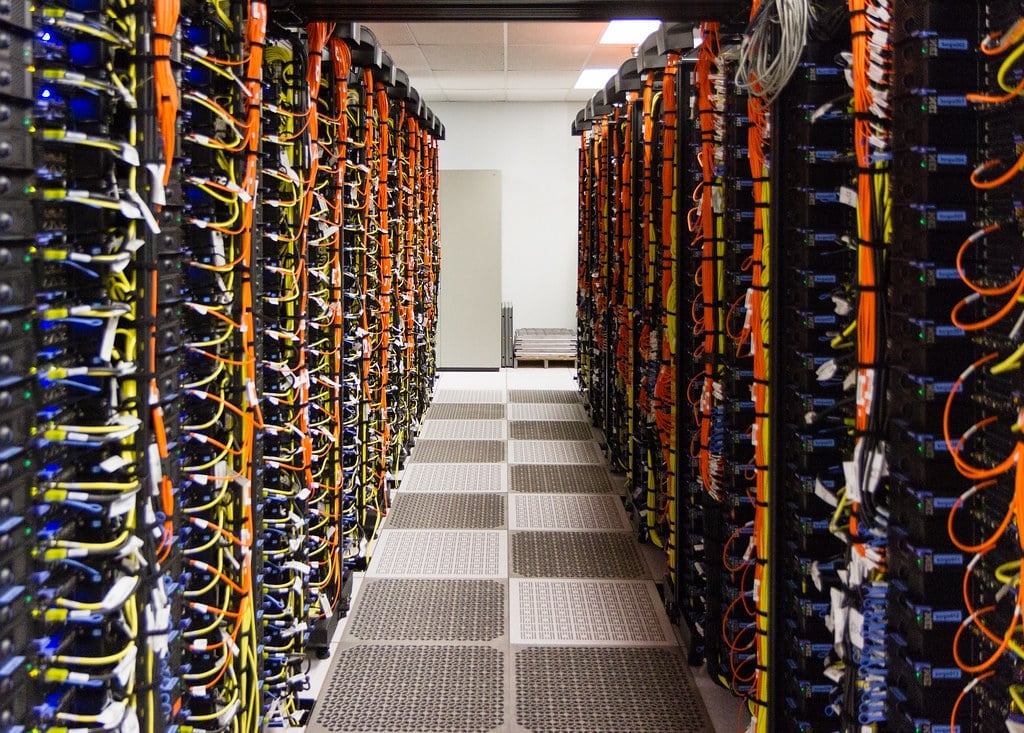
Masdar also signed an agreement with Khazna Data Centers to explore building green data centers in Greece, powered by dedicated clean energy and storage. No investment value, capacity or timeline was announced.
Interest in the sector predates the pledge. A study reviewed by the Region of Attica puts total investment interest in data centers in Attica alone at close to €1 billion. Projects include a venture between UAE-based DAMAC and Greece’s Public Power Corporation (PPC), a Microsoft complex and a data center hub of nearly €300 million in Paiania, just outside Athens.
The water worry
Many data centers cool their servers with evaporative systems and cooling towers. A large data center can consume anywhere from hundreds of thousands to several million cubic meters of water a year, particularly in warm climates such as Greece’s.
That matters in Attica, the region around Athens. In September 2025, the Athens Water Supply and Sewerage Company (EYDAP) said reserves at the Mornos reservoir, a key source for the capital, had fallen to 192.8 million cubic meters, 64 percent below the 2010–2024 average.
A wet winter eased the pressure. Mornos reserves nearly tripled between October and April, and on March 31, 2026, the four reservoirs serving Attica held 723.6 million cubic meters. That is still well short of 2022, when reserves approached 1.32 billion cubic meters, and EYDAP’s president warned this year that “the problem has not been solved.”
Water use depends heavily on cooling design. Systems that recirculate water or rely on air use far less than evaporative cooling, though they usually need more electricity. No UAE announcement has said how any Greek facility would be cooled.
The power price worry, and the Irish example
Critics often point to Ireland. Data centers used 22 percent of the country’s metered electricity in 2024, up from 5 percent in 2015 and more than all urban homes combined at 18 percent, according to Ireland’s Central Statistics Office.
A report published in May 2026 estimated that Irish households paid €715 million more for electricity between 2015 and 2023 because of data center growth. The report’s author, ecological economist Seán Fearon, argued that extra demand “increases the number of hours in which gas sets the price in the Irish power system, driving up electricity costs.”
The report was commissioned by two environmental campaign groups, Friends of the Earth Ireland and Beyond Fossil Fuels, and the industry disputed its findings. Maurice Mortell, chair of the industry body Digital Infrastructure Ireland, accused Friends of the Earth Ireland of “just trying to sow division in society.”
Greece is at a very different scale. Installed data center capacity in the country is estimated at only a few dozen megawatts, although it could pass 1 gigawatt before the end of the decade if planned projects go ahead.
The case for the projects
The UAE plan differs from simply plugging data centers into the grid. Masdar’s solar plant comes with battery storage, and the Khazna agreement is built around dedicated clean power. Facilities supplied by their own plants would lean less on the national grid. But buying a solar project already in development does not by itself add capacity, and it is not known whether any future data center will run mainly on its own supply.
Supporters also point to the record so far. Prime Minister Kyriakos Mitsotakis said Emirati direct investment in Greece had already exceeded the €4 billion target set in 2022.
The fears are understandable after Attica’s drought and Ireland’s experience. But no UAE-backed data center in Greece has yet been sized, sited or scheduled. The questions to watch are how large any facility will be, how it will be cooled, whether it will produce its own power, and how Greece manages grid access.