Greece’s public procurement authority has officially annulled two major contracts covering commercial operations at key archaeological sites with the Hellenic Single Public Procurement Authority (EADISY) revoking the controversial agreements following legal appeals by competing private firms.
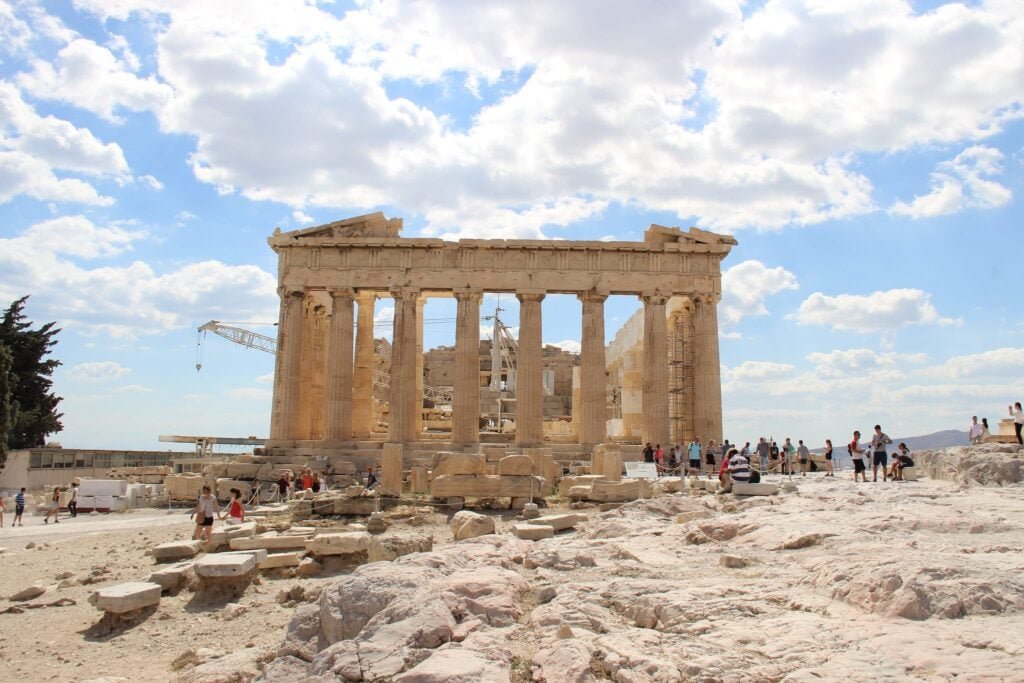
The disputed state tenders covered the commercial management of 27 museum gift shops across Greece, alongside public restroom facilities and visitor storage lockers at the world-famous Acropolis in Athens.
This regulatory intervention has triggered intense political backlash against the government. Mainstream opposition parties now demanding the immediate resignation of Culture Minister Lina Mendoni over alleged fiscal misconduct.
Bypassing European Union procurement rules
The Hellenic Organization of Cultural Resources Development (ODAP) originally signed both commercial agreements in August. Competing businesses filed formal appeals to challenge the legality of the restricted bidding processes.
They argue that ODAP treated the agreements as basic property leases to bypass strict transparency laws.
EADISY ruled that the 27 museum shops represented a massive project that required an EU-wide public tender, finding that ODAP had improperly restricted the bidding process to a select closed circle of domestic firms.
The authority also struck down the restroom contract for failing to meet basic European publication requirements. It based its decisions on the legality of the procedures rather than the financial terms.
Exposing highly disadvantageous financial terms
The financial structures of the canceled contracts drew sharp public criticism prior to the official regulatory intervention.
A corporate consortium consisting of Space Hellas and Radiant Technologies won the lucrative museum shop contract. Under a six-year lease with an option for a six-year extension.
The group agreed to pay a fixed monthly fee of €50,600 plus 2 percent of sales, averaging just €1,874 per month for each premium archaeological shop across sites like Delphi, Olympia, Knossos, and Epidaurus.
Crucially, the state recently utilized European Union funding to fully renovate these commercially valuable sites. The government spent €600,000 of EU Recovery Fund cash on the Acropolis shop alone as part of a wider €6.3 million modernization program.
Awarding critical Acropolis infrastructure to paper corporations
The second canceled contract granted the exclusive management of restrooms and lockers at the Acropolis to Public Shine Facility Management for a fee of €2,500 monthly.
The site attracts approximately 5 million international tourists annually, generating immense potential retail revenue.
The winning company was established in November 2025 with just €25,000 in capital. The newly formed business possessed zero prior operational experience in managing heavy public infrastructure.
Eventually, this reaised serious concerns from the outset about the protection of public assets.
Mainstream opposition demands Culture minister Lina Mendoni’s resignation
The regulatory cancellations intensified parliamentary pressure on the ruling New Democracy party.
PASOK criticized the ministry for ignoring formal parliamentary inquiries regarding the tenders for 50 days. It stated that the deals lacked basic transparency and competition.
Factions from the New Left party also demanded a full release of all confidential tender documents.
The newly formed Greek Left Alliance (EL.A.S.), led by former Prime Minister Alexis Tsipras, went much further by explicitly demanding Culture Minister Lina Mendoni’s immediate resignation and calling the cancellations absolute proof of a corrupt public contract scandal.
The socialist alliance claims that closed government tenders have cost Greek taxpayers €20 billion. They pleged to review all harmful state contracts and prosecute officials for breach of duty if they assume power.