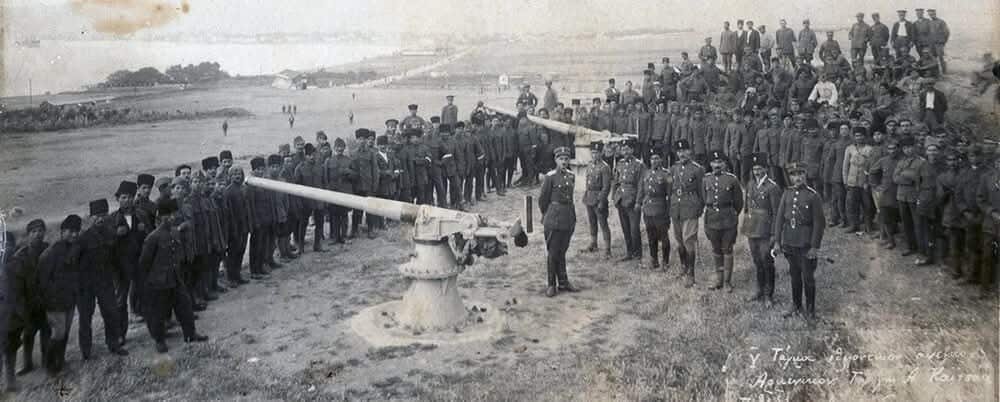
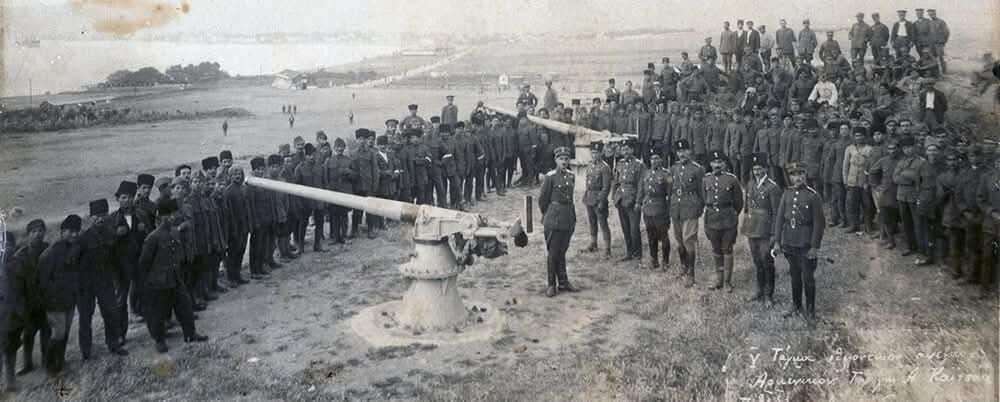
Among the most stirring chapters of the 20th century is the story of the Armenian Legion, specifically the 5th Armenian Battalion of the Greek Army, that fought against the Turks in Smyrna.
Formed during the tumultuous Asia Minor Campaign (1919–1922), this unit was more than a military formation; it was a sacred alliance born of shared blood, common enemies, and a refusal to vanish from the earth.
By 1921, both Greeks and Armenians recognized that they were facing an existential threat from the rising Turkish Nationalist movement led by Mustafa Kemal. For the Armenian volunteers, many of whom were survivors of the 1915 Genocide, the Greek front in Asia Minor represented a “last stand.” From the streets of Constantinople and Smyrna to the rugged terrain of Cilicia and Nicomedia, men gathered to enlist.
They did not join the Greek Army merely as mercenaries or foreign auxiliaries. They fought as brothers-in-arm, bound by a “common destiny,” viewing the Greek struggle for Enosis and the Armenian dream of a liberated homeland as two sides of the same coin: a rebellion against centuries of Ottoman oppression. Under the command of Colonel Torcom, a veteran of the Russian and Bulgarian fronts, the Legion became a model of discipline.
However, its heartbeat was found in figures like Aram Gaidzag (Aram “Lightning”). A legendary Fedayi, Gaidzag’s nickname reflected the speed and ferocity with which he struck. Under his guidance, the 5th Battalion was trained not just for conventional warfare, but for the “war of the desperate.” They were men who had already lost their homes, their parents, and their land; they fought as people with nothing left to lose but their honor.
The final parade of the Greek-Armenian alliance in Smyrna
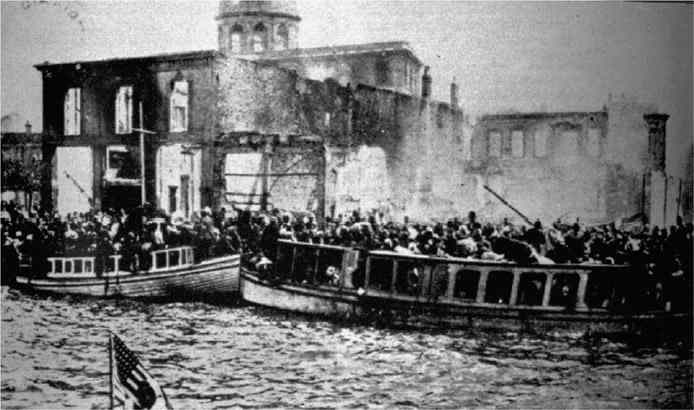
The most defining moment of the Greek-Armenian alliance occurred during the darkest hour of modern Greek history: the Catastrophe of Smyrna in September 1922. As the Greek front collapsed and the Great Fire began to consume the city, the Armenian Legion refused to flee in panic.
Eyewitnesses recorded a scene of haunting dignity amidst the carnage: the Armenian Legion was the last organized unit to withdraw from the city. It marched across the Smyrna Quay (Prokymea) in perfect formation, the Greek and Armenian flags flying side-by-side above the smoke.
As thousands of refugees scrambled for the sea, the Legion maintained order, providing a final shield for civilians against the advancing Turkish forces. They knew that as Armenian volunteers in Greek uniforms, capture meant certain death, yet they chose to be the final guardians of the city.
A legacy of honor
Following the retreat, the Legion was disbanded in Athens in November 1922. While the geopolitical maps were redrawn and survivors settled in neighborhoods such as Neos Kosmos and Nikaia, the alliance lived on in family archives—like those of the Paloulian and Kouyoumdjian families.
The story of the Armenian Legion is a testament to the fact that even in total military defeat, there is a victory of the spirit. It remains the ultimate symbol of the Greco-Armenian bond: a partnership of two ancient peoples who, when faced with the fire of destruction, chose to stand together upright with flags raised until the very end.