
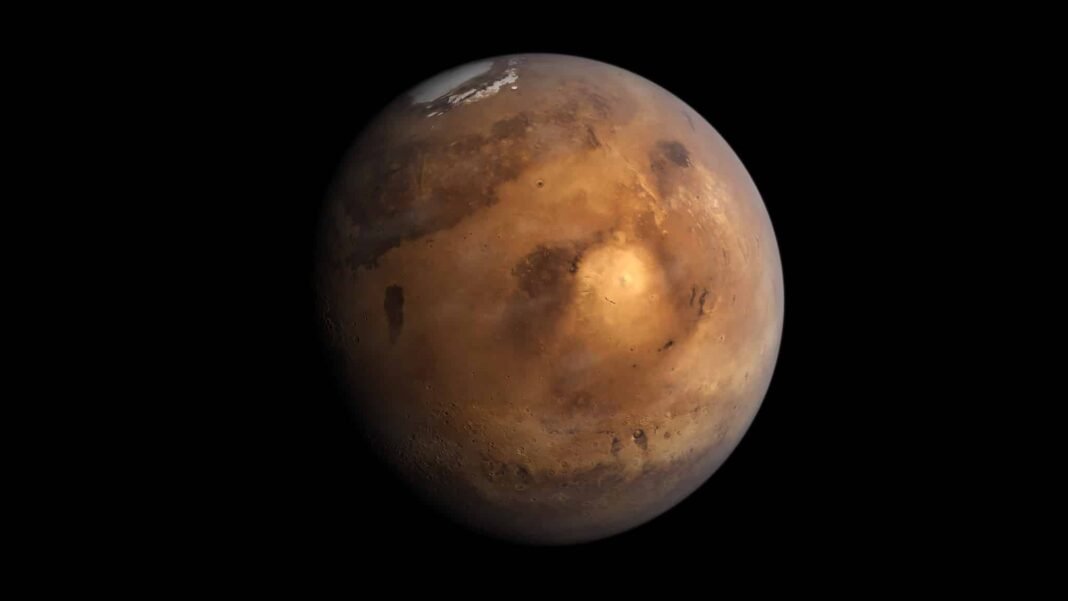

Mars has long raised questions about its past. Dry riverbeds, mineral deposits, and layered rocks suggest that water once flowed across the planet. For decades, scientists have sought clear evidence that a vast ocean once covered Mars’ northern plains—possibly up to one-third of the planet.
Early efforts focused on ancient shorelines. Features known as Arabia and Deuteronilus were thought to mark the edges of a long-lost sea. But their uneven elevation cast doubt on that idea. A true shoreline should follow a consistent level. These do not. They also fail to form a continuous boundary around the planet.
Researchers proposed several explanations. Some pointed to volcanic activity. Others suggested shifts in the planet’s axis. None fully resolved the problem.
“If Mars did have an ocean, it dried up a long time ago – possibly several billion years ago, more than half of the age of the planet itself,” said Michael Lamb of the California Institute of Technology. He noted that wind, eruptions, and other forces may have erased subtle features over time.
Scientists shift focus to broader landscape patterns
A new study takes a different approach. Instead of looking for sharp coastlines, researchers examined broader patterns across the Martian surface. They compared these patterns with Earth, where oceans leave behind wide, gently sloping regions known as continental shelves.
Using global elevation data, the team identified a large, low-slope band across Mars’ northern lowlands. The zone lies between about minus 1,800 (5,900 ft) and minus 3,800 meters (12,500 ft). It forms a continuous strip along the boundary between the southern highlands and northern plains.
The region aligns with key geological features. Ancient river valleys tend to lie above it. Deltas and sediment deposits appear within it. Even the debated shoreline traces fall inside this band.
Geological evidence supports long-term water activity
Geological findings strengthen the case. Thousands of layered sediment deposits exist within the zone, some of which are hundreds of meters thick. Clay minerals and altered rocks point to long-term interaction with liquid water.
New research suggests Mars may have once hosted a vast ocean covering up to one-third of the planet.
Instead of clear shorelines, scientists found a broad, low-slope zone across the northern plains—supported by sediment deposits, mineral evidence, and rover data. pic.twitter.com/nKUjOyrgjp
— Tom Marvolo Riddle (@tom_riddle2025) April 20, 2026
Delta systems in Aeolis Dorsa and Hypanis Valles show repeated changes in water levels. These patterns suggest that the ocean expanded and retreated over time. “The shelf is a new observation that ties together evidence of what the coastal zone would have looked like,” said Abdallah Zaki.
Rover data adds further support
Additional evidence comes from rover observations. China’s Zhurong rover detected sediment layers that dip in a consistent direction. On Earth, similar structures often form along coastlines shaped by water.
These findings suggest long-term interaction between water and land, rather than short-lived flooding events.
Discovery reshapes search for ancient oceans
If confirmed, the findings suggest that Mars once hosted a large ocean that may have covered about one-third of the planet, mainly across its northern hemisphere. Scientists believe this occurred billions of years ago, when Mars had a thicker atmosphere and warmer conditions.
Researchers say the discovery could change how scientists search for ancient oceans. Instead of focusing on sharp boundaries, future studies may look for broad surface patterns.
Upcoming missions, including the Rosalind Franklin rover, aim to study these regions in detail. Scientists hope to learn how long water remained on Mars and whether the planet once supported life.


