

Researchers have deciphered ancient genomes from two women buried in the Green Sahara roughly 7,000 years ago, uncovering a previously unknown human lineage that remained deeply isolated across North Africa for thousands of years.
The study, led by Nada Salem at the Max Planck Institute for Evolutionary Anthropology in Germany and published in Nature, provides the first genome-wide data from people who lived in the Sahara when it was a landscape of lakes, rivers and grasslands.
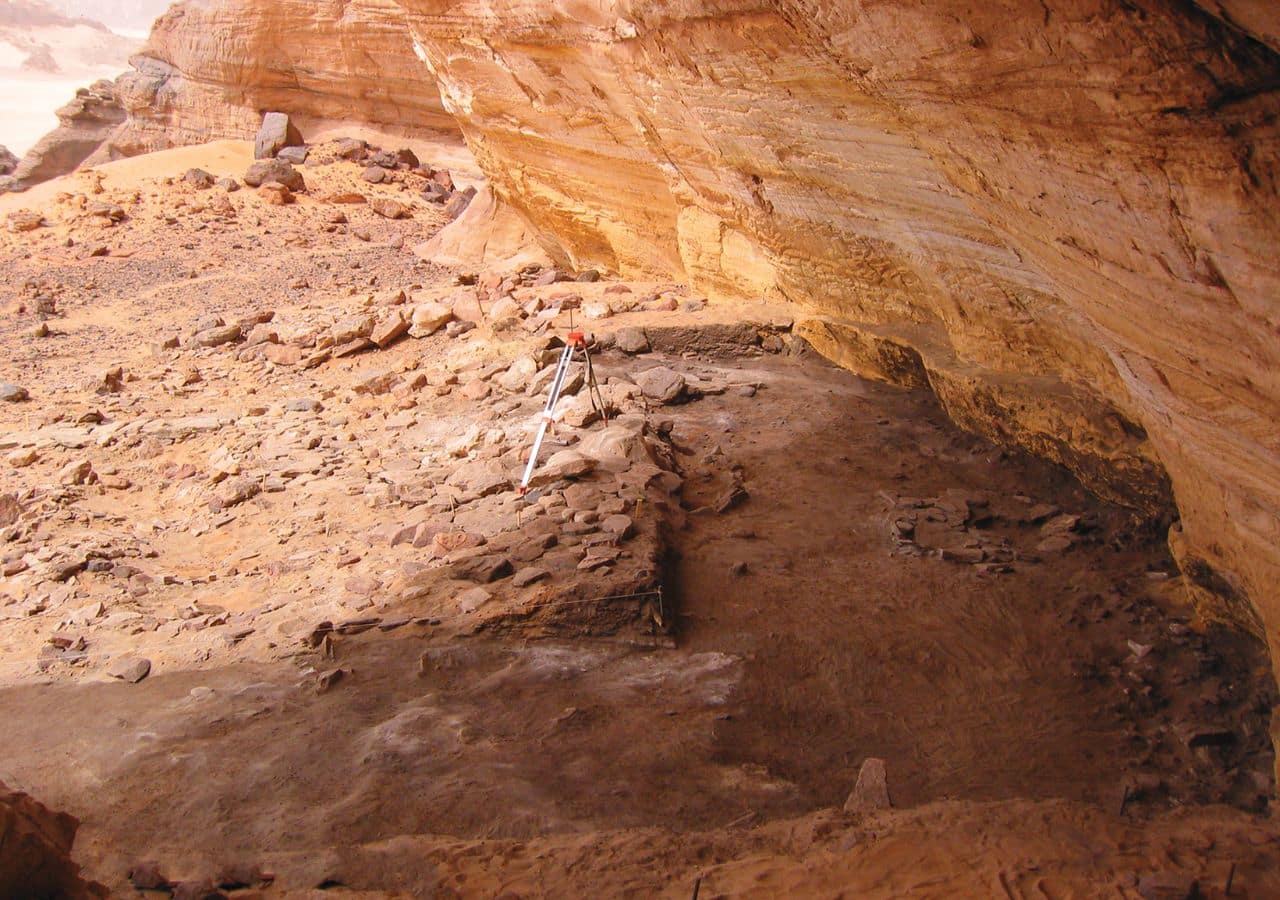
The two naturally mummified women were recovered from the Takarkori rock shelter in the Tadrart Acacus Mountains of southwestern Libya. Strontium isotope analysis confirmed they were local to the region.
They lived during the African Humid Period, when the Sahara supported savanna-like environments between 14,500 and 5,000 years ago.
DNA preservation at the site was extremely poor, with human DNA making up less than 1.4 percent of the extracted material. Researchers used specialized ancient DNA capture techniques to recover enough genetic information for analysis.
Two mummified women unearthed from Libya’s ancient rock shelter
The results showed that 93 percent of the women’s ancestry traced back to a North African population previously unidentified in any genetic study. This lineage diverged from sub-Saharan African populations around the same time modern humans first left Africa, then remained largely cut off from outside groups throughout most of its existence.
The remaining 7 percent of their ancestry came from a Levantine source, a small but significant trace that also explains the modest amount of Neanderthal DNA detected in their genomes.
7,000-year-old natural mummy found at the Takarkori rock shelter (Individual H1) in Southern Libya. pic.twitter.com/mpa6tjAN1S
— Tom Marvolo Riddle (@tom_riddle2025) April 14, 2026
The Takarkori individuals carried roughly 0.15 percent Neanderthal ancestry. That figure is about ten times lower than found in most populations outside Africa, and about one-quarter of what was found in ancient foragers from Taforalt Cave in Morocco, who lived around 15,000 years ago.
Despite this, both Takarkori and Taforalt individuals showed equal genetic distance from sub-Saharan African lineages, pointing to no meaningful gene flow from sub-Saharan Africa into North Africa even during the humid Green Sahara period.
Deciphered genomes from the Green Sahara reshape North African ancestry models
The study also refines the understanding of the Taforalt foragers. Earlier research identified part of their ancestry as broadly African but could not pinpoint its source. Salem and colleagues now identify that missing component as a Takarkori-related North African lineage, accounting for roughly 40 percent of the Taforalt genome.
On how pastoralism reached the Sahara, the minimal Levantine ancestry in the Takarkori women tells a clear story. Herding spread through cultural exchange rather than migration. Local populations with deep North African roots adopted the practice largely on their own terms.
Modern-day Fulani herding communities from the Sahel showed the closest genetic affinity to the Takarkori lineage among living populations, consistent with archaeological evidence of southward pastoral expansion as the Sahara dried out.


