

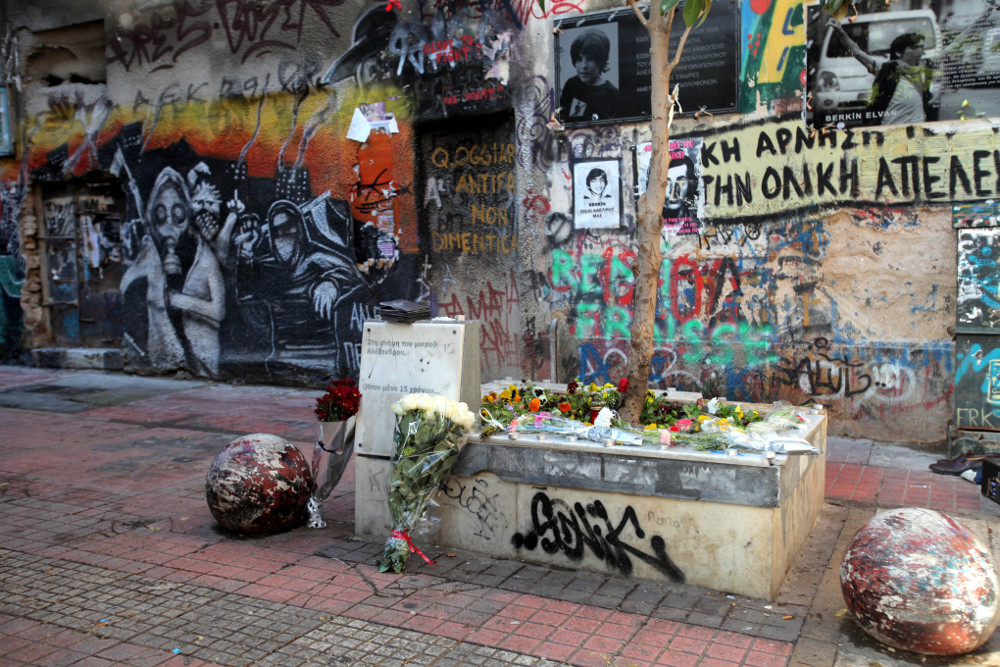
December 6th marks the anniversary of the murder of fifteen-year-old Alexandros Grigoropoulos by police officer Epaminondas Korkoneas in 2008, an act that stands as a landmark case of police brutality in Greece.
His death occurred in the Exarchia district of Athens, a neighborhood known for its anarchist and leftist activity. The incident sparked widespread protests, riots, and clashes across Greece, reflecting deep public anger over police violence, economic inequality, and political discontent.
Grigoropoulos and his friends were reportedly hanging out in Exarchia when a verbal altercation occurred between them and two police officers, Epaminondas Korkoneas and Vasilis Saraliotis. Korkoneas fired his weapon, striking Grigoropoulos in the chest. While Korkoneas claimed he fired as a warning and did not intend to hit anyone, witnesses and forensic evidence suggested otherwise.
Korkoneas claimed that Grigoropoulos threw a bottle at his patrol car when he was cruising in Exarchia. He then returned on foot with his partner and claimed that he fired his gun in the air to scare the boy and teach him a lesson. Yet, somehow, his two “warning shots” proved to be fatal.
As news spread, public anger erupted. For hours, parts of the area were in flames, and storefronts, bus stations, and apartment building entrances were destroyed. Several policemen were injured.
In 2010, Korkoneas was convicted of intentional homicide and sentenced to life imprisonment. His partner, Vassilios Saraliotis, received a 10-year sentence for complicity but was later released.
Korkoneas’ sentence was reduced to 13 years on appeal in 2019, leading to his release due to time served, which reignited public anger.
Anniversary of Alexandros Grigoropoulos
The protests of that night became an annual tradition. The killing of Alexandros Grigoropoulos on December 6, 2008, carries significant weight for Greek society. For many, it remains a deep collective wound, marking a turning point in the country’s modern history. The death of a 15-year-old at the hands of a police officer is seen as a stark reminder of how fragile the relationship between citizens and state authorities can be.
Violence
At the same time, the anniversary frequently provokes tension and violence. Almost every year, marches and memorial gatherings are accompanied by clashes between small groups of protesters and riot police. These incidents can involve stone-throwing, petrol bombs, burning refuse bins, damaged storefronts, and the use of tear gas by authorities.
While not representative of the day’s broader meaning, such episodes underline how emotionally charged the event remains and how unresolved the underlying issues still feel for many. Overall, the anniversary serves as a reminder of the importance of democratic values, accountability, and the responsibility of the state to protect its citizens, especially the young and vulnerable.


