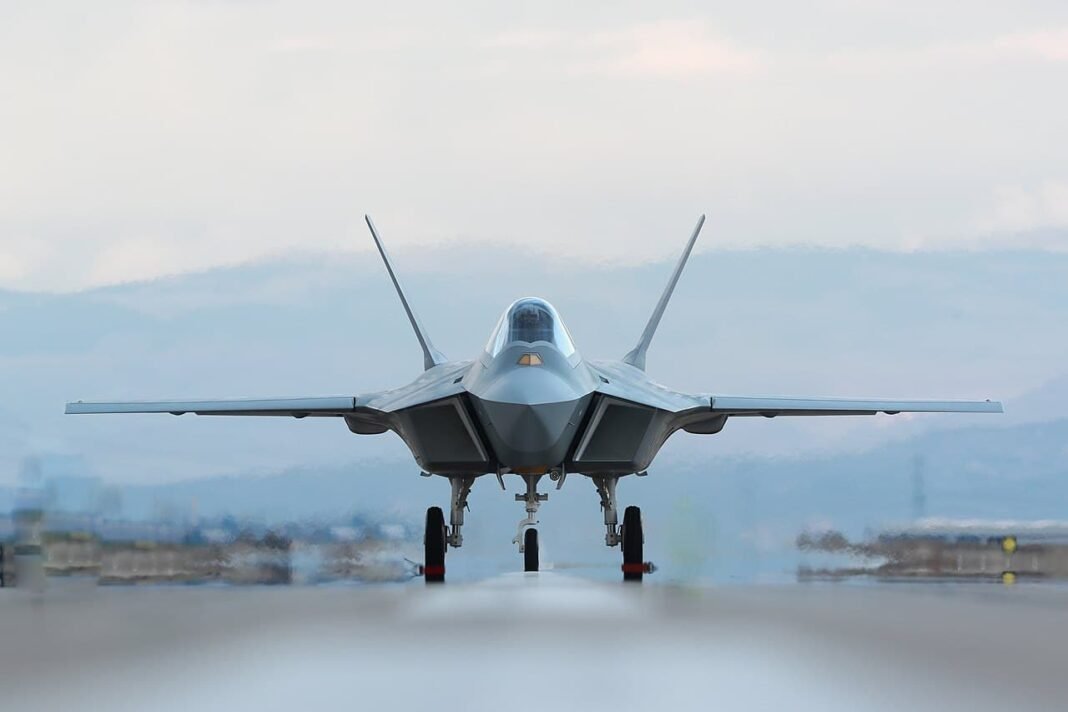
Turkey’s next-generation KAAN fighter program moved forward with the delivery of ten F110-GE-129E turbofan engines from the United States. Turkey’s defense Minister Yaşar Güler confirmed the transfer during a parliamentary oversight session and said negotiations continue for another eighty engines to support early production.
The General Electric F110 engine will power KAAN during flight testing and the first phase of operational service. Meanwhile, Turkey is developing its own high-thrust TF35000 engine, which the government intends to introduce with the Block 30 and Block 40 variants, later production configurations that reflect incremental upgrades in performance and systems maturity.
Sanctions remain strategic variable for Turkey’s KAAN fighter
The engine deliveries come at a time of ongoing uncertainty over US export controls. Washington imposed restrictions under the Countering America’s Adversaries Through Sanctions Act (CAATSA) after Turkey purchased the Russian S-400 air defense system, and those measures continue to influence defense cooperation.
Turkish officials say delays in export licensing for KAAN-related components already complicate planning. They warn that prolonged obstacles may push Ankara to explore other suppliers. Several members of the US Congress have also urged the State Department to keep sanctions in place until Turkey changes its approach to the S-400.
This climate increases the risk surrounding the additional eighty engines. Opposition lawmakers in Turkey now question whether the development schedule can remain on track if licensing hurdles intensify.
Development timeline and strategic ambitions for Turkey’s KAAN fighter
Turkish Aerospace (TAI) manages the program under a prime contract signed in August 2016. According to Turkish plans, KAAN is expected to remain in frontline service into the 2070s, with the first operational aircraft scheduled for delivery to the country’s air force by the end of 2028.
Although the TF35000 engine remains in early design stages, Ankara continues to treat aerospace sovereignty as a strategic goal.
Design profile and performance targets
TAI has outlined key design expectations:
- Length: ~21 meters (~69 feet)
- Wingspan: ~14 meters (~46 feet)
- Height: ~6 meters (~20 feet)
- Engines: Two powerplants targeting ~29,000 lb thrust each
- Top Speed: Mach 1.8
- Ceiling: ~55,000 feet
- Agility: +9g to −3.5g limits
Engineers emphasize low observability, advanced mission-system integration, and network-centric operations. Design goals include high situational awareness, reduced pilot workload, onboard damage monitoring, and interoperability with allied fleets, placing KAAN within the fifth-generation fighter class.
Broader procurement context
Turkey continues to explore additional fighter-fleet options during KAAN’s rollout. Officials confirm ongoing dialogue regarding the F-35 program and potential acquisition of used Eurofighter Typhoons from regional partners. However, S-400-related political resistance in Washington continues to complicate cooperation.
Balancing independence and global supply chains
The KAAN program highlights Turkey’s drive for greater domestic capability while still relying on key foreign technologies in the near term. Delivery of the first F110 engines marks tangible progress, but the fate of the remaining engines and the pace of local engine development will significantly shape the program’s trajectory.
If Turkey meets its current schedule, KAAN will enter frontline service before the end of the decade, placing the country among a small group of nations fielding an indigenous fifth-generation combat aircraft.