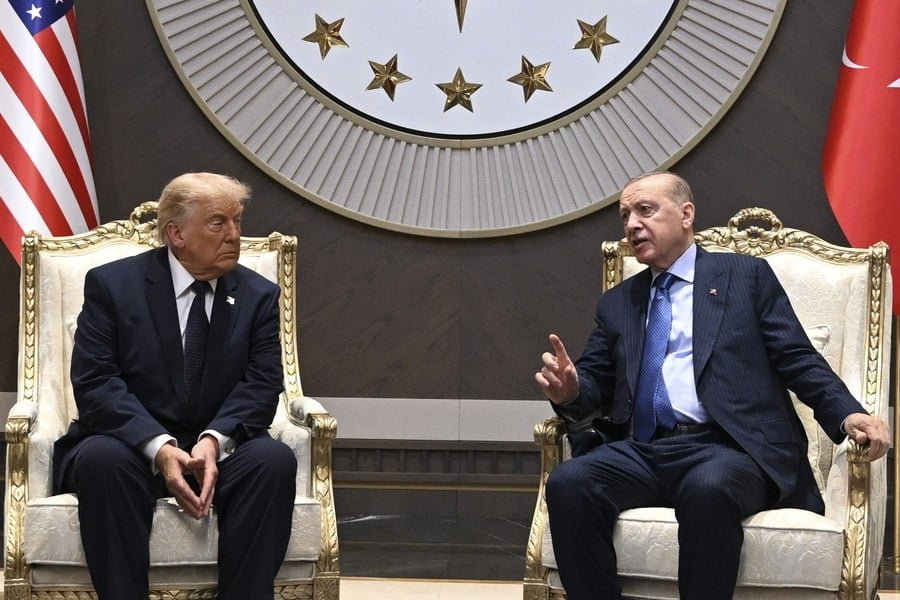
Talks between U.S. President Donald Trump and Turkish President Recep Tayyip Erdogan have revived Ankara’s hopes of returning to the F-35 fighter jet program, while raising concern among Greece, Israel and members of Congress.
Trump did not announce a completed deal during his meeting with Erdogan at the NATO summit in Ankara. He did, however, signal that his administration could reconsider Turkey’s exclusion from the F-35 program and move to lift sanctions imposed after Ankara acquired the Russian-made S-400 system.
Trump signals openness on F-35 after meeting Erdogan
“We have a better relationship with Turkey, and Turkey has been in many ways much more loyal than other countries that we think would be loyal,” Trump said when asked about the issue.
“So yeah, it’s something certainly we’d consider. It’s a great plane. It’s the best, currently the best plane by far, and certainly something we will consider,” he added. Trump also said he intended to remove sanctions on Turkey.
“We’re going to be taking the sanctions off,” Trump said. “It’s time to do that. We don’t want to sanction friends.”
The remarks marked a notable shift in tone from Washington. Turkey was removed from the F-35 program in 2019 after moving ahead with the S-400 purchase. U.S. officials have long argued that the Russian system could compromise sensitive information about the F-35’s stealth capabilities and operating profile.
Erdogan says Turkey expects favorable F-35 decision after meeting with Trump
Erdogan presented the issue as a long-running matter between Ankara and Washington and suggested that Turkey expects progress after the summit.
“The F-35 issue is not a new one for us. We have discussed it with the US before, and we received a commitment regarding the five aircraft,” Erdogan said, according to Anadolu Agency.
“God willing, I believe a favorable decision on the F-35 issue will emerge from this Leaders’ Summit,” he added.
The Turkish president also expressed confidence in Trump personally, saying, “President Trump always stands by his word.”
Turkey has argued for years that its removal from the F-35 program was unfair and that Ankara had fulfilled its obligations as a partner in the project. Turkish officials also reject the U.S. argument that the S-400 threatens NATO systems or the F-35 platform.
For Ankara, a return to the program would carry both military and political significance. It would restore access to one of the world’s most advanced fighter aircraft and signal a major reset in U.S.-Turkey defense ties after years of strain.
Mitsotakis says NATO must weigh allies’ security concerns
Greek Prime Minister Kyriakos Mitsotakis avoided directly commenting on the Trump-Erdogan exchange, but said NATO decisions must be guided by good neighborly relations and take into account the security concerns of all member states.
“I will not comment on yesterday’s statements by President Trump and President Erdogan,” Mitsotakis said as he arrived for the NATO leaders’ session. “The only thing I can say is that an alliance must be based on the fundamental principle of good neighborly relations.”
Mitsotakis then referred to Turkey’s long-standing threat of war against Greece if Athens exercises its legal right to extend its territorial waters.
“At a time when my country faces a casus belli from Turkey in the event that we exercise our lawful right to extend our territorial waters, I believe it must be clear that the sensitivities of all NATO members must be taken into account,” the Greek prime minister said.
“We are, after all, a defensive alliance, and I am certain that these pending issues can be resolved in the spirit of good neighborly relations and cooperation,” he added.
His remarks placed the F-35 debate within Greece’s broader concerns over Turkish policy in the Aegean and Eastern Mediterranean. Athens has repeatedly argued that alliance unity cannot be separated from respect for sovereignty, international law and peaceful relations between NATO members.
Lawmakers Raised Regional Concerns in Turkey F-35 Debate
Trump’s remarks brought renewed attention to existing resistance in Washington. Before the Trump-Erdogan meeting, a group of 18 members of Congress had urged House leadership to block any effort to reinstate Turkey in the F-35 program.
In a letter to House Majority Leader Steve Scalise and House Minority Leader Hakeem Jeffries, the lawmakers cited U.S. restrictions tied to Ankara’s acquisition of the Russian-made S-400 air defense system. They said Turkey should remain barred from the program unless the S-400 issue is resolved.
The letter referred to both the Countering America’s Adversaries Through Sanctions Act, known as CAATSA, and the National Defense Authorization Act for Fiscal Year 2020. It said publicly available information does not show that Turkey has removed the S-400, taken it out of operational use, or otherwise addressed the concerns that led Washington to impose sanctions.
“The integrity of this framework, and the message it sends to every country weighing whether to buy Russian weapons, depends on Congress’s willingness to enforce it,” the lawmakers wrote.
The lawmakers also cited Turkey’s posture toward Greece and Cyprus, its support for Azerbaijan in operations against Armenia, and Ankara’s stance toward Israel as part of their broader case against restoring Turkey’s access to the aircraft.
Netanyahu warns Turkey’s F-35 return could shift regional balance
Israeli Prime Minister Benjamin Netanyahu has also raised concerns about a possible Turkish return to the F-35 program, pointing to Ankara’s record toward Greece and Cyprus as a factor Washington should weigh before approving any advanced arms transfer.
Israel views the matter through the lens of regional security and its own qualitative military edge. Israeli officials have warned that Turkey’s acquisition of fifth-generation fighter aircraft could alter the balance of power in the Eastern Mediterranean and the wider Middle East.
The issue has gained added significance as relations between Israel and Turkey have deteriorated sharply. For Israel, the question is not only whether Ankara should regain access to a U.S. weapons platform, but whether such a move would strengthen a regional actor with increasingly hostile rhetoric toward Israel.