
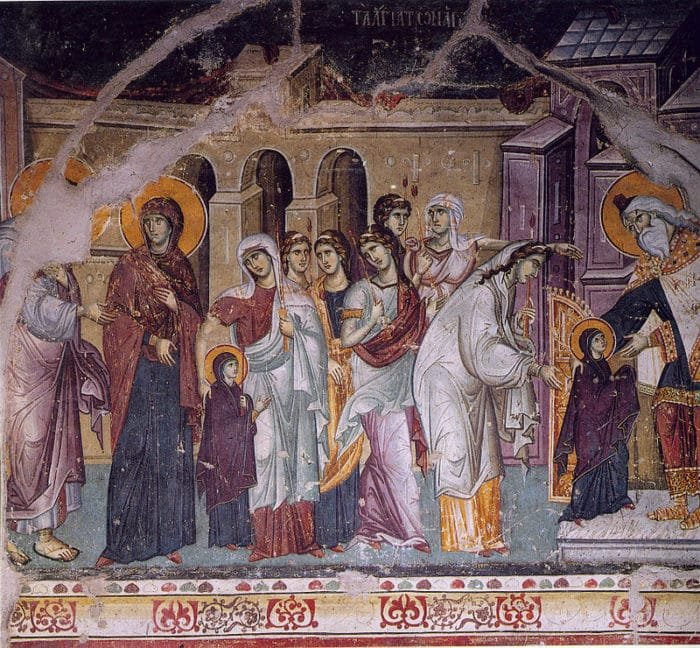

The true identity of the leading Byzantine painter Manuel Panselinos has been revealed by researchers studying a medieval illuminated manuscript in Paris.
The name of Panselinos has been associated with the greatest Byzantine art, and his frescoed hagiographies have been considered as important as those of Giotto and Raphael.
Scholars now believe Panselinos was merely a nickname, most likely for Ioannis Astrapas, who was from the northern Greek city of Thessaloniki.
Art historians had long suspected that the name—Greek for “full moon”—could have originated as a nickname for some member of the so-called Macedonian School of painting, based in Thessaloniki.

The Associated Press reported recently that recent research by a Greek monk and linguistics scholar linked Panselinos to Macedonian School painter Astrapas. Now, court handwriting expert Christina Sotirakoglou has matched lettering on a manuscript tentatively attributed to Astrapas with characters on a church painting in northern Greece, long seen as Panselinos’ best work.
Father Cosmas Simonopetritis, a former senior administrator in Mount Athos, the semiautonomous monastic community where the Protato church stands, says Sotirakoglou’s and his own research “clearly prove” Panselinos’ real identity.
“Panselinos was a real person, and [the name] was just the nickname by which Ioannis Astrapas became known,” he told the Associated Press.
Astrapas aka Panselinos was the most important painter

Born in the 13th century in Thessaloniki, Astrapas, aka Panselinos, was the most important hagiographer of the Macedonian school and one of the greatest of the Palaeologian Renaissance.
He was a role model for generations of painters, and his contemporaries are associated with a renaissance in Orthodox art that revived forms and techniques inherited from antiquity. Facial expressions acquired a deeper humanity, and greater attention was paid to proportion and depth of field in composition.
His works can be found in many monasteries on Mount Athos, including those of Vatopedi, Lavra, Protatos, and Karyes. Archaeologists believe some are also in the Agios Efthymios Chapel in Thessaloniki.
His paintings are considered archetypal, functioning as a universal school for all future hagiographers and establishing the fundamental principles that are the beacon of Orthodox ecclesiastical painting.
Panselinos believed that art should be firmly anchored in tradition, and he was strict about that principle as time went on. He fought for the preservation of historic Orthodox iconography when Byzantine art was threatened with alteration by Western elements.


