
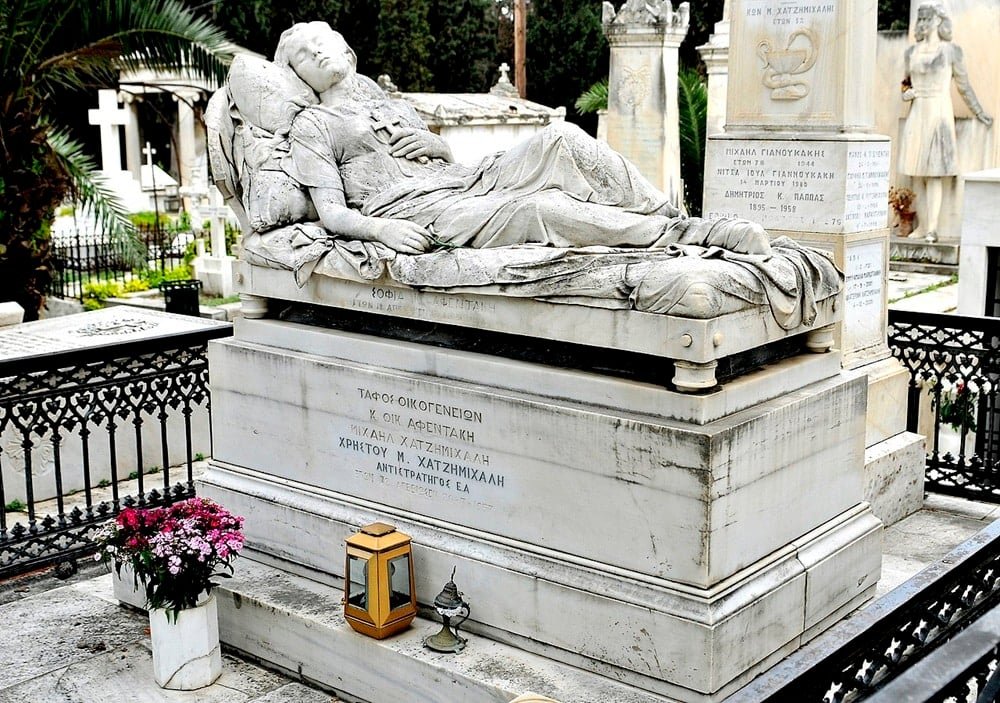

The human relationship with death is both primordial and universal. From Egypt and Mesopotamia, to ancient Greece and the New World, burials were far more than a practical necessity. They were a way to honor the memory of the deceased and to signal their social status.
By Polyxeni Moira
Ancient Burial Practices
In the pyramids of Egypt, the royal tombs of Ur, the tholos structures of Mycenae, or the Sutton Hoo (Brittain) burial ship, architecture and art were closely linked with the concepts of immortality and memory.
In the Christian tradition, burial acquired a new dimension. The relics of martyrs and saints became pilgrimage sites, and burial spaces were associated with the sanctity of the church.
Funerary Art Through the Ages
During the Renaissance, funerary art took on a more personal character. Monuments became markers of social and economic status, while cenotaphs (monuments without the body) served as tributes to the personality or achievements of the individual.
Cemetery architecture evolved, and the 18th century saw the emergence of imposing, shadowed, and melancholic mausoleums as spaces for experimentation in monumental architecture.
In the 19th century, perceptions of the dead changed. “Graveyards” became “cemeteries,” spaces where the dead could rest in peace and the living could walk among greenery and monuments, gaining historical knowledge and cultural experience.
In Europe and America, the so-called “garden cemeteries” emerged, combining nature with funerary art while highlighting historical and artistic values. In this context, necropolises that link history, art, and culture occupy a special place. Cemeteries such as Père-Lachaise in Paris, Montjuïc in Barcelona, or the Cimitero Acattolico in Rome are not merely places of burial. They are open-air, living museums, gathering monuments, sculptures, and life stories, offering visitors experiences of education, reflection, and artistic enjoyment.
Ammirando la Piramide di Caio Cestio dal Cimitero acattolico…
Gazing upon the Pyramid of Cestius from the Non-Catholic Cemetery…
📸 IG nadia_gr74#VisitRome pic.twitter.com/172n6iFZg4
— Turismo Roma (@Turismoromaweb) September 27, 2025
Cemeteries in the modern era have ceased to be exclusively places of burial and remembrance. Τhey are evolving into multidimensional sites that reflect social perceptions of life, death, and culture. In some cases, such as the Merry Cemetery in Romania, visiting a burial site can transform visitors’ understanding of the meaning of death. Folk satire, humor, and naïve art that dominate the epitaphs create an environment where memory coexists with a celebratory attitude towards the two facets of human existence—life and death. This ironic portrayal of death serves as a reminder that both aspects of the human journey deserve acknowledgment and celebration.
The well-known Merry Cemetery in Săpânța, Maramureș, Romania 🇷🇴☦️ pic.twitter.com/mVroCgHoML
— Tezaure Românești (@TezaureRo) November 5, 2025
Cemeteries as Cultural and Social Spaces
At the same time, in countries like Sweden, Austria, Hungary, Spain etc cemeteries serve as recreational spaces, partly due to their natural surroundings and proximity to urban centers. In Malmö, Sweden, residents use cemeteries for activities such as hiking, cycling, exercising, walking dogs, playing with children, and tourism, thus highlighting their role as vibrant, everyday green spaces.
Contemporary approaches recognize that cemeteries fulfill multiple functions. They serve as places of burial and memory but also as valuable “green lungs” that improve urban environmental quality and contribute to environmental protection. Furthermore, they function as sites of cultural heritage, education, tourism, and social cohesion.
Beyond their practical and functional character, cemeteries are profound cultural landmarks. They are not places for the dead, but for the living, as people return there not only to honor the memory of those who have passed but also to reflect on their own mortality. These sites act as witnesses to local history, capture the religious and cultural identity of communities, and combine tangible and intangible heritage—from sculptures, statues, and architectural works to rituals, customs, and ways of confronting death.
Visiting a cemetery today often includes elements of pilgrimage as well as aspects of religious-cultural tourism, serving as a way to engage with local, national, and international cultural traditions. In many European and American cities, the rational management of cemeteries is accompanied by the creation of digital infrastructures, websites, educational programs, events, and guided tours targeting both the general public and specialized groups such as art history and architecture students.
Thus, cemeteries today are vibrant cultural environments that blend memory, art, nature, education, and cultural experience, demonstrating that they can be places not only of rest but also of meaningful connection to history, society, and humanity itself.
The First Cemetery of Athens
In Athens, the First Cemetery represents the Greek counterpart to these spaces. Established in 1837 on the hill of Mets during the mayoralty of Dimitrios Kallifronas, it adhered to contemporary standards of hygiene and respect for the memory of the dead. Its location (near the Ilisos River and on a high, well-ventilated site) combined practical considerations with religious traditions regarding water and purification. Over time, the cemetery expanded, was organized into sections, acquired chapels and mausoleums, and became the resting place of notable figures, from heroes of the Greek War of Independence and politicians to artists and intellectuals.
The cemetery is not merely a place of death. It is an open-air museum, a sculpture gallery, featuring works that highlight the art of 19th and 20th century marble carving. The most iconic example is the “Sleeping Girl” by the Tinian sculptor Yannoulis Chalepas, while other monuments draw inspiration from Ancient Greek, Byzantine, and Egyptian models, making rich use of Pentelic marble and bronze. The First Cemetery reflects the history and social reality of modern Greek society, with inscriptions recording professions, beloved habits, and personal sayings.

The cultural dimension of the cemetery is multifaceted. It functions as a place of memory, greenery, education, cultural heritage, and tourism. Its inclusion in 2010 in the European Cemetery Route of the Council of Europe recognizes its value as a site connecting local and European history, culture, and artistic tradition. Through this route, visitors can explore the monuments of historical figures, study works of art and gain a better understanding of how Greek society has engaged with death and memory.
A visit to the First Cemetery is not merely a walk among graves. It is an experience combining historical knowledge, artistic enjoyment, and personal reflection. Visitors learn about the political, social, and cultural life of Athens, observe sculptures that document the evolution of Greek art, and encounter the human side of death—through the emotions, struggles, dreams, and habits of those who have passed away.
This experience can change the way we perceive death and memory. Unlike “dark tourism,” visiting the First Cemetery belongs to cultural tourism, offering knowledge, aesthetic pleasure, and connection to historical and social continuity. The site, like other major European cemeteries, demonstrates that the dead, through their art and monuments, remain present in collective memory and the lives of the living.
The First Cemetery of Athens, with its rich sculpture collection, historic graves, and cultural significance, offers a unique opportunity to connect with Greek history and art. From heroes of the War of Independence to contemporary artists, the cemetery functions as a book of Greek society, read among the marbles and monuments. Proper management, digitization, guided tours, and promotion can transform this “silent” necropolis into a living Open-air museum and a cultural attraction for Athens.

Despite its significant value, the management of the First Cemetery faces challenges. While historic cemeteries across Europe are gradually becoming vibrant cultural landmarks and urban tourism hubs, the utilization of such sites in Greece remains limited.
The lack of digital maps, systematic signage, and electronic applications restricts the visitor experience and makes navigation difficult without a guide. Despite efforts by the Municipality of Athens and the Committee for the Protection of Funerary Monuments, many monuments remain abandoned or damaged, and information about the history and art hosted by the site is limited and fragmented.
The absence of an integrated platform for tours, information, and tourism promotion highlights the need for coordinated action. The experience of other European cemeteries, which have websites, digital tours, mobile applications, and printed informational material (maps, guides, etc), can serve as a model for the First Cemetery to be developed as a cultural and tourist destination.
In a fast-paced world, the First Cemetery reminds us of the value of memory, art, and history. It is a place where time slows, the forms of sculptures speak about life through death, and the city of Athens provides an open corner of culture for all who wish to explore it.
Written by Polyxeni Moira, Professor, Sociology of Tourism, Department of Tourism Management, University of West Attica, Greece


