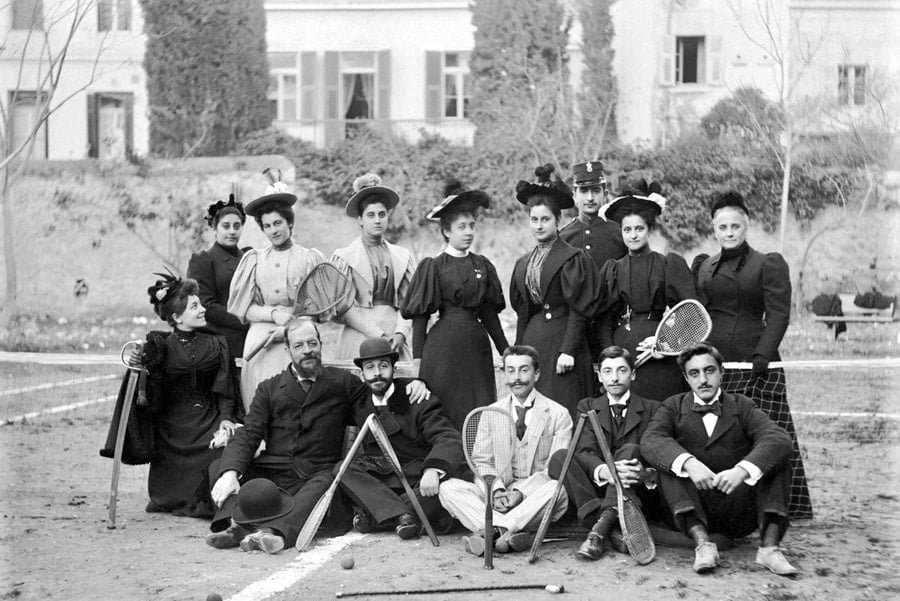
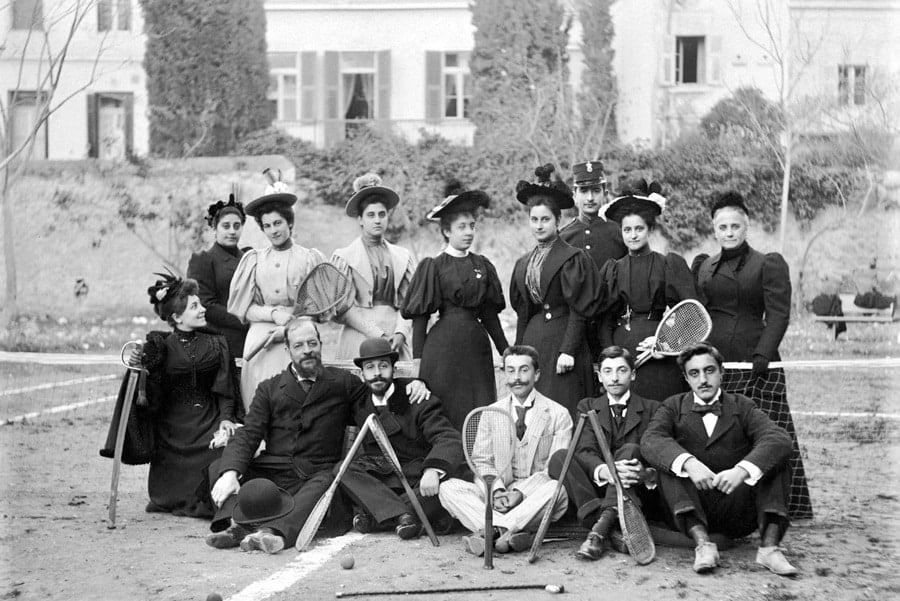
In a photograph captured at the turn of the 20th century, a group stands poised on a dusty court, tennis rackets in hand. This is not merely a social gathering; it is a snapshot of the Athens Lawn Tennis Club (O.A.A.) during its formative years. Founded in 1895, the club emerged in an Athens that felt worlds away from the bustling modern capital of today.
At the time, the city was home to only 128,000 residents, illuminated by a few thousand gas lanterns, with horse-drawn carriages rattling over dirt roads. Amid this landscape, tennis was an alien concept.
As early player Alexandros Merkatis once noted, these enthusiasts were often dismissed as “innovative madmen.” Dressed in white during the winter, carrying their rackets through the streets, they were a curious sight to locals who found this “foreign pastime” imported from England to be quite bizarre.
Tennis at the 1896 Athens Olympic Games
Despite the ridicule, this “pastime” quickly cemented its place in history. The O.A.A. became a cornerstone of the modern Olympic movement, serving as the proud host for tennis events during the 1896 inaugural Olympic Games and the 1906 Intercalated Games.
In 1896, two tennis events were contested, both for men. They began on 9 April and continued on 8 April, 10 April, and 11 April. Fifteen competitors from six nations, including seven Greeks, took part in the tennis competition.
The O.A.A. successfully bridged the gap between Greece’s ancient heritage and the burgeoning international sporting culture of the 20th century.
Today, the club stands as a testament to those early pioneers who persisted despite public mockery. Looking at this photograph, we see more than just a stiff, formal portrait. We are looking at the foundation of a sporting institution that has continuously evolved for over 130 years, transforming from a ridiculed “foreign” experiment into a proud, permanent fixture of Greek history.