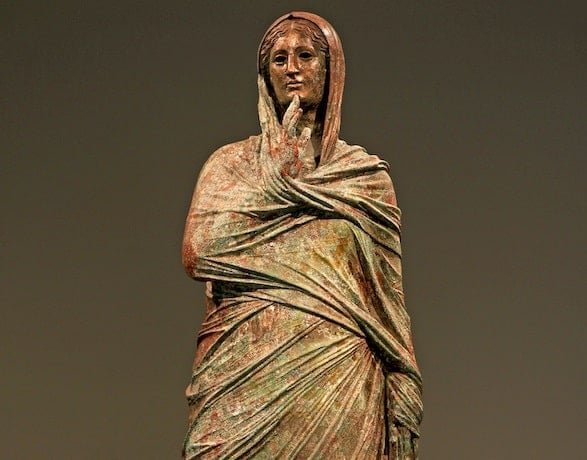
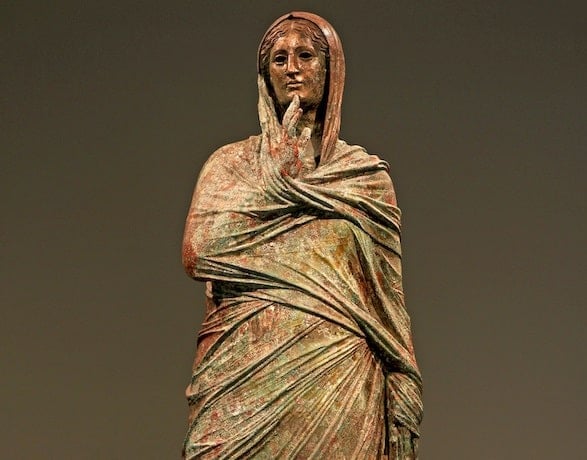
The Lady of Kalymnos is an exquisite Greek sculpture dating back to the Hellenistic period, around the 3rd century BC.
It is perhaps the most monumental bronze statue to be raised from the sea, as it was pulled up by a fishing boat in the sea east of the Greek island of Kalymnos in 1994 from a depth of about 120 meters (390 ft.).
It is a Hellenistic variation of the statue type known as the Large Herculaneum Woman.
This well-preserved statue is a prime example of the artistic developments during the Hellenistic era, characterized by a focus on realism, emotion and intricate detail.
A noblewoman or a deity?
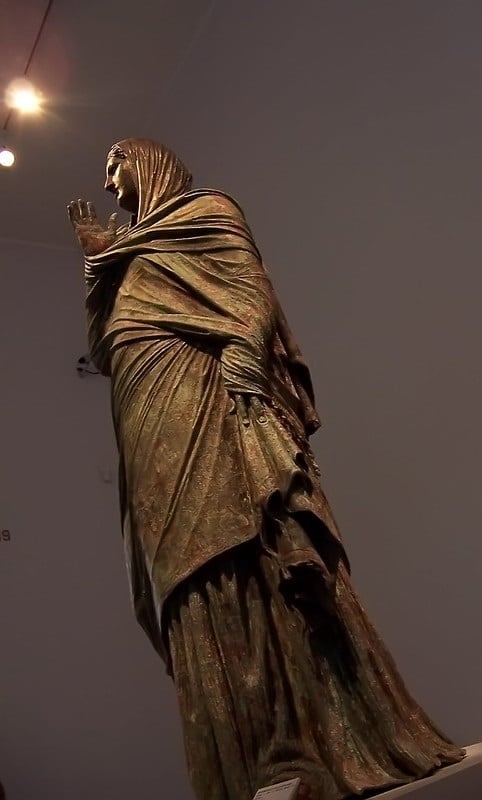
The figure, believed to represent a noble or elite woman of the time, is notable for its graceful and lifelike portrayal. She is depicted standing in a poised yet naturalistic stance, with her drapery expertly rendered to emphasize movement and texture. Another theory is that the statue represents the ancient Greek goddess Demeter.
She displays an extraordinary degree of bronze-casting skill in showing different textures between her skin, her hair, her overcoat and her undergarment—the fringe of her woolen coat is exceptional in ancient sculpture. The way her body and its tension show through her clothing is also magnificent.
The style showcases the Hellenistic fascination with individualized, expressive depictions of the human form.
“The Lady of Kalymnos” is a magnificent well-preserved ancient Greek bronze statue of a woman whose body is covered with a tunic and a fringed robe.
Larger than life-size, 1.95m high, 3rd Century BC. The sculpture was found in the nets of a local fisherman in 1995. It’s bronze,… pic.twitter.com/Nw4kuWhTMh
— ArchaeoHistories (@histories_arch) February 8, 2025
Where did the Lady of Kalymnos originally stand?
Archaeologists and historians have proposed several theories regarding where the Lady of Kalymnos originally stood before it was lost at sea. Since the statue was recovered from the seabed near Kalymnos, it is believed to have either belonged to a temple, a public space, or been part of a shipment of valuable artworks.
One widely supported theory is that the Lady of Kalymnos was being transported by sea when the ship carrying it sank. The Aegean was a major route for the movement of artworks, particularly from Rhodes, Athens, or Asia Minor to wealthy patrons in Rome or other Mediterranean cities.
The statue’s discovery near Kalymnos suggests it might have been en route to a buyer, possibly in Italy, Alexandria or another Hellenistic kingdom, when the ship was lost.
Currently located in the Archaeological Museum of Kalymnos, Greece, the statue illuminates the island’s importance in ancient art and culture, as it was a vital hub in the maritime economy during the Hellenistic period.
Kalymnos fishermen switch to searching for antiquities
Archaeologist George Koutsouflakis writing at Getty.edu described the statue as the “most monumental bronze statue to be raised from the sea.”
He added that the delivery of the Lady of Kalymnos to the Hellenic Archaeological Service and the stupendous reward granted for it had a huge impact on the community of local fishermen and resulted in an unexpected chain reaction: for the next twenty years, parts of statues were delivered to the department, some of them newly found and raised from the sea, others that had been stored for years in Kalymnian cellars.
“Dragging nets for the recovery of bronzes was for a while considered much more profitable than fishing. We can only imagine the damage inflicted on ancient shipwrecks in the deep. Whatever entered the Archaeological Service after 1994 was very fragmentary and of highly questionable origin,” Koutsouflakis said.
Has the missing sister of the “Kalymnos Lady” also been discovered?
A headless bronze statue similar to the Kalymnos Lady, dating from the Hellenistic times, weighing 300 kg (661 pounds) and measuring six feet in height, was caught by Turkish fishermen in 2020 off the coast of Marmaris (Physkos), near Bodrum.