
On June 2, 1941, Nazi troops executed the male population of the small village of Kontomari in Chania, Crete, in an event etched in history as the Kontomari Massacre.
It serves as a grim reminder of the brutal reprisals unleashed by German forces after the hard-fought Battle of Crete.
In the final days of May 1941, following a fierce and heroic resistance by Cretan civilians and Allied forces from Greece, New Zealand, Australia, and Britain, the Battle of Crete concluded with a German victory. The Germans had launched their invasion on May 20, relying exclusively on airborne forces. Despite suffering heavy losses, they achieved their objective of occupying the island by May 29.
The German triumph came at a significant price. The Nazis sustained approximately 14,000 casualties, including a substantial portion of their elite paratrooper corps. Winston Churchill, in his memoirs, famously remarked that with the forces Germany lost in Crete, they “could have occupied Cyprus, Iraq, Syria, and even Persia.”
A crucial factor in these heavy German losses was the unprecedented and heroic resistance of the Cretan people. Lacking sufficient weaponry, civilians bravely resisted with whatever they could find – from agricultural tools to stones and even bare hands.
Nazi massacre in Kontomari

This unexpected and fierce civilian resistance infuriated the Nazis, leading to an immediate and savage wave of reprisals. From the moment they gained control, the occupiers launched systematic raids on cities and villages, leaving behind a trail of destruction and death.
As noted by Tasos Vournas in “Ta Nea” on October 27, 1990: “After the end of the Battle of Crete and the removal from the island of those Allied forces who were able to escape by ship to Egypt, the Nazis unleashed a savage wave of reprisals against the civilian population. Villages such as Perivolia, Alkianos, Kirtomados, Agia, Stalos, Galatas, Maleme, Tavronitis, Kontomari, Platanias, Kastelli Kissamos, Skenes, Fournes, Messala, Vatolakos, Modi, Viannos and others were burned and the male inhabitants were shot.”
On that fateful day, June 2, 1941, German troops entered Kontomari with a singular, horrific purpose: the extermination of the village’s male population. They rounded up the men, executing them in cold blood regardless of their age.
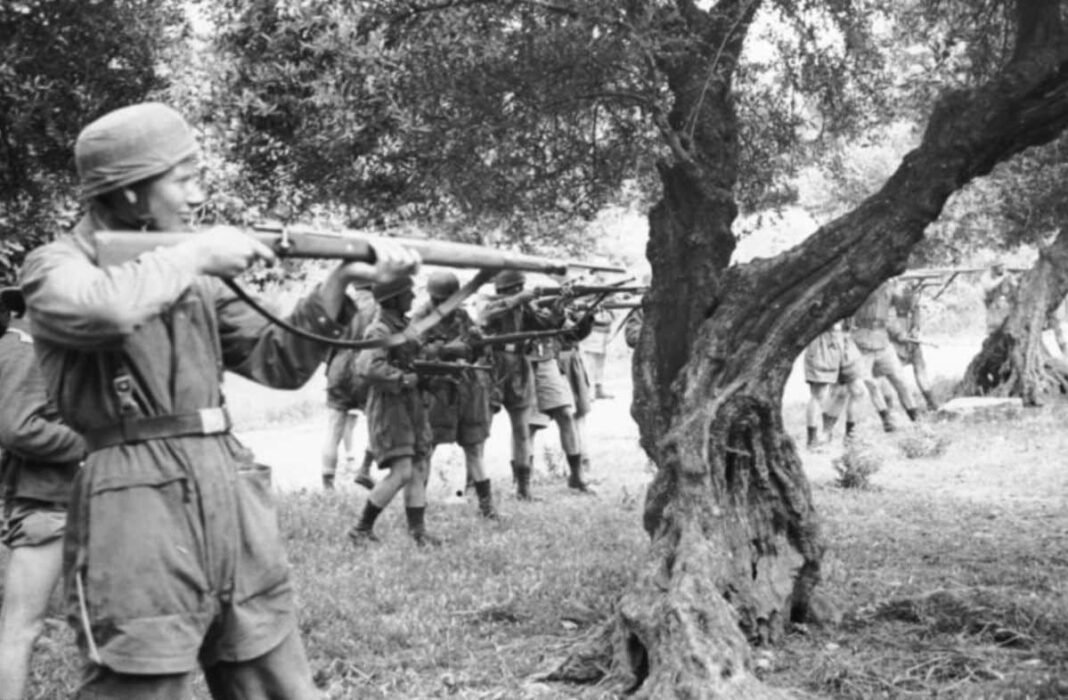
Decades later, “Taxydromos” magazine published shocking photographic material from the BUNDESARCHIV Archive of Federal Germany. These harrowing photographs, taken by German Lieutenant Vance Peter Weixler, provided irrefutable visual evidence of the massacre.

The gathering and execution
The massacre took place after all the inhabitants of the village had been gathered. General Student’s order was explicit: “All the men of the village from 18 to 50 years old are to be executed, without any discrimination.”
And yet until that moment, no one believed in the execution. Most people thought that they would be given the chore of burying the killed Germans who had fallen in the first days of the fighting.
The German execution squad had taken positions around the future dead and was waiting for the order to lead them a few meters higher into the olive grove, where the execution would take place in the next few minutes.

The bodies of the village’s young men lie dead on the ground and further away, a German soldier, with a pistol in his hand, shoots over each dead body, completing the image of horror.

The Kontomari Massacre stands as a chilling testament to the Nazi regime’s brutality and a poignant reminder of the immense sacrifices made by the Cretan people during World War II.
Related: Germany Apologizes for WWII Massacre in Crete