
The “new” Suez Canal, which was officially inaugurated on August 6, 2015, changed the world of shipping, doubling the cargo capacity of the original canal, which was built in the mid-1800s.
The nation of Greece has been connected to the Suez Canal since it was first envisioned as a pie-in-the-sky project in the mid-nineteenth century by engineer Ferdinand Lesseps.
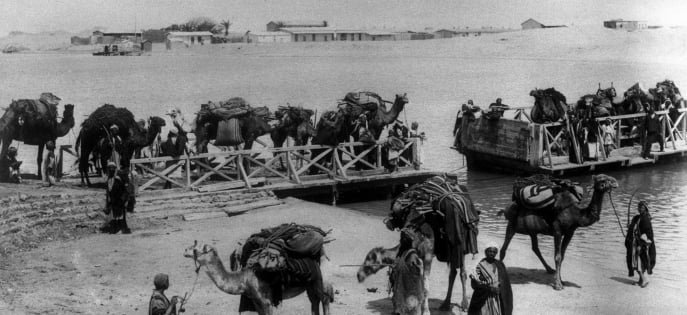
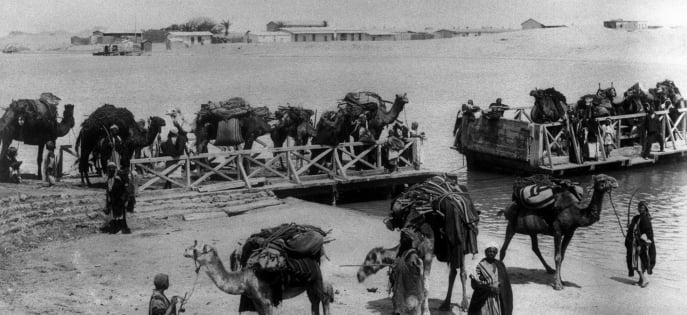
Greek workers helped build the canal after construction began in 1859 and continued until it was finished ten years later.
The Greek men who helped make the canal possible were the hard-working natives of various islands such as Kastelorizo, Astypalea, Patmos, Rhodes, and Kasos.
Greek islanders traveled to Suez
Many Greek islanders traveled to Suez, where they worked and put down roots despite horrendous working conditions, such as a lack of clean water, searing heat, and constant cholera and typhus epidemics.
“Lesseps needed staff members, and many looked for better wages,” noted Christos Kavallis, the president of Cairo’s Greek community. “The conditions were certainly difficult. They used to dig with their hands and many people were killed.”
“They also needed Greek sailors in order to maneuver the ships inside the canal, and thus the community flourished in the Canal,” he said. “Today a large part of the community comes from the communities that were created all those years ago in Port Said and Ismailia. Initially, at least 4,000 Greeks arrived in the area and many had roots from Kasos.”
Mass emigration
What amounted to a mass emigration took place on the island between 1859 and 1866, during the canal construction, and after that, many Greeks continued working for the Canal company. Their contribution to the project was acknowledged by Lesseps, who told the natives of Kasos that he wanted to do something for them in return.
Living and working conditions were truly unbearable in the Sinai desert, with pummeling heat during the day and freezing cold at night, and the hardy islanders had also to deal with insects, chronic lack of water, and epidemics; yet the hard-nosed seamen from the arid island of Kasos did not flinch.
That is why de Lesseps himself recognized the Kasos Islanders’ invaluable contributions toward the completion of the great work that inscribed his name in history.
The workers asked Lesseps to name the new city that would be built in the area “New Kasos.” However, it had already been decided that the city would be named after Said Pasha; therefore, it received the name Port Said.
Despite the name, however, after the passage of a few years, the city had acquired a definite Greek character, as did the nearby town of Ismailia due to the large Greek community and their churches, shops, and schools.
The Suez Canal is the world’s largest canal with a total length of 168 km (104 miles). It has a maximum width of 160 to 200 meters (656 feet) and a depth of 11.60 meters (38 feet).
Starting from Port Said on the Mediterranean and ending in Port Suez on the Red Sea, the modernized canal now boasts a second, auxiliary canal where ships traveling in opposite directions may now pass one another. The improved canal was opened in the summer of 2015.
Panama Canal honors Kasos islanders
The people of Kasos and their incredible labors during the building of the canal had become widely known across the world.
When the Panama Canal, connecting the Atlantic Ocean with the Pacific, was completed, the builders unanimously agreed that the first captain to cross the canal should be from the island of Kasos. And that captain was Nikitas Mavrakis, who had been born on Kasos in 1859.
However, the company that built the Panama Canal knew the rules of public relations of the time very well. They wanted the name of the captain to sound more American, or at least be more easily pronounced, so they changed Mavrakis’ name to “John Konstantine.”
However, visitors to the Panama Canal Museum today can gaze at the portrait and bust of the proud Kasos seaman with his real Greek name below it. His name represents not only himself but all the Greeks who helped make modern canal building possible through their backbreaking labors and sacrifices.


