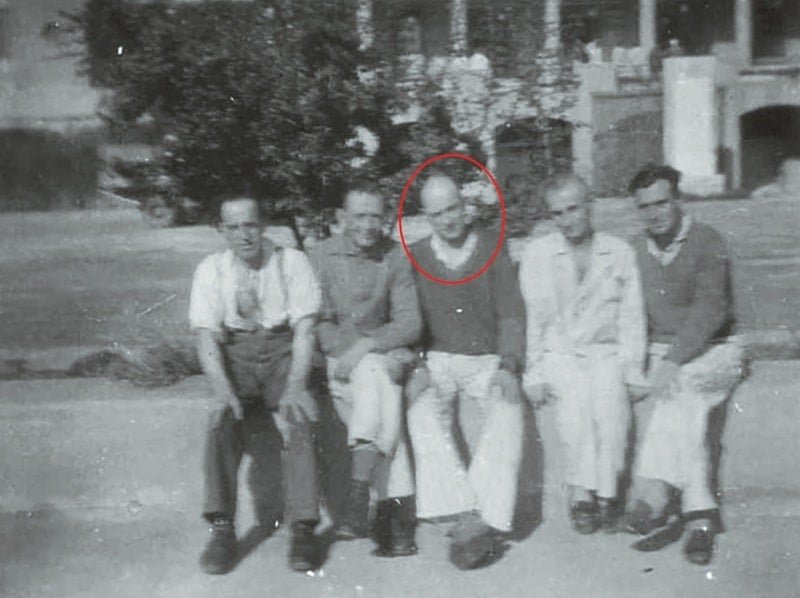

Twenty-six years after the end of the Greek Civil War, two Cretan rebels reappeared from the mountains on February 23, 1975.
This is the extraordinary story of Giorgos Tzombanakis and Spyros Blazakis, two men who finally descended from the White Mountains of Crete—the last active remnants of a civil war that the rest of the world had forgotten decades prior.
The Civil War that froze in time
On August 30, 1949, the Battle of Grammos officially ended the Greek Civil War, the darkest and most fratricidal chapter in the nation’s history. While most fighters of the “Democratic Army” fled to Eastern Europe or surrendered, a small group of about 30 remained in the rugged mountains of Crete. Over time, they vanished—some were killed, some escaped abroad, and others were captured. Eventually, only two remained, living like ghosts among the peaks.
The end of the manhunt for the Cretan rebels
February 22, 1975: Giannis Theodorakis (brother of the famed composer Mikis Theodorakis) informed the Prosecutor of Appeals that a formal amnesty decree had been published for the two missing rebels. Holding the Government Gazette in his hands, the prosecutor signaled the Gendarmerie to cease the manhunt and lift the bounty on the two fugitives, 26 years after the war’s end.
February 23, 1975, 10:20 AM: On the road leading to Therisso, 15 kilometers outside Chania, Tzombanakis and Blazakis finally emerged. They fell into the arms of relatives and comrades—free men at last, their heads held high.
Living like “agrimia”
Despite being offered three chances over the years to return in exchange for a verbal renunciation of their political beliefs, they refused. They chose instead to live like agrimia (the wild mountain goats of Crete) in limestone caves.
As the years passed, the authorities piled charges upon them—ranging from anti-government acts to murders they likely never committed—simply because they were the only ones left to blame.
“We know they’ve pinned every crime in the region on us,” they told British journalist David Tonge in a 1972 clandestine interview that shocked the world.
Even with a bounty of 150,000 drachmas on their heads—a fortune in post-war Greece—and despite many locals knowing exactly where they were hiding, not a single Cretan betrayed them.
A legend’s homecoming
The scene in their villages, Gavalochori and Kokkino Chorio, was one of pure emotion:
Tzombanakis’s aunt, Markari, aged 102, stood in the village street weeping as she welcomed her nephew home.
Memories resurfaced of the day Giorgos’s dying father asked to see his son one last time. The police had surrounded the house in an ambush, but Giorgos sensed the trap and vanished into the brush.
The villagers greeted them with a traditional Rizitiko song: “My wild ones, my withered deer, tell me where your places are…”
Life on the Cretan peaks
In a press conference following their return, they described a life of extreme hardship and poetic isolation. They spent their days on the “Ornio” peak at an altitude of 2,500 meters, looking out over the sea. On clear days, they could see as far as the Peloponnese and Attica.
They survived on what they could find. From 1960 onwards, they possessed a small radio to hear the news. However, during the 1967 dictatorship, the hunt intensified. They described spending weeks in total darkness, hiding in deep caves.
“Don’t think we could have survived without the support of the people,” they noted. “Both Leftists and Rightists helped us. Without them, we would be dead.”
The “baggage” of a lifetime
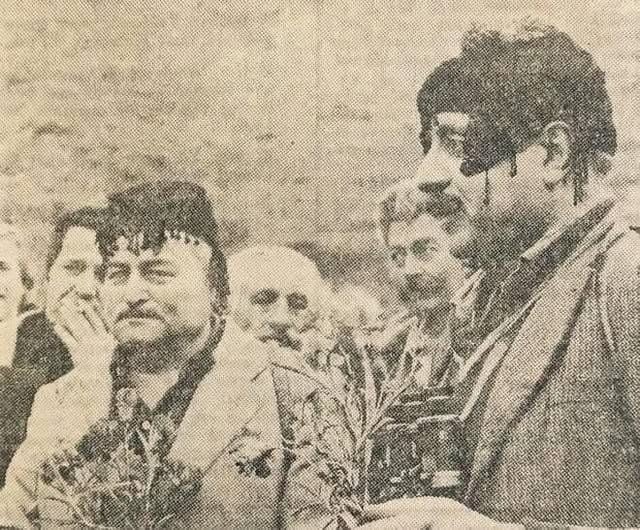
When they finally came down, foreign journalists were curious about what they carried in their rucksacks. It was their entire life’s possessions: walking sticks, binoculars (looted from the Nazis in 1942), a flashlight, a hair clipper, a razor, and a small tin of face cream. “Don’t laugh,” Giorgos joked, “my skin is very sensitive.”
Their first night back in “civilization” was spent at the Kydon Hotel in Chania. It was not an easy transition. The next day, on a flight to Athens, Giorgos admitted he couldn’t sleep a wink—the sound of the hotel toilets flushing all night was more jarring to him than the mountain wind.
The final chapter
In Athens, their first act was to lay flowers at the Polytechnic Memorial to honor the fallen students of the 1973 uprising. They later traveled to the Soviet Union as official guests.
Eventually, they settled into quiet lives. Blazakis married and lived in Athens, while Tzombanakis married and remained in his beloved Crete. Despite the distance, they remained inseparable friends until the end. In a final act of synchronicity, the two “last guerrillas” passed away within just one month of each other in late 1996.
Related: Dekemvriana: Greece’s Turning Point to Civil War