

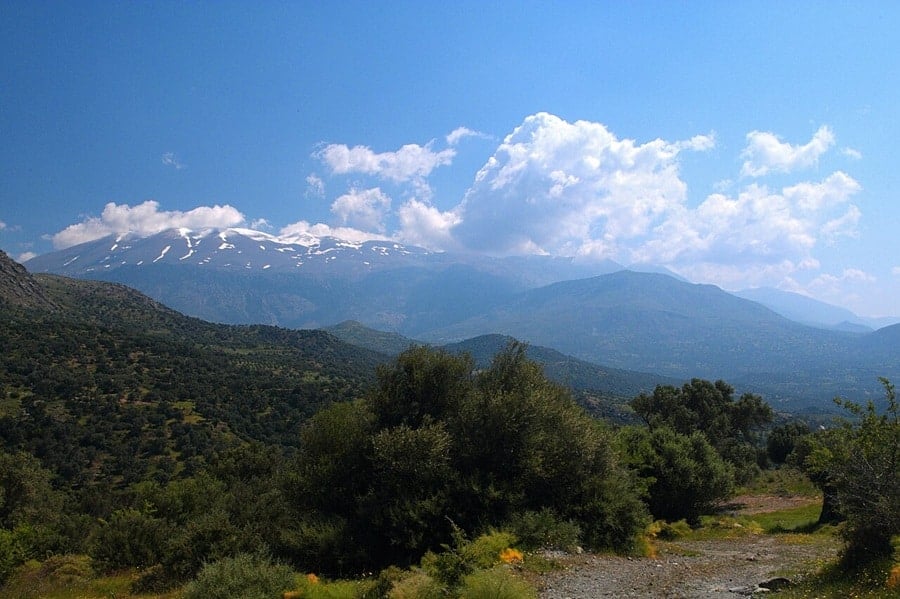
Mount Ida, known to locals as Psiloritis, is Crete’s highest peak and holds a central place in Greek mythology, as it is the location where, according to legend, the Titaness Rhea hid her infant son Zeus from his father Cronus. The story of Zeus’s childhood survival on Mount Ida is a foundational narrative for the entire Olympian pantheon.
The myth’s focus is the Ideon Antron (the Idaean Cave), also known as Psychro Cave, one of the primary sites believed to be Zeus’s secret nursery, although the Diktean Cave also lays claim to the legend.

Greek Mythological narrative of Zeus’s birth on Mount Ida
The mythological narrative begins with Cronus, the reigning Titan. A prophecy stated he would be overthrown by one of his children, leading him to swallow all five previous offspring immediately after their birth.
To save the sixth child, Zeus, his mother Rhea fled to Mount Ida on Crete. Inside a deep cave on the mountain, she gave birth to Zeus. To deceive Cronus, she wrapped a stone in swaddling clothes and presented it to him, which he promptly swallowed, believing he had consumed the final threat.
To ensure Zeus’s survival, Mount Ida functioned as a covert sanctuary. Zeus was raised by local nymphs (sometimes named Ida and Adrasteia), who nourished him with milk from the divine goat Amaltheia and wild honey.
Crucially, the infant god was protected by the Kouretes, a band of mythical warriors. To prevent Cronus from hearing the baby’s cries, the Kouretes performed a loud, ritualistic war dance outside the cave, clashing their bronze spears against their shields. This noise drowned out Zeus’s crying, allowing him to grow safely until he was ready to confront his father.

Echoes of the past
Excavations in the Idaean Cave have confirmed its monumental importance as a cult site. Artifacts dating from the Neolithic period through the Minoan and Geometric eras attest to centuries of worship.
Votive offerings, including elaborate bronze shields, figurines, and ceremonial objects, suggest the cave was a central sanctuary for both Minoans and later Greeks. It may have originally been dedicated to a Cretan-born deity that was later identified with the Olympian Zeus.
Even the legendary King Minos of Knossos was said to visit the Idaean Cave to receive laws and commands directly from his father, Zeus, further cementing the mountain’s critical role in the ancient civilization of Crete.
A Minoan mountain stronghold: Zominthos
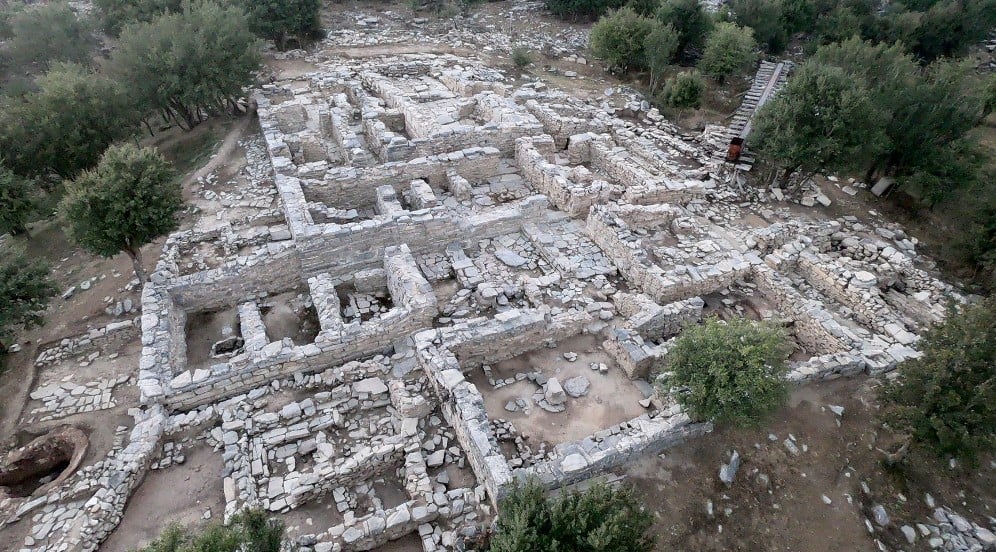
Beyond the mythological significance, Mount Ida was also a site of real ancient human activity. The mountain’s connection to the gods is confirmed by an archaeological discovery that reveals a surprising facet of the Minoan civilization, which is usually associated with the sea and coastal life.
Discovered in 1984, the ancient Minoan palace of Zominthos is situated on a plateau on Mt. Psiloritis, about 1,200 meters (nearly 4,000 feet) above sea level. This unique site confirms that the Minoans were also highlanders, establishing significant settlements in the rugged interior.
The palace complex is the only mountaintop Minoan settlement ever to have been excavated and is still yielding groundbreaking information. Zominthos is strategically located directly on the ancient route connecting the main administrative center, the palace at Knossos, with the Idaean Cave.
This placement strongly suggests that Zominthos was vital in controlling the pilgrimage route to the sacred cave, linking the Minoan political center to the island’s most powerful religious sanctuary.
Related: Five of the Most Staggering Caves to Explore on the Island of Crete

