
The Byzantine Empire is not always recognised as the crucial link that connected the classical world with modern Europe.
However, this is an element that is fundamentally true and makes the already fascinating Byzantine history even more intriguing to scholarls.
While the Western Roman Empire collapsed due to external enemies only a few centuries after its establishment, the Eastern Roman (Byzantine) Empire not only managed to survive for another millennium but it also kept the flame of ancient Greek knowledge and Roman might alive.
The Byzantines safeguarded a wide range of priceless texts. From the works of Greek philosophers, mathematicians, physicians, scientists and astronomers to Roman legal systems and artistic traditions that shaped the modern world we live in, the Byzantines were responsible for their preservation.
This preservation wasn’t simply a few old monks hoarding old stuff, as might stereotypically be thought; it was a systematic effort to safeguard millennia of human knowledge for the world to use and build on, by generations of people.
The Byzantine Empire preserved the intellectual heart of Greece and Rome, providing us today with concrete proof as to what became the very bedrock for the eventual Renaissance and the establishment of our modern civilization.
The Byzantine Empire linked the past to the present of Europe
Think of it this way: The Byzantine Empire, born from the split of the Roman Empire to a Western and an Eastern part, managed to keep the spirit of classical Greece alive when things began to get pretty chaotic in the West.
Byzantine scholars meticulously copied and studied ancient texts, making sure the philosophy, literature and scientific understanding of the ancient world didn’t vanish. A prime example of their influence is Emperor Justinian I’s Corpus Juris Civilis, a comprehensive collection of Roman law.
This exceptionally well-organised legal framework became a cornerstone of modern European legal systems, directly connecting ancient legal principles and modern laws.
The monasteries of Mount Athos, or Agio Oros in Greek, played a fundamental role in preserving classical literature and wisdom from antiquity too.
Along with theological texts, the monasteries at Mount Athos saved large numbers of collections of ancient Greek literature in their libraries. This is in contrast to many other monastic libraries that primarily housed religious literature, considering their mission to be exclusively religious rather than more openly scholarly. This conservation of a wider knowledge base was not a given.
This creative approach, which involved the hard work of hundreds of Greek and non-Greek monks who lived on the Athonite peninsula, resulted in the preservation of many classical manuscripts.

Byzantine art
Byzantine art and architecture also left a lasting impression on our modern world, in ways direct and indirect. These later influenced Europe via the Renaissance.
Structures like the Hagia Sophia, with its groundbreaking dome and breathtaking mosaics, show how Byzantine architects and artists used knowledge from the ancient world to create a new paradigm of Christian expression, building upon and expanding from old wisdom.
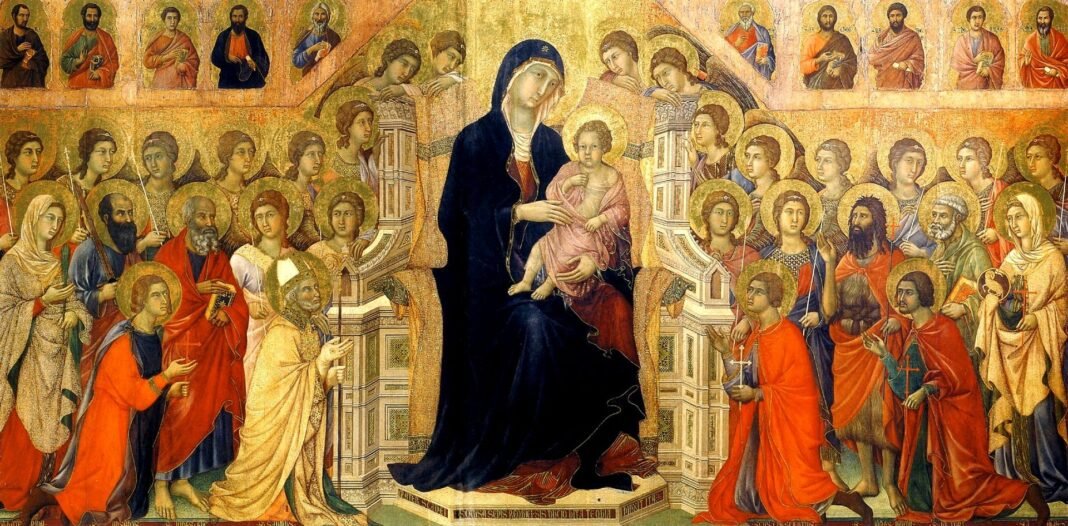
The intricate and beautiful details that evolved from ancient Greece and Rome to become Byzantine art—particularly the Christian iconography—with its distinctive, austere style, inspired later Renaissance artists, who were looking to replicate, evolve and spread the beauty and grandeur of these times.
This is how the Byzantine Empire, with its preservation of older traditions, techniques and knowledge managed to bridge the ancient and modern worlds. It is widely believed that Byzantine traditions and centuries-old rules had a foundational impact on the evolution of art during the Italian Renaissance.
Byzantine art had an impact on everything from Venice’s exquisite mosaics to early Renaissance painters’ holy paintings, which focused on religious themes and now adorn several locations throughout Europe and beyond. These elements make the Byzantine Empire and its often misunderstood role in European history ever more important.