

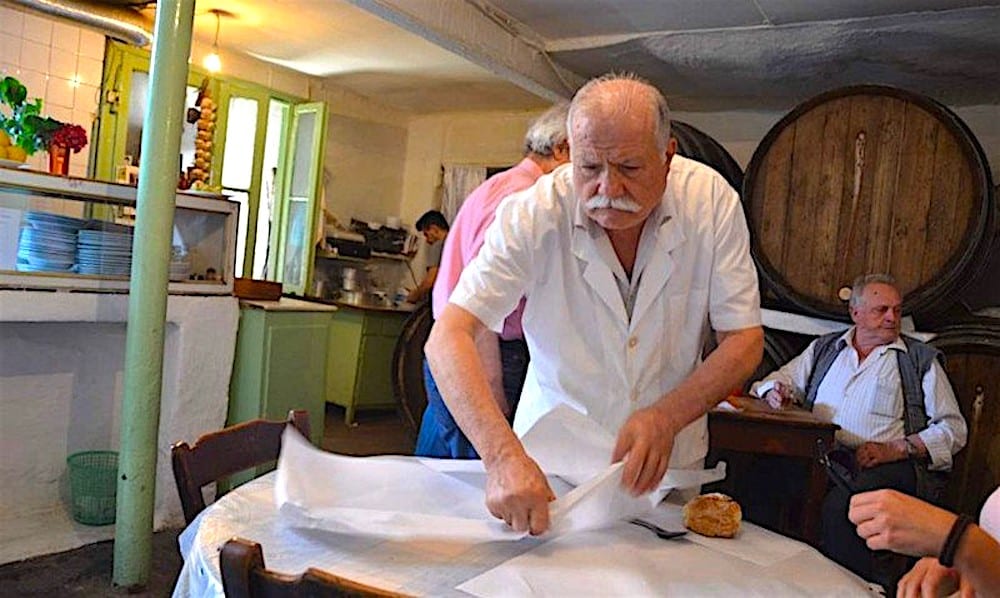
In the basements of Athens, away from the digital frenzy and neon signage of the modern city, a century-old institution, the koutouki, persists.
Koutouki is a cramped, subterranean tavern and remains the city’s most stubborn cultural stronghold. These “holes in the ground” are not merely eateries; they are historical sanctuaries where the Greek working class, and later its intelligentsia, forged a unique identity around the scent of pine resin and fried salt cod.
Anatomy of the koutouki

The term koutouki likely derives from the Turkish kütük, meaning “log” or “block of wood,” a reference to the heavy wooden barrels that define its interior. Architecturally, the koutouki is an exercise in minimalism. These establishments are found almost exclusively in basements or semi-basements, with low ceilings and scarce light provided by bare bulbs. Rickety tables are tightly packed together, creating an atmosphere of enforced closeness that feels quietly conspiratorial.
Massive wooden wine barrels line the walls, serving both as functional storage and as the venue’s silent sentinels. Within these spaces, social hierarchy dissolves. Construction workers, students, and executives sit side by side on the same woven rush chairs, drinking from the same thick glass tumblers. In a koutouki, the primary commodity is not food but communal equality.
A century of crisis and chords

The history of the koutouki is a chronicle of modern Greece’s social upheavals. Its evolution was accelerated by two major events:
1. The 1922 Refugee Crisis
Following the Asia Minor Catastrophe, refugees flooded mainland Greece, bringing with them a culture of meraki (passion) and music. In shantytowns like Drapetsona and Kokkinia, basements became the first hangouts.
Initially operating as tekedes (hashish dens), they transitioned into wine-centric koutoukia when the Metaxas dictatorship cracked down on illicit substances in the 1930s. This era gave birth to rebetiko—the “Greek blues.” Icons like Markos Vamvakaris sang their sorrows in these underground spaces, their bouzouki notes echoing off bare stone walls.
2. The Post-War “Bakalotaverna“
After WWII, the koutouki entered its “Golden Age.” During the poverty-stricken 1940s and 50s, many grocers converted their storage rooms into small taverns. By day, they sold legumes and oil; by night, they served wine and olives to neighbors. This hybrid, known as the bakalotaverna (grocery-tavern), solidified the koutouki’s place as the affordable entertainment of the people.
Gastronomy of necessity

The koutouki menu is rarely written out anywhere for patrons to see, relying instead on oral tradition and the availability of the day. The cuisine is a study in transforming humble ingredients into art:
The Retsina: This is bulk wine drawn straight from the barrel. Known as “amber,” its sharp pine resin flavor is the defining taste of the Athenian underground.
Bakaliaros skordalia: The “national dish” of the basement—crispy fried salt cod paired with a potent garlic dip.
Legumes: Fava and gigantes (giant beans) are slow-cooked until they reach a creamy consistency.
As Athens modernizes at a rapid pace, the koutouki remains a living organism rather than a museum of folklore. It stands as a final act of resistance against the fast and impersonal nature of contemporary life.
These basements prove that history is not just found in textbooks but is written every night in the circular wine stains left on a wooden table.


