Ancient Greek sculpture is regarded by many as the pinnacle of fine art over the past 2,500 years, with iconic statues that continue to captivate admirers to this day.
During the commonly accepted Golden Age of Greek art, from about 450 to 400 BC, most of the innovation in artistic techniques and theories took place within this relatively short period. Polykleitos of Argos (also Polyclitus or Polycletus) was the sculptor who established the principles that shaped many of the masterpieces of that glorious era.
The Golden Age marked a time when artists sought to refine their techniques, experimenting with science and mathematics as tools to enhance realism in their works. This represented a departure from the more primitive and rigid creations of the 6th century BC. By the 5th century, sculptures had become more fluid, naturalistic, and expressive.
To achieve this, Ancient Greek artists developed systems designed to capture an idealized version of nature—one that appeared both realistic and believable. They created mathematical systems of proportion, the most famous of which was Polykleitos’ Canon, a set of rules for crafting the ideal human figure that later inspired countless other works of art.
Polykleitos believed that his system provided the closest possible representation of perfection, using these mathematical proportions as fundamental principles in both the creative process and execution of a work. Sculptors began depicting gods through a lens of logic and harmony, employing symmetry to achieve perfect balance and order in their figures. This pursuit of symmetry, proportion, and motion gave rise to statues that appeared both structured and alive, embodying the Ancient Greek ideal of beauty and harmony in the art of sculpture.
Ancient Greek sculpture in the Golden Age
The Ancient Greeks were innovators in the academic fields of geometry, mathematics, and literature. They also excelled in the arts, and the first great philosophers and founders of Western thought were likewise Greek. They believed that to be a complete individual, one had to possess knowledge across all these disciplines.
In Ancient Greece, children were educated in a broad range of subjects. Philosophers studied science and mathematics, as did artists. The Greeks believed that art could not exist without an understanding of mathematics and science, which they incorporated into their creative works. Ancient Greek sculptors flourished during the Classical period (5th–4th century BC), with the middle phase of this era—roughly 480–330 BC—referred to as the Mature Classical period.
The most celebrated style of this period, known as High Classical, emerged during the 5th century BC. It became the standard of excellence, highly referenced and copied in later art movements. Artworks from the High Classical period are often seen as the pinnacle of Greek artistic achievement, a testament to balance, proportion, and idealized beauty. This era, known as the Golden Age of Ancient Greek sculpture, was also the time when the great sculptor Polykleitos created his majestic works, setting the standards for artistic perfection.
The Polykleitos Canon in Ancient Greek sculpture
One sculptor in particular is credited with pioneering many of these techniques—Polykleitos, who formulated a canon that came to serve as the artistic standard in Ancient Greek society. Polykleitos lived and worked in the 5th century BC, alongside other renowned sculptors such as Pheidias, Praxiteles, and Myron. According to Plato and Pausanias, he was a native of Argos, while later writers such as Pliny the Elder and Cicero claimed he was born in Sicyon, a city not far from Argos in the Peloponnese.
He was one of the most influential masters of Greek sculpture and theory, and is now considered one of the greatest sculptors in the history of art. His ideas and theories have been followed by other sculptors, and he is known for his lost treatise, the Canon of Polykleitos. However, his ideas have been transferred through his followers and admirers and applied by his contemporaries and future sculptors.
The canon was a scientific system of proportion, symmetry (Greek: συμμετρία), and idealization using mathematics and science to produce works that he believed to be the manifestation of beauty and perfection. Many scholars have since debated what exactly Polykleitos’ intentions in creating his statues were. He believed that by using his system of work, the ideal representations of nature would be possible. His system, which applied to the human body, was composed of two elements: symmetry and proportion. Modern scholars and art historians regard these as Polykleitos’ most radical yet effective techniques, which went on to become central principles in later art theory.
Polykleitos used symmetry to harmonize and balance his figures. Art historian and Yale professor Jerome Pollitt states, “The symmetry concept is an aspect of one of the most deeply rooted and abiding features of ancient Greek thought, both artistic and philosophical.” The idea of perfection and harmony was a strong aspect of Greek culture; Polykleitos explored these ideas further than other artists. He was the first to write them all out in a treatise on sculpture for others to follow.
The Doryphoros

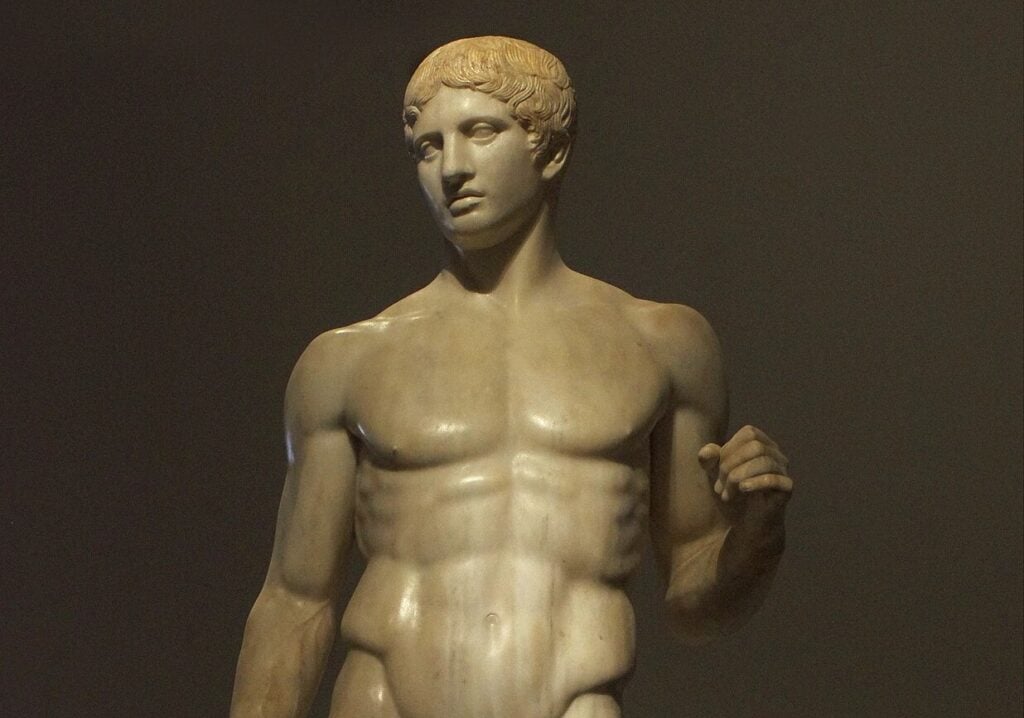
Polykleitos’ concept of symmetry held that all parts of the body needed to be in harmony, with measurements in proportional unity. Most scholars consider the Doryphoros (Spear Bearer) to be the embodiment of the Canon of Polykleitos. This statue of a standing young male, with his weight shifted onto one leg and originally holding a spear—now lost—is regarded as the pinnacle of Polykleitos’ work.
In The Ancient View of Greek Art: Criticism, History, and Terminology, Jerome Pollitt writes, “Polykleitos is recorded to have been a kind of display piece made as an illustration of Polykleitos’ Canon.”
Furthermore, American classical scholar and archaeologist Emily Vermeule remarked of the Doryphoros, “This statue survives to give a new breadth and meaning to the career of a sculptor who must be ranked among the ten greatest artists in history.”
Vermeule elaborated:
“The relaxation and tension of the standing walking pose, the sound construction of the frame, and the proportions of five parts for the body to one part for the head were all taken by the ancients as an indication that sculptors had introduced a new level of science into their art.”
Kenneth Lapatin, Curator of Antiquities at the J. Paul Getty Museum, observed:
“Polykleitos has broken down the motor capabilities of the body into a series of opposites for the purpose of schematic and clear exposition. The natural bilateral symmetry of the body allows him to compare and contrast left/right, bent/straight, and so on…”
Through this celebrated statue, Polykleitos demonstrated the dexterity and potential movement of the human body, achieving a more believable sense of motion. The technique of shifting a figure’s weight onto one leg is called contrapposto, or “counterbalance.” Using contrapposto, Polykleitos emphasized the bilateral symmetry already present in the human body, producing statues that were far more lifelike and natural than the rigid and stiff figures of the 6th and 7th centuries, such as the Kouros.
In search of perfection in Ancient Greek sculpture
By combining the theories of harmony and symmetry in an attempt to approach perfection, Polykleitos developed a system of proportions firmly grounded in science and mathematics. John Griffiths Pedley, Professor Emeritus of Classical Archaeology and Greek at the University of Michigan, wrote of Polykleitos’ work: “These proportions were thought to depend on the symmetria (commensurability) of the various body parts.”
Using mathematical or geometrical proportions and the visible harmony of counterbalancing forces, arranged in a chiastic scheme according to symmetria, Polykleitos achieved his goal. He applied precise measurements so that the body was proportional to the head, ensuring that all parts would be in correct relation to one another—arms, legs, torso, and so on.
Polykleitos harmonized these techniques to conceptualize symmetry, proportion, and ultimately perfection. For the Ancient Greeks, this represented the manifestation of true beauty, often expressed through an idealized male figure. Beauty was the ultimate principle of Polykleitos’ Canon.
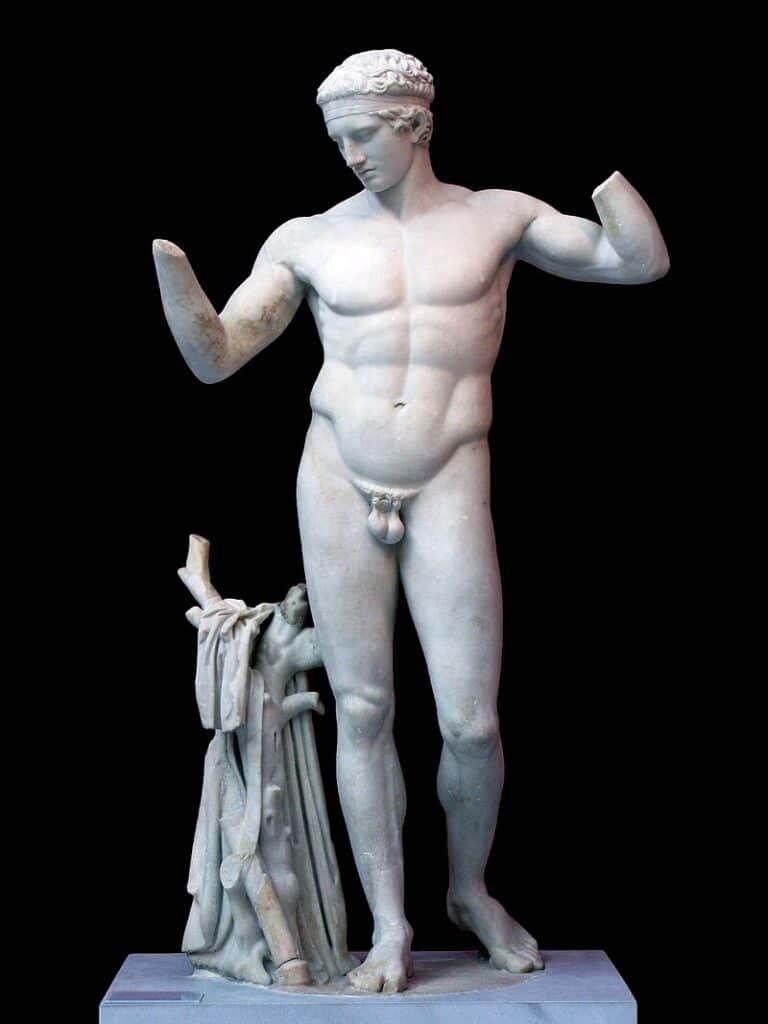
Another of his works, the Diadoumenos, is also said to embody his canon. This statue depicts an athletic male figure, rendered with more grace and refinement than the Doryphoros but following the same ideals of proportion and harmony. Both the Doryphoros and the Diadoumenos feature young, idealized male nudes representing athletic types. For many scholars and art historians, these figures illustrate the Ancient Greek pursuit of beauty and perfection, and classical Greek sculpture of the Golden Age is widely regarded as the embodiment of this ideal.
Influence of Polykleitos
Polykleitos sought to combine the scientific and artistic qualities of sculpture, integrating the theoretical and practical aspects of proportional symmetria. However, it was Praxiteles, the famous sculptor of the Late Classical period, who fully realized this approach. While heavily influenced by Polykleitos, Praxiteles did not simply copy him; he adapted Polykleitos’ techniques to create a new level of realism. By his time, art had shifted toward a more emotional aesthetic, emphasizing expressive qualities alongside intellectual ideals.
Pliny observed: “Many artists used the Canon, but not until Praxiteles does an artist use philosophy along with proportions to represent the human form intended by Polykleitos.”
Emily Vermeule notes: “The Praxitelean vision of the softened human form is, in a greater arc of its surroundings, developed out of the Diadoumenos and other mature experiments of Polykleitos.” Praxiteles’ Hermes and the Infant Dionysus closely follows the techniques of Polykleitos’ Doryphoros, the primary difference being that Hermes holds the infant Dionysus rather than a spear. The posture and proportions remain nearly identical.
Yet, Praxiteles’ statue is even more lifelike and dynamic than that of Polykleitos. He renders Hermes with sensuous flesh, detailed musculature, and a naturalistic form, giving the figure a warmer, more humane quality compared to the polished marble idealism of Polykleitos.
Another example of Polykleitos’ influence is Praxiteles’ Venus of Arles. The goddess of love is rendered in perfect proportions and a contrapposto pose, but the figure is more sensuous than anything in Polykleitos’ work. The female form, while idealized, appears more lifelike and human, illustrating Praxiteles’ emphasis on emotional expression.
In later centuries, artists continued to combine the theoretical principles of Polykleitos with practical techniques to give sculpture realistic and emotionally resonant qualities. Polykleitos’ ideals of symmetry, proportion, and balance were transformed to address the emotional and expressive dimensions of the human form, which artists recognized as essential to compelling art.