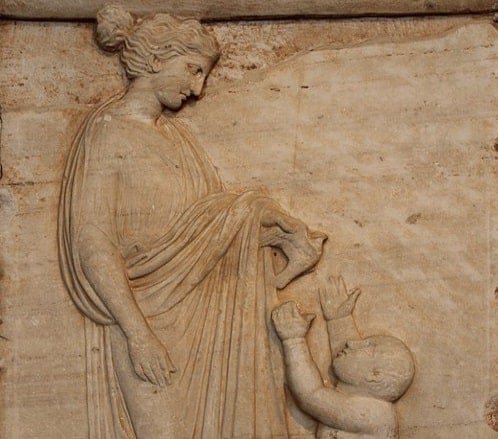

The funerary stele of Mnesagora and Nikochares, an ancient Greek marble relief from Vari, near Athens, dating to circa 420–410 BC, is a stunning example of classical art.
It is housed in the National Archaeological Museum of Athens and depicts a touching and tragic scene that has captivated historians and art lovers alike.
The relief depicts a young girl standing on the left, possibly Mnesagora, gently extending a bird toward a kneeling infant boy, likely Nikochares, on the right. The inscription on the stele, written in Ancient Greek, commemorates the deceased siblings.
“Mnesagora, daughter of Nikochares, and Nikochares, son of Nikochares. This stele is set up by their father, in memory of his beloved children.”
The girl’s expression is calm and affectionate, while the baby eagerly reaches up, adding a sense of warmth and innocence to the scene. The tender interaction between the two children captures an innocent moment, yet it is imbued with sorrow, as the accompanying epigram reveals that the siblings died together, making the scene even more poignant.
In Greek funerary art, birds often symbolize the soul’s departure from the mortal world. Here, the act of offering the bird may represent a final farewell or an attempt to comfort the younger sibling in death.

Ancient Greek funerary stele of the siblings’ untimely death
The epigram inscribed on the stele offers a heartbreaking glimpse into their untimely deaths and the grief of their parents. The parents, in their profound sorrow, commissioned the stele to honor their children’s memory and preserve a visual record of their lost lives.
This memorial, like many funerary sculptures of the time, sought not only to commemorate the deceased but also to convey the deep emotional impact their passing had on their family.
Athenians practiced elaborate funerary customs, believing in honoring the dead to ensure their peaceful passage to the afterlife. During this period, grave stelae became more personal and emotionally expressive. The shift from earlier, rigid figures to more lifelike and tender compositions reflects the growing focus on individual identity and familial bonds.
Unlike earlier Archaic stelae, which featured idealized, frontal depictions of the deceased, Classical stelae showed more natural poses and interactions, as seen in the Vari stele. The emphasis on intimacy and sorrow aligns with contemporary Athenian values, where the oikos (family unit) was central to society.
This stele is more than just a piece of funerary art—it offers a window into Athenian society, revealing how family, grief and artistic expression were deeply intertwined. Its survival allows modern audiences to connect with the human emotions and experiences of the past, reminding us that love and loss transcend time.
Related: Greek Funeral Customs, From Ancient Times to Today