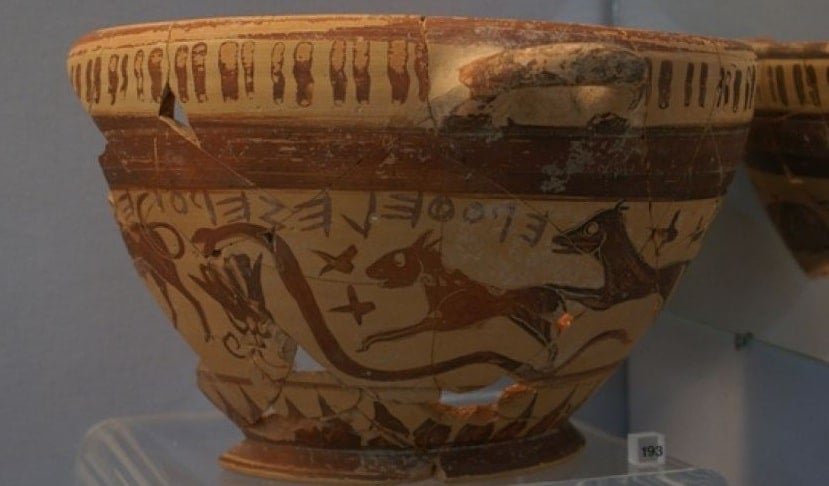
For decades, a fractured clay wine cup sitting in Greece’s Lamia Archaeological Museum was regarded as just another example of “Orientalizing” art—a common 7th-century BC style featuring rows of exotic animals.
However, a revolutionary analysis by researcher John Barnes has transformed this humble vessel, known as a skyphos, into one of the most significant scientific artifacts of the Archaic period.
The cup, which dates back to 625 BC, was unearthed near the acropolis of Halai. Halai (or Halae) was an important coastal town and harbor. Its ruins are located at the modern seaside village of Theologos in the region of Phthiotis, Central Greece.
While nearly a third of the vessel is missing, the remaining fragments depict a curious menagerie: a bull, snake, rabbit, scorpion, dolphin, two dogs, and the front half of a lion. To the untrained eye, it looks like a standard hunting scene. To Barnes, it looked like the night sky.
Reading the “wrong” patterns
Barnes’ breakthrough came from noticing “errors” in the art that made perfect sense in astronomy. In traditional Greek pottery, animals are usually grouped by habitat—lions with bulls or dogs chasing hares.
On the Halai skyphos, however, the grouping is atypical. A dolphin, a sea creature, sits inexplicably among land predators. A scorpion, a motif rarely used in this era except on shield emblems, occupies a prominent position.
“My dad raised me on astronomy,” Barnes noted during his research. “To me, the snake, rabbit, and dog together looked like constellations.” Specifically, he identified them as Hydra, Lepus, and Canis Major. Their positioning on the cup mimics their orientation in the celestial sphere, with the “snake” (Hydra) stretching beneath the “dog” and “rabbit.”
A seasonal timekeeper
The analysis suggests the cup functioned as a seasonal calendar. The animals are not arranged as a single snapshot of the sky but in clusters representing the four seasons:
- Winter: Represented by the dog, rabbit, and snake
- Summer: Represented by the lion and dolphin
- Autumn/Spring: Likely occupied the missing third of the cup, where Taurus (the bull) and Scorpius (the scorpion) bridge the transitions
The significance of the star map on the Greek vessel
This discovery pushes back the timeline of Greek astronomical sophistication. Previously, historians believed the Greeks adopted a formal system of constellations from the Babylonians much later, around the 5th century BC.
If the Halai skyphos is indeed a star map, it proves that “everyday” Greeks were already tracking the seasons through a complex celestial shorthand as early as the 7th century BC.
As the Archaeological Museum of Lamia continues to showcase the piece, it serves as a reminder that ancient “decor” often hid profound scientific data. The Halai skyphos wasn’t just for wine; it was a way to hold the entire year in the palm of one’s hand.