Archaeologists have traced the origins of what may have been the deadliest weapon of the Bronze Age — the composite bow. A new study, led by Gabriel Šaffa and published in the Journal of Archaeological Method and Theory, challenges long-held beliefs about when and where this revolutionary weapon first appeared.
The findings reveal that the composite bow, famed for its power and precision, was a late innovation of the Bronze Age, not an early one as previously believed.
The rise of a deadly innovation
For centuries, the bow and arrow were humanity’s most powerful ranged weapons. But the composite bow — built from layers of wood, horn, and animal sinew — transformed warfare. Its compact design packed enormous strength, sending arrows farther and with greater force than simple wooden bows.
Šaffa’s research indicates that this technology did not emerge in multiple regions, contrary to earlier theories. Instead, it appeared only once — most likely in the Near East — around the early second millennium BCE. From there, it spread rapidly across Eurasia, reshaping how ancient armies fought and conquered.
Rewriting history
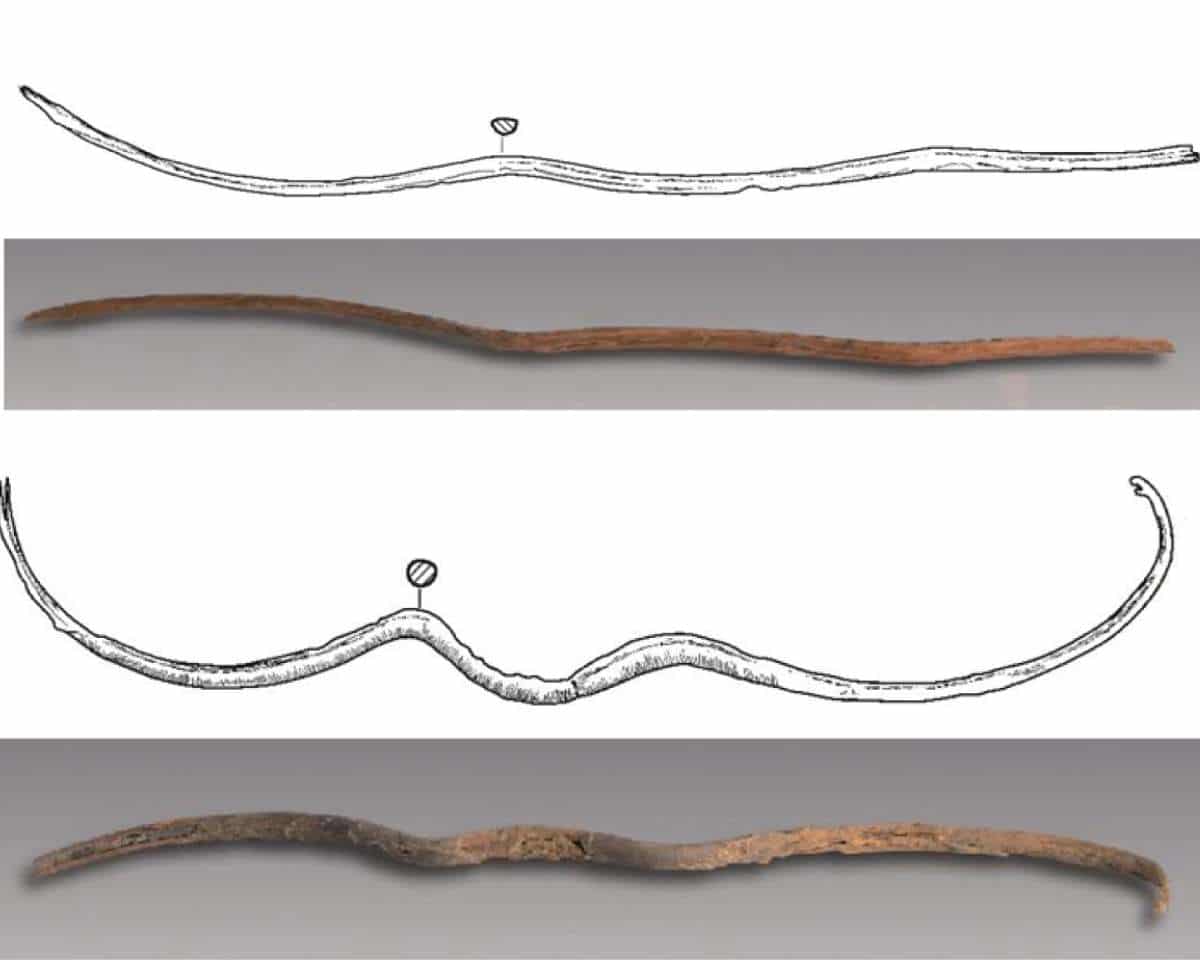
Until now, many archaeologists believed that early versions of the composite bow existed as far back as 3300 BCE. However, Šaffa’s review of artifacts and ancient art suggests otherwise. Many bows previously thought to be composite were actually self bows — single-piece wooden bows shaped into a curved, double-convex design.
These bows were impressive, the study explains, but they lacked the layered construction that made later composite bows so deadly. The research team combined archaeological, genetic, and iconographic data to show that true composite construction — wood, horn, and sinew bonded with glue — only appeared in the Late Bronze Age, around 1600 BCE.

Born in the age of chariots
The study links the weapon’s emergence to other technological milestones — the rise of spoke-wheeled chariots, horse domestication, and bronze metallurgy. These breakthroughs transformed ancient societies, and the composite bow fit perfectly into this new world of fast-moving warfare.
The first known composite bows were found in Egypt’s Theban necropolis, including examples buried with Pharaoh Tutankhamun around 1300 BCE. These bows, though discovered in Egypt, likely came from northern regions such as Syria or Anatolia. Their distinct “angular” shape — bending sharply at the grip — marked a major leap in design and efficiency.
Egypt may have adopted, not invented, the composite bow, the study explains. Its roots almost certainly lie in the Near East, where chariot warfare first evolved.
A weapon that conquered continents
Once developed, the composite bow spread fast. Indo-Iranian groups played a crucial role in carrying the technology across the vast Eurasian steppes. By 1200 BCE, it had reached China’s Xinjiang region, where archaeologists later uncovered more than a hundred ancient examples in the Yanghai cemetery — the largest known collection of composite bows in the world.
These bows, preserved in the region’s dry climate, show how the technology evolved. Early designs mirrored Egyptian styles, while later ones grew more sophisticated and asymmetrical — with one limb shorter than the other, better suited for mounted warfare.
The study suggests that the movement of horse-riding cultures from the Near East through Central Asia drove the rapid spread of the weapon. The Andronovo and Srubnaya cultures, early Indo-Iranian groups, likely acted as key transmitters.
The Scythian refinement
By the Iron Age, the composite bow had reached its peak form among Scythian warriors. These nomadic horse archers of the Eurasian steppes, active between 900 and 300 BCE, refined the bow into a compact, curved weapon ideal for shooting from horseback. Their distinctive double-bent design became the symbol of steppe warfare — powerful enough to pierce armor and small enough to handle while riding at full speed.
Depictions of Scythian archers on Greek pottery and in Central Asian burials confirm its widespread use. Later civilizations — from Persia to China — adopted variations of this same design, keeping the weapon dominant until the rise of firearms more than two millennia later.
A single origin, a global legacy
Šaffa’s work overturns decades of speculation about multiple origins for the composite bow. Instead, he argues for a single birthplace and an extraordinary story of diffusion, one that mirrors the spread of other Bronze Age innovations like the chariot and the domesticated horse.
The study also dispels the notion that early Indo-European groups, such as the Yamnaya, used composite bows. Evidence shows they relied on wooden self bows. Only later Indo-Iranian cultures mastered and advanced the composite design, leading to the powerful Scythian form.
Looking ahead
Šaffa calls for further interdisciplinary research, combining archaeology, linguistics, and even genetic data, to better trace how the composite bow traveled across ancient networks. Future studies, he says, could use cultural phylogenetics — a method borrowed from evolutionary biology — to model how technologies like the composite bow evolved and spread.
For now, his findings reshape our understanding of ancient warfare. The deadliest weapon of the Bronze Age — born from the fusion of wood, horn, and sinew — was not the product of many cultures but of a single breakthrough that changed the course of history.