
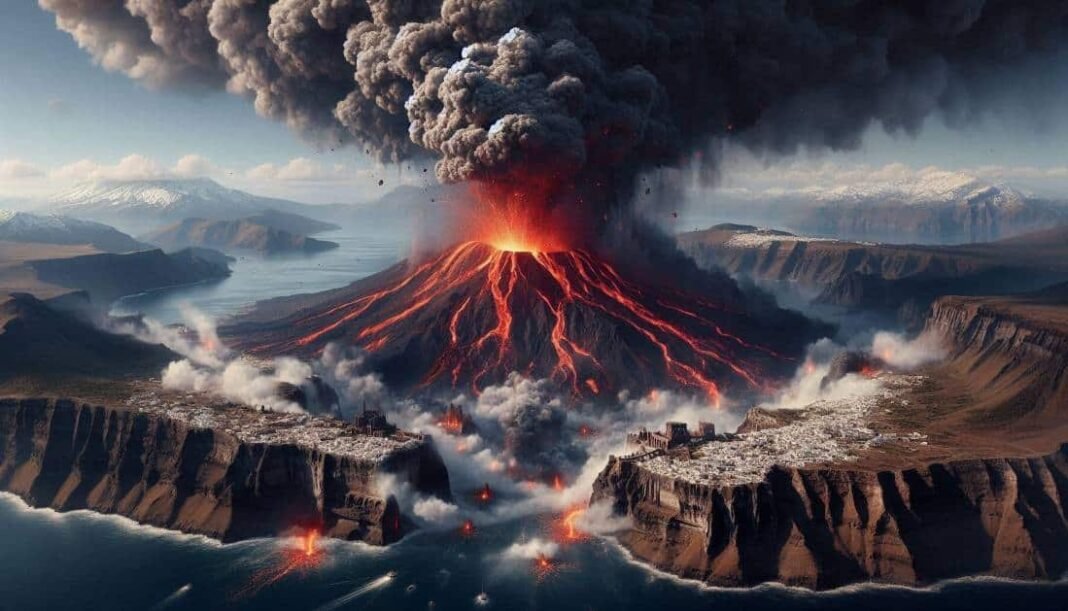

The long-debated timing of the Santorini (Thera) volcano eruption and its suggested link to Egyptian Pharaoh Ahmose has taken a sharp turn. A new radiocarbon study led by researcher Hendrik J. Bruins reports that the Bronze Age volcano blasted the Aegean decades before the rise of Nebpehtire Ahmose, the pharaoh often tied to the disaster.
The findings, published in PLOS One, challenge the long-held idea that the Santorini eruption influenced Egypt during the early 18th Dynasty.
Volcanic disaster reshaped the ancient Aegean
The eruption, also known as the Thera event, was one of the largest in the Holocene. It buried the Minoan town of Akrotiri under deep ash and sent tsunamis into Crete and the eastern Mediterranean. For years, scholars tried to match this catastrophe with Egyptian records, especially the so-called “Tempest Stela” of Ahmose. Some argued that the stela described fallout from the Santorini disaster. But solid evidence was missing.

Researchers test Egyptian objects from the dynasty shift
Bruins and colleagues approached the question from the ground up. They focused on radiocarbon testing of Egyptian objects tied to the transition from the 17th to the early 18th Dynasty. That period marks Ahmose’s rise and the reunification of Egypt after the Hyksos rule. Until now, few items from this era had been dated with high-precision scientific methods.

Researchers analyzed three groups of artifacts: a stamped mudbrick from Ahmose’s temple at Abydos, a linen burial cloth linked to Queen Satdjehuty, and six wooden shabtis collected in Thebes by Flinders Petrie. The team then compared these dates with high-quality radiocarbon measurements taken from sites hit directly by the Santorini eruption, including Akrotiri, an olive branch on Thera, and tsunami deposits at Palaikastro in Crete.
Mudbrick links Ahmose’s building works to later dates
The key object was the mudbrick stamped with Ahmose’s throne name. It contained a rare intact fragment of straw, likely added during brickmaking in his reign. Radiocarbon testing placed the straw around 3230 years before present.

After calibration, the highest-probability age centered around 1500–1470 BCE. That timing matches a late date for Ahmose’s rule, not an early one. It also places the brick’s creation near year 22 of his reign, when his building projects at Abydos were underway.
In contrast, radiocarbon samples from the Santorini eruption were consistently older—around 3340 years before present. Seeds from the volcanic destruction layer at Akrotiri, tree rings from the Thera olive branch, and bones from the eruption-driven tsunami all delivered nearly identical dates. Their combined average shows the eruption occurred earlier than the late 17th Dynasty, well before Ahmose’s rise.
Burial linen and shabtis support an earlier eruption
The linen burial cloth associated with Satdjehuty told a similar story. Its radiocarbon age was even older than the mudbrick. The date suggests the cloth belonged to the 17th Dynasty or earlier, raising questions about whether the textile was reused or whether Satdjehuty died sooner than long assumed.

The wooden shabtis added another line of evidence. Three of the six dated figures fit squarely within the 17th Dynasty. Two others, including one linked by name to a known official under Ahmose, matched the early 18th Dynasty. All were younger than the eruption layer from Santorini.
Study confirms the eruption predates Ahmose’s reign
Taken together, the results show a clear pattern. The Aegean volcano erupted before Ahmose’s time. The event cannot be placed within his reign and did not trigger the storm described on the Tempest Stela. Instead, the eruption belongs in the murky Second Intermediate Period, a turbulent era that predates Egypt’s reunification.
Bruins’ findings also reinforce a “low chronology” for the start of the New Kingdom, aligning with genealogical studies from the El-Kab region. Those records had suggested that Ahmose ascended the throne later than some traditional chronologies proposed.
The study marks the first direct radiocarbon comparison between Egyptian objects from this dynastic transition and the volcanic material from Santorini. Its conclusion is firm: the catastrophic Minoan eruption did not occur during the lifetime of Pharaoh Ahmose. It happened earlier—and its shockwaves never touched the founding years of the 18th Dynasty.


