


The remarkable legacy of Saint John the Russian continues to thrive in Greece, where his revered relics are enshrined in a church in Evia. His memory is commemorated annually on May 27, a significant date for Orthodox Christians.
His feast day remains an important religious observance, drawing pilgrims and faithful from across the country to his shrine on the Greek island.
Born around 1690 in Little Russia (modern-day Ukraine), Saint John came from an Orthodox Christian family. His life took a dramatic turn during a war between Russia and the Ottoman Empire when he was captured and sold into slavery. John’s journey led him to Prokopion in Cappadocia, Turkey, where he served as a captive under a Turkish aga.
The life of Christian captives during this period was exceptionally harsh, often involving brutal torture to force them to renounce their faith. Prokopion was notoriously home to a military camp of the Janissaries, known for their extreme cruelty. Despite being a young, beardless man, John was subjected to the same terrible torment. Yet, even at a tender age, his unwavering faith shone through, inspiring fellow believers and, remarkably, gradually softening the hearts of his captors.
The unwavering faith and asceticism of Saint John the Russian
John lived in the Turkish aga’s stable, finding solace and spiritual strength in the humble surroundings. He drew parallels between his own life and that of Christ in the Bethlehem manger, transforming a corner of the stable into his “small paradise” where he spent all his free moments in prayer. The more brutal his daily life became, the stronger his faith grew.
He embraced an ascetic lifestyle, dedicating many nights to vigils and his days to strenuous labor. Beyond his personal spiritual discipline, John actively helped the unfortunate and sick within his Christian community, who were enduring immense suffering at the time.
His profound dedication and kindness slowly began to melt the hearts of the aga and his wife. Impressed by his character, they even offered him a more comfortable room with hay, which John, in his profound modesty, respectfully declined, preferring his “small paradise” in the stable.
Miracles and the Aga’s transformation
John the Russian’s unwavering faith, meekness, humility, and kindness did not go unnoticed by his “masters.” The aga and his wife gradually witnessed blessings in their own lives, and the aga even openly attributed his newfound wealth to the presence of the devout young man.
A pivotal moment occurred when the aga embarked on a pilgrimage to Mecca. Back at home, as pilaf, a favorite dish, was being served, the aga’s wife, concerned for her husband, asked John to pray for him, wishing her husband could partake in the meal. John, who was serving dinner, astonishingly asked for a plate of pilaf, stating he would send it to his master in Mecca. The guests at the table naturally reacted with laughter, but the aga’s wife, perhaps out of a glimmer of curiosity or respect for John, instructed the cook to give him a plate. John then withdrew to his stable corner, prayed, and to everyone’s astonishment, the plate vanished.
The true “melting of hearts” transpired upon the aga’s return from Mecca. He carried with him the very same metal plate, engraved with his wife’s initials, that she had given to John. He recounted how, in a locked room in Mecca, a full plate of his favorite dish had mysteriously awaited him. Both the aga and his wife, having witnessed such undeniable proof of John’s firm faith and ability to work miracles, recognized him as a righteous man who had found favor with God.
Despite his newfound status and the aga’s respect, John continued to refuse a move from the stable, remaining steadfast in his commitment to his ascetic life of prayer and faith. He passed away on May 27, 1730, at approximately 40 years old, after a severe illness. At the aga’s request, John was buried according to Christian customs, with the aga himself providing a costly outfit for his burial.
The enduring legacy in Greece
Following John’s death, reports emerged of a mysterious light appearing at his grave. The saint himself appeared in a dream to his spiritual father, instructing that his body be moved. The local Christian community transferred the relics of Saint John the Russian to the Church of Saint George in Prokopion, where they remained until 1924.
A significant event in modern Greek history, the population exchange between Greece and Turkey in 1923 (following the Greco-Turkish War), led the Greek Christian community to bring the precious relics of their beloved saint with them to Evia, Greece.
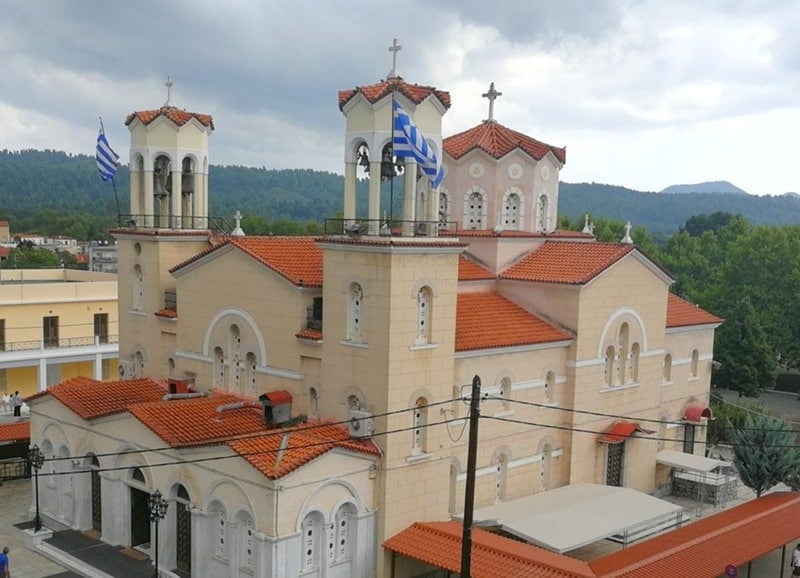
In a gesture of remembrance and continuity, a new settlement was established and named Neo Prokopion (New Prokopion), after his original hometown. A grand church was built there to house his relics, and since then, Saint John the Russian has been venerated and celebrated in Greece with profound devotion.
Saint John the Russian’s life story is a powerful testament to enduring faith, humility, and the ability to inspire change, even in the most challenging circumstances.


