

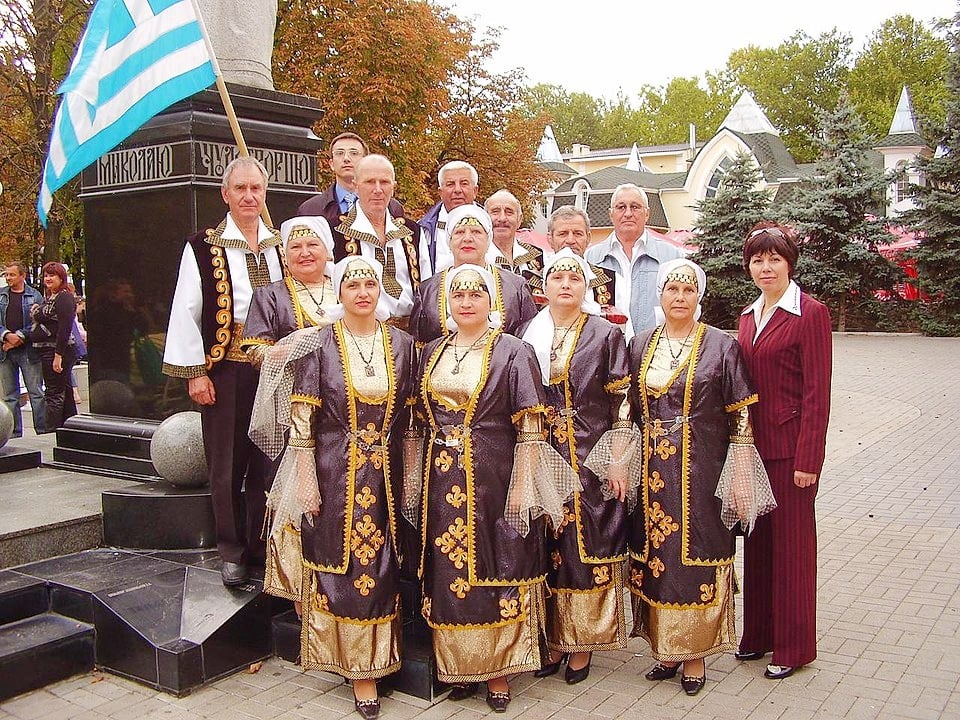
What usually comes to mind when we think of Greek culture is the sun-drenched architecture of white houses clinging to cliffs over the Aegean Sea, but in Mariupol, Ukraine, a very different side of Greek heritage thrives far from the borders of the modern Greek State.
For generations, the Greek communities around the Azov Sea, especially in Mariupol, have preserved an incredibly ancient form of their language. It is called Rumeika, derived from the Turkish “Rum,” the term the Ottomans used for the Greek descendants of Byzantium (Eastern Roman Empire)—the Romioi, or Romans. Hearing it is like catching a ghost from the northernmost reaches of the medieval Byzantine world, known at the time as the Eastern Roman Empire.
This Greek dialect is resilient and still alive, a blend of Medieval Greek with Slavic influences, and a touch of Turkic elements woven in over the centuries.
The Greek language of Mariupol, stuck in time
To understand how Rumeika, this unique dialect of the Greek language, ended up in Mariupol, we need to rewind to the fall of Byzantium. When Greek settlers fled the collapsing Empire to the Crimean Peninsula, they carried with them a late-medieval version of their language. While Greek in the Peloponnese and Athens evolved over the centuries into what we now call modern Greek, Rumeika largely froze in place.
Linguists find this remarkable because the dialect has preserved sounds that disappeared elsewhere in the Greek-speaking world. For example, a Rumeika speaker in Mariupol today says “zou” for “I live,” instead of the standard “zo” (ζω). On paper, it seems like a minor difference, but these subtle quirks are the literal fingerprints of a community that maintained its Greek identity despite centuries of isolation and life under Ottoman and Russian rule.
The situation changed dramatically in the late 1700s, when Catherine the Great resettled thousands of Greeks from Crimea to the Azov Sea. Suddenly, Rumeika speakers found themselves living alongside the Urum Greeks. The Urum were devout Orthodox Christians with a strong sense of Greek identity, yet their spoken language was Turkic, creating a fascinating cultural and linguistic intersection.

This massive movement of people resulted in a vibrant, ever-changing environment where everyone constantly switched between languages just to get by. Over time, Slavic words naturally crept into everyday conversation. Yet the core elements of the Rumeika dialect endured. A table remained a trapez, the village center was still the hora. The community learned to navigate life within the Russian Empire and later the Soviet Union without losing the rhythm and character of their ancestral tongue.
Keeping Rumeika alive today is a steep challenge. For many years, Soviet standardization and the allure of urban jobs drew younger generations away from the dialect, favoring Russian or Ukrainian as a path to advancement—a familiar story for speakers of endangered languages everywhere.
What is especially notable is how the recent, devastating conflicts in the region have displaced countless families. Typically, when a community scatters, the language is the first casualty. For the Greeks of Mariupol, however, speaking words like kourtsits (girl) or singing the old songs during a Panagia festival has become a literal act of cultural survival. It is their way of affirming that their heritage has not been erased.

The situation in Mariupol today
Today, the reality for the Greek community in Mariupol is bleak. The city remains under Russian occupation following the 2022 siege and ongoing conflict. Although the active frontlines have moved several hours away, the wider war continues.
For the local Greeks, the consequences have been devastating. Before the invasion, the broader Azov region was home to over 100,000 people of Greek descent. Today, that once-vibrant diaspora has largely been dispersed. The vast majority have fled, seeking refuge in places such as Cyprus, Greece, or western Ukraine. Only a small, quiet fraction remains in the heavily monitored city, often compelled to adopt Russian passports just to survive and maintain their homes. The future of this remarkable community remains uncertain.


