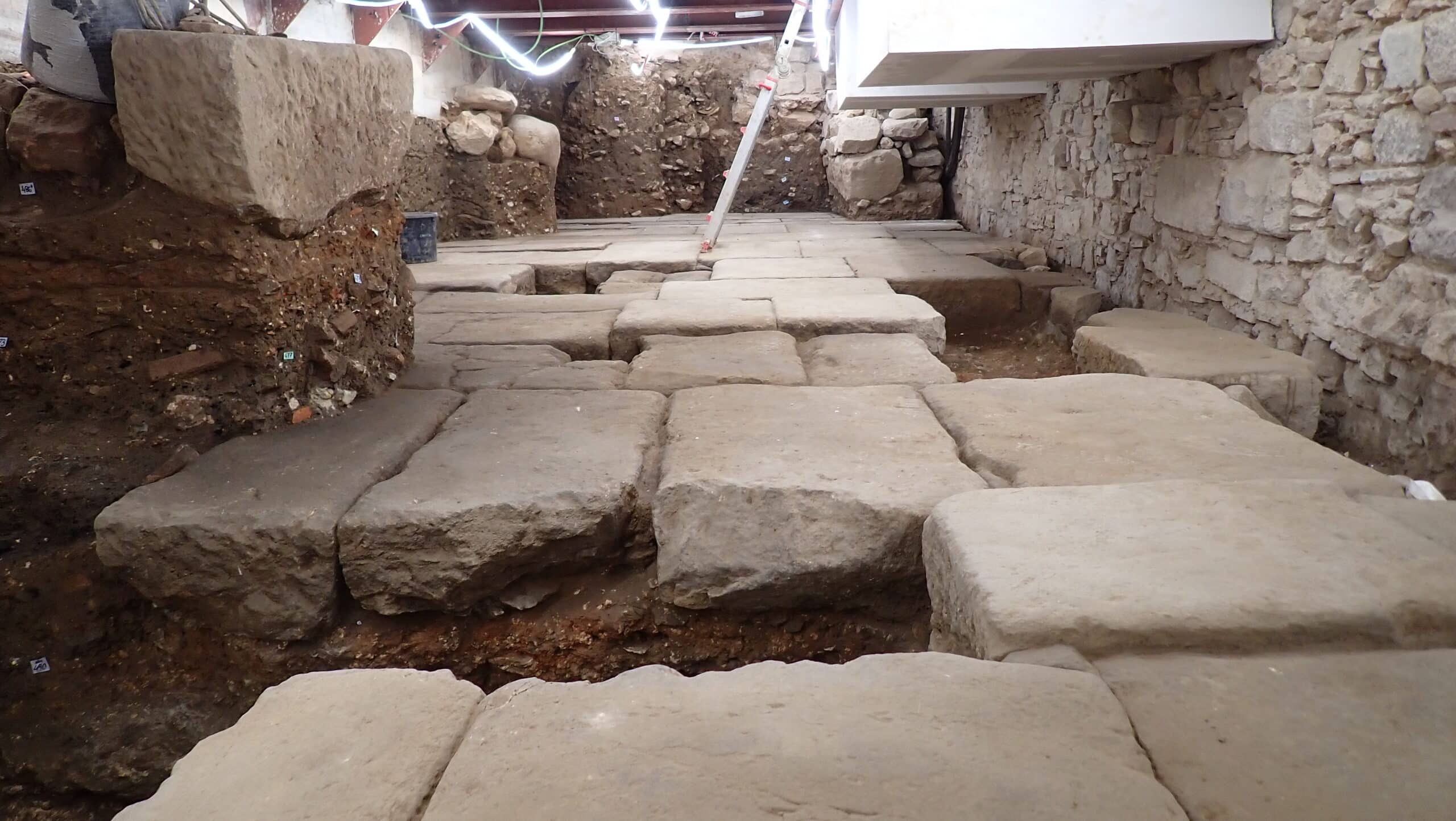
During work on a hotel expansion in Barcelona, Spain, archaeologists uncovered a monumental Roman stone pavement believed to have belonged to the forum, the civic center of ancient Barcino.
The discovery was made during construction at 3 Carrer d’Hèrcules, and the restored remains will be preserved in the building’s basement and opened for public visits.
The find was made during a more than two-year archaeological intervention at Casa Requesens, a Gothic property from the 14th and 15th centuries at Carrer d’Hèrcules 3 and Carrer d’Arlet 5. The work began in June 2023 and ended in July 2025.
Archaeologist Jordi Amorós of AGER Arqueologia led the excavation under the supervision of Barcelona’s archaeology service and Catalonia’s regional culture authorities.
Discovery of the Roman Forum in Barcelona
The project began as a preventive dig for a new elevator shaft measuring 6 square meters (65 square feet). At a depth of about 2.5 meters (8.2 feet), archaeologists found an unexpected stone pavement.
Because of the importance of the discovery, officials said the excavation area was expanded to 80 square meters (861 square feet). Grup Gargallo, the property owner, also changed the construction plan to preserve the remains and include them in the hotel project for public access.

The main find is a 42-square-meter (452 square feet) pavement made of large Montjuïc stone slabs dated to the founding period of the Roman colony, between 15 and 10 B.C. The slabs were laid in rows running northwest to southeast, parallel to the decumanus and in line with Barcino’s original street grid.
Researchers said it is the first pavement of this type found in the city and linked it to the forum because of its form and central location. They said it is still unclear whether it belonged to a public building or the open square itself.
Ancient pavement and hydraulic structures found
The pavement is bounded on the southeast by a substantial Roman concrete structure visible in the hotel courtyard. Next to it is another paved area with two square wells, each 2.6 meters (8.5 feet) deep, connected by a siphon.
Researchers said the setup points to a hydraulic system, possibly tied to a fountain or water management within the forum. More than 150 fragments of imported marble were also found.
Archaeologists said the discovery may change the accepted view of the Roman Forum, Barcelona, because the evidence suggests the space was aligned parallel to the decumanus rather than the cardo maximus. They said that it could reshape how scholars understand the layout of public space in Roman Barcino.
Later remains show the site was reused in late antiquity, the early medieval period, the Gothic era, and modern times. Finds from the dig also include imported ceramics, 58 coins, and a medieval grain silo with a capacity of 3,000 liters (793 gallons).