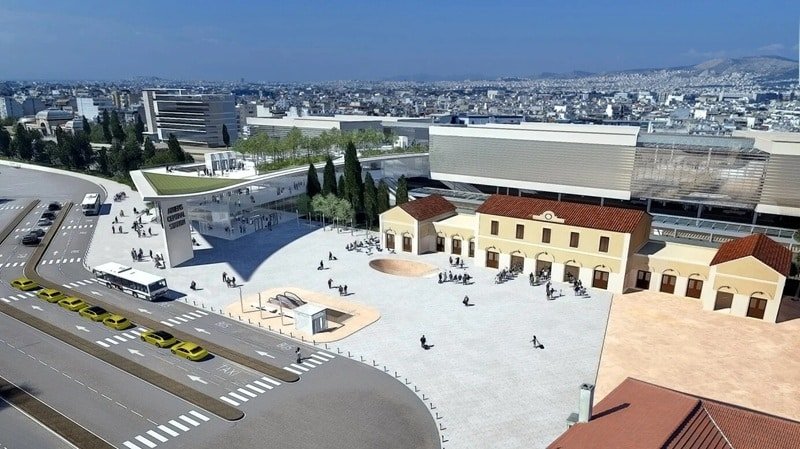
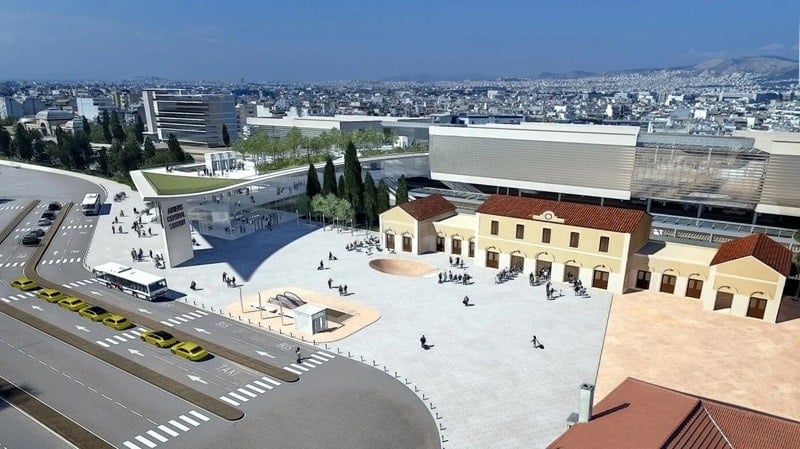
A major restoration project is underway to breathe new life into one of Athens’ most iconic landmarks: the Athens-Peloponnese Railway Station.
GAIAOSE, the state-owned company responsible for managing and developing the vast real estate portfolio of the Greek railway network, has announced a strategic three-phase plan to revitalize this historic structure, ensuring its transition from a decaying relic into a centerpiece of urban regeneration.
Athens-Peloponnese Railway Station: A journey through history
Located in the Metaxourgeio district, the Peloponnese Station stands as a testament to the “Golden Age” of Greek railways.
Originally designed by French engineers Alfred Rondel and Abel Gotteland, the station underwent a significant stylistic transformation by the renowned Saxon architect Ernst Ziller in the late 19th century.

Architecturally, the building is a neoclassical masterpiece with distinct Orientalist influences. It is famously a smaller-scale replica (with minor variations) of the Sirkeci Terminal in Istanbul—the legendary terminus of the Orient Express.
Inaugurated on June 30, 1884, the station served as the gateway to southern Greece for over 120 years. Its distinctive arched roof and elegant facades became synonymous with the arrival and departure of generations of travelers until it finally closed its doors on August 7, 2005.
Spanning 1,005 square meters, the building is legally protected as a “Work of Art” by the Ministry of Culture, recognized for its immense architectural and symbolic value to Greece’s industrial history.
The three pillars of restoration

To reverse years of wear and vandalism, GAIAOSE is implementing a comprehensive roadmap, starting with an “emergency surgery” for the building
The second phase involves an ongoing tender for a full suite of studies. These include architectural, electromechanical, and structural designs, as well as a landscape plan to transform the surrounding grounds. These plans are slated for submission to the Ministry of Culture in 2026.
The final phase focuses on the sustainable reuse of the building and its surrounding plots. This plan runs parallel to the redevelopment of the neighboring Athens Central (Larissa) Station. A major highlight of this phase is a traffic study proposing a new pedestrian bridge to reconnect the neighborhoods divided by the railway tracks.

Panagiotis Balomenos, CEO of GAIAOSE, emphasized the weight of the project:
“The rescue and reopening of the Peloponnese Station is a strategic priority. We have moved beyond immediate protection to the restoration of this emblematic monument. This is more than a construction project; it is an investment in our collective memory, our architectural heritage, and the urban rebirth of the area.”
Related: Greek Railway Incidents Expose Critical Safety Flaws