

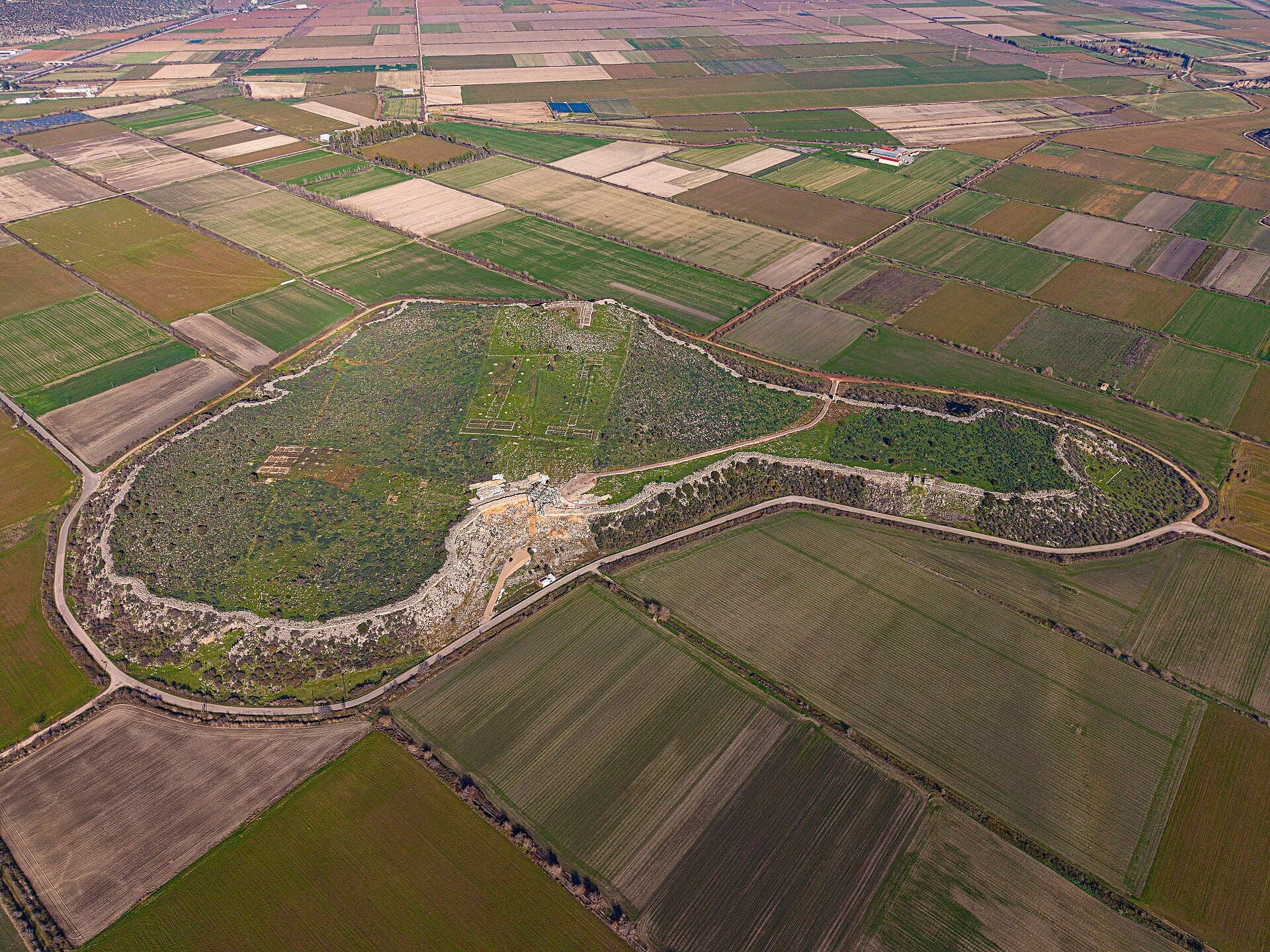
One of the largest fortified complexes of the Mycenaean world, the citadel (acropolis) of Gla in Boeotia, Greece, is gradually coming back into focus following new restoration work on its South Gate and sections of its massive Cyclopean walls.
The project aims to preserve the site while making it easier for visitors to understand its scale and layout.
A Vast Mycenaean Stronghold
The citadel of Gla stands at the northeastern edge of the Copais basin and is considered one of the most extensive fortified complexes of the Late Bronze Age in Greece. Its position offers wide views over the plain and lies close to the northern Euboean Gulf.
The site developed in the 13th century BC into a major administrative and economic center, closely linked to large-scale drainage works in the region.
Its size and organization sets it apart from other structures of its time. It features two wings arranged at right angles, forming a rare perpendicular plan in ancient Greek architecture. Researchers say this design points to a clear and unified vision from the outset, rather than gradual expansion.
Inside, the structure shows strong signs of organized space use. Rooms are clearly divided, suggesting that different areas served specific functions. These may have included administrative tasks, storage, or residential use.
The overall arrangement resembles patterns seen in Mycenaean palatial buildings, known for their structured layouts and functional planning.
Restoring the South Gate
The latest works focused on the South Gate, one of the main entrances to the citadel, and a nearby section of the defensive wall. The project included detailed documentation of the surviving material, structural assessment, and stabilization.
Parts of the gate and wall were restored using materials chosen to match the original construction as closely as possible. At the same time, excavation work at the foundations and within the wall itself provided new insights into how the structure was built.
Improving the Site for Visitors
In addition to the restoration, large areas of vegetation were cleared, making the layout of the citadel easier to understand and reconnecting it visually with the surrounding landscape.
The broader goal is to gradually present Gla as a unified and accessible archaeological site, allowing visitors to better appreciate both its scale and its role within the wider landscape of the Copais area.
Related: Melathron of Gla: 3,300-Year-Old Mycenaean Building in Greece Reveals Advanced Architecture


