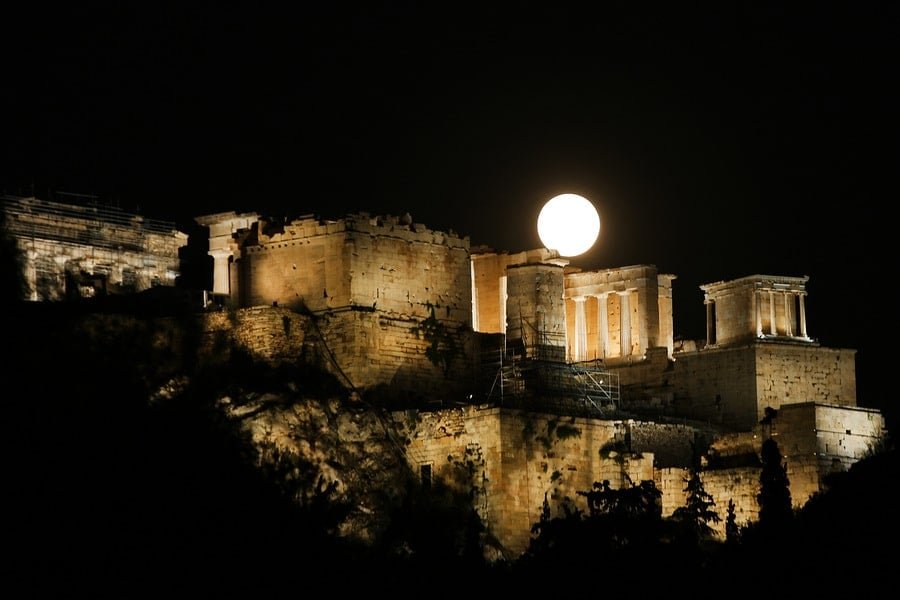

The Full Moon of February 2026 reaches its exact peak shortly after midnight, at 12:09 a.m. local time in Greece, in the early hours of February 2. For most observers, however, the most striking view will come earlier on the evening of February 1, shortly after sunset.
As the Moon rises low over the eastern horizon, it will appear unusually large and imposing. This well-known visual illusion occurs when the Moon sits close to the horizon, making it look larger than it truly is as viewers subconsciously compare it with objects in the surrounding landscape.
Jupiter steals some spotlight from February Full Moon
This year’s February Full Moon does not appear alone in the night sky. Jupiter will shine brightly above the eastern horizon, standing out as a prominent evening object.
The pairing of the brilliant planet with the Full Moon creates a striking and easily visible celestial display, even for casual skywatchers, adding depth and contrast to the night sky.
Full moon at the Temple of Poseidon in Sounio, Greece pic.twitter.com/lVvVhNvqCe
— God’s Whisper (@GodsWhisper777) January 25, 2026
Why it’s called Snow Moon
In many traditional calendars, February’s Full Moon is known as the Snow Moon. The name reflects the harsh winter conditions historically associated with this month in the Northern Hemisphere, when heavy snowfall and severe weather were most common.
Some cultures also call it the Hunger Moon, a reference to the difficulty of finding food during the deepest part of winter. Among certain Indigenous North American traditions, the Moon is linked to bears and the birth of their cubs, which gives it the name Bear Moon.
Cultural meaning beyond astronomy
This Moon also carries spiritual significance in several parts of the world. In India, it coincides with Guru Ravidas Jayanti, a day honoring the teachings of Guru Ravidas, who promoted equality and social justice.
Around the same time, Hindus observe Magha Purnima through fasting, prayer, and acts of charity, marking an important moment in the religious calendar.
Full rotation of the Moon captured by NASA’s Lunar Reconnaissance Orbiter pic.twitter.com/0mDsMg6wkn
— Astropics (@astropics) January 3, 2026
When February has no Full Moon
On rare occasions, roughly once every nineteen years, February passes without a Full Moon. Astronomers call this phenomenon a Black Moon, which occurs because of how lunar cycles align with the calendar.
Time zone differences mean that the appearance—or absence of a Black Moon—can vary by location, adding another layer of complexity to the phenomenon. In 2026, however, February offers not only a Full Moon but also a memorable planetary companion.