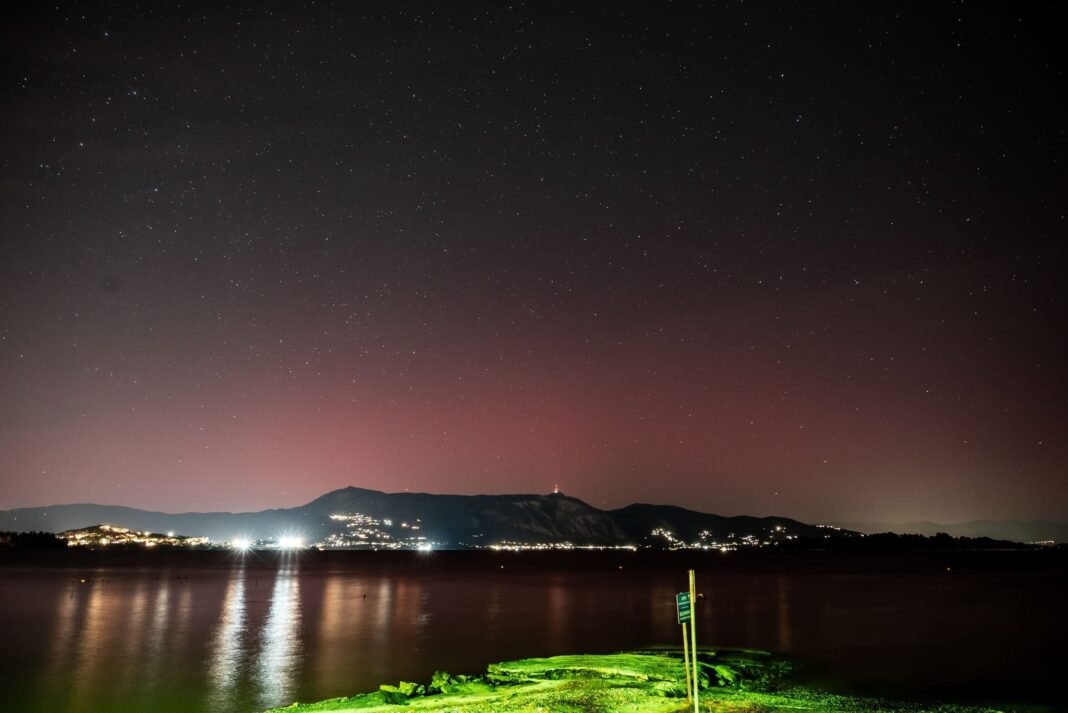
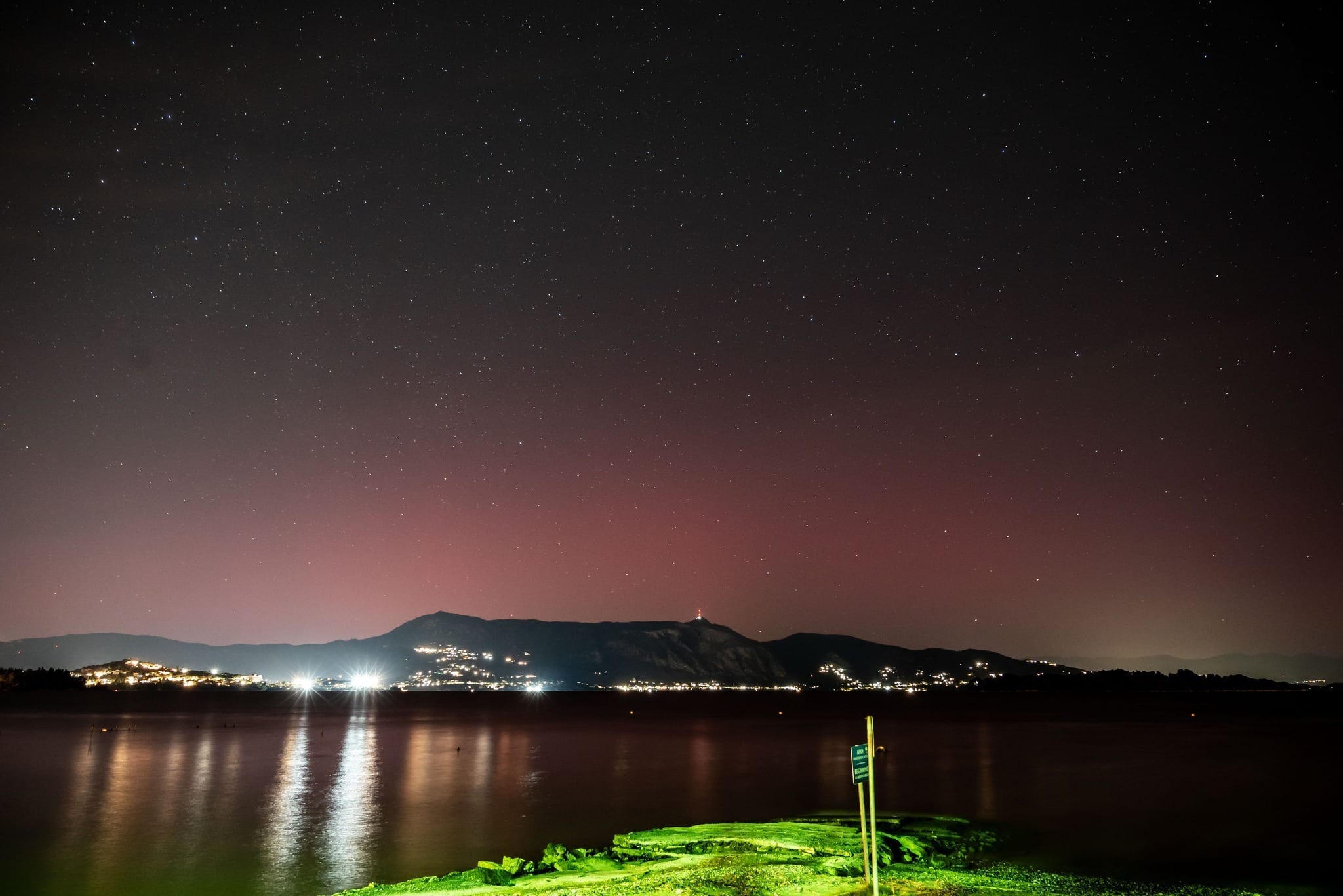
Social media feeds across Greece have been flooded with surreal images of the Northern Lights as a powerful G4-class geomagnetic storm—the strongest in over two decades—painted the Mediterranean horizon in hues of crimson and violet.
While usually reserved for the Arctic Circle, this extraordinary solar event pushed the boundaries of the Northern Lights further south than most have seen in their lifetime, reaching the heart of the Balkans and the Greek islands.
Northern Lights sightings in Greece
The phenomenon, caused by a massive solar flare, was visible across several Greek regions, leaving residents and photographers in awe.
In Greece, the Aurora appears red rather than the typical green seen in Scandinavia. This is because, at lower latitudes, we only see the “top” of the aurora—where solar particles collide with oxygen at much higher altitudes (over 200km), creating the distinctive ruby glow that has captivated the Greek public.
Chortiatis, Thessaloniki: The northern Greek skyline was transformed into a canvas of deep purples and reds. The rare atmospheric conditions allowed the Aurora to be captured clearly above the mountainous terrain of Macedonia.
Το βόρειο σέλας στον ουρανό της Θεσσαλονίκης pic.twitter.com/L9wUv9iP07
— Όμιλος Φίλων Αστρονομίας (@OFA_astronomy) January 19, 2026
Corfu (Kerkyra): In a truly historic moment, shortly after midnight, the Aurora appeared over the Ionian Sea. Photos captured the ethereal glow over the island, documenting a sight that is practically unprecedented for the region.
The most powerful geomagnetic storm since 2003
This geomagnetic storm reached Level 4 on a 5-point scale. According to Shawn Dahl of the Space Weather Prediction Center (SWPC), while the Earth experienced a brief Level 5 storm in 2024, the current solar activity is technically the most sustained and intense “since the 2003 Halloween storms.”
Experts warn that while the visual display is breathtaking, such high-intensity solar activity carries risks for modern infrastructure, including potential disruptions to satellite communications, GPS signals, and power grids.