
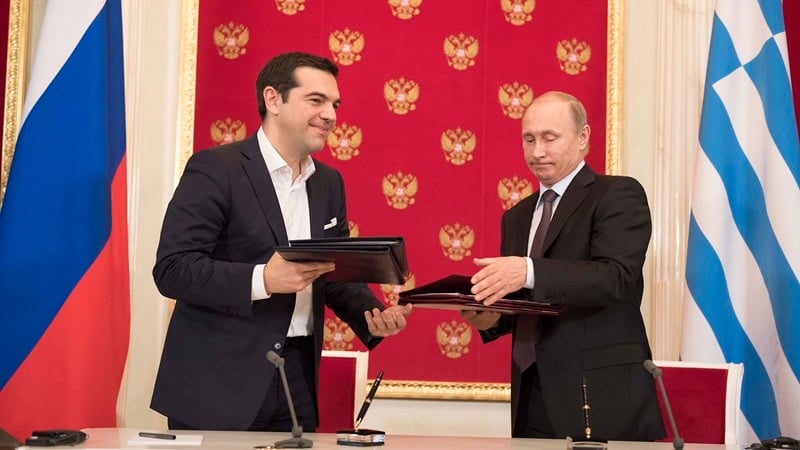
Former Prime Minister Alexis Tsipras’s memoir, Ithaca, reveals details about the Greek government’s contacts with Russia in the first half of 2015, detailing the journey from “cautious optimism” to Russian President Vladimir Putin’s blunt refusal of financial aid.
Half of Tsipras’ delegation believed they were traveling to the Soviet Union
Tsipras recounts his first trip to Moscow in April 2015, noting that the Russian political leadership was wary about the benefits of opening ties with the Greek government. Tsipras’ own goal was to enhance Greece’s negotiating leverage against its EU creditors.
The Greek delegation, which included figures such as Kotzias, Isychos, Lafazanis, and Valavani, created an odd atmosphere. Tsipras admits that half of the delegation seemed to believe they were traveling to the Soviet Union rather than modern Russia.
Tsipras recalls imagining Russian Prime Minister Dmitry Medvedev’s internal monologue as Greek ministers addressed him as “Comrade Prime Minister”: “I imagined, I could almost hear him muttering to himself: ‘Is it possible? These are not just old communists, they are time travelers.’”
Related: Tsipras on the Political Drama of July 2015: Defiance, the 17-Hour Showdown and the U-Turn
Cautious talks in Russia
During the first visit, the Greek side raised the prospect of extending the Turkish Stream gas pipeline through Turkey and into Greece. On the pipeline, the Russians were “positive but cautious.” Tsipras notes: “They proposed we start discussions, without them taking any specific commitments or providing a clear timeline.”
President Vladimir Putin similarly avoided deep engagement on the Greek debt crisis, preferring to ask about general political developments in Greece. Tsipras recalls that whenever the conversation shifted to debt negotiations, Putin would steer the discussion to other topics, offering no specific commitment on the pipeline or financial aid.
Putin snubs Tsipras
The crucial second meeting took place a few months later in St. Petersburg. Tsipras presented his negotiation intentions and formally proposed that Russia make even a symbolic investment of €200-300 million (now equivalent to $230.8 million-$346 million) in Greek government treasury bills.
Putin’s response was, according to Tsipras, brutally frank: “He told me that he would prefer to give the money we requested to an orphanage, because if he gave it to Greece, it would be like throwing it into a trash can.”
Putin explained that Greece was a bankrupt country that would not be saved by €300 million; it needed €300 billion. He then urged Tsipras, instead of seeking aid from Russia, “to find a solution with Merkel.” Even after the “No” vote in the referendum, Tsipras sought final advice from the Russian leader via a phone call.
The exchange concluded with Putin offering one last piece of guarded counsel:
“Do you have anything else to tell me regarding the next day? Any advice? What do you think I should do?’ I asked meaningfully. ‘You will decide what you must do, but I believe that a sustainable agreement will be good for everyone.’”
Related: “Ithaca”: Alexis Tsipras on Yanis Varoufakis


