

American philhellene and veteran photographer Robert McCabe pictured post-war Greece in hundreds of mesmerizing photos that depicted the landscape and people of the country during difficult but more innocent times.
His lifetime work, reflected in numerous exhibitions and books, made him an unofficial ambassador for Greece. His ties to the country were further strengthened when he married his Greek wife, Dina.
In 2020 he was granted honorary Greek citizenship at a ceremony held at the Greek Consulate in Boston.

“It is a tremendous honor to be a citizen of Greece. I can’t think of anything else that could give me more pleasure,” McCabe said, adding “Now the language of Ulysses is my language. And the beautiful Aegean Sea, with its magnificent islands and its unique history, is now my sea.”
Robert McCabe and his love affair with Greece

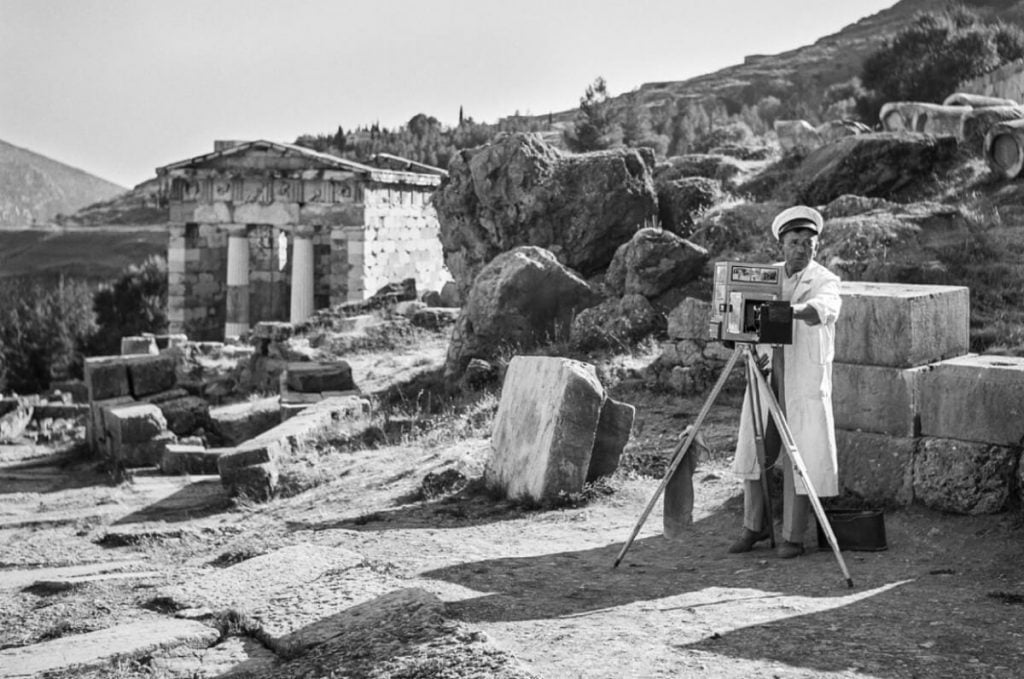
The 90-year-old first visited Greece in the 1950s as a student at Princeton University. He soon began taking photographs documenting life in Greece, from archaeological sites and landscapes to everyday events and people, when the country was still largely untouched by tourism.

The greatest gift the American photographer has given Greece is sharing his point of view of the country, the way he captured with such respect and admiration ancient sites like Epidaurus and the Acropolis before their restoration.
Just as importantly, McCabe also took more humble photographs portraying everyday life in Greece, including wooden fishing boats, barbershops, and tavernas, presenting scenes of a country that is almost lost today.

McCabe has also supported many Greek-American institutions, including Athens College, the Gennadius Library, and the American School of Classical Studies in Athens.
The famed photographer also bought and restored the Boston home of Samuel Gridley Howe, who fought on the Greek side in 1824 during the Greek War of Independence.
Robert McCabe photographs Mykonos
Robert McCabe photographed Mykonos over 48 hours during the summer of 1955. Those images were the early beginnings of a career in journalism. They captured a slice in time of a Greek era long gone.
A sleepy island of fishermen and farmers struggling to make ends meet became a global destination for hedonistic lifestyles and obnoxious displays of material abundance by both visitors and locals alike.

“In 1955 Mykonos was like an independent island principality, with its own culture, its own dances, songs, poetry, cuisine, textiles, architecture, even language,” stated McCabe.
“All of this had evolved and been carefully honed over a period of thousands of years, through wars, occupations, drought, and other calamities. This beautiful island represented in a way an undisturbed example of a very carefully polished self-sufficient Aegean civilization.”

Acropolis Museum exhibition on McCabe’s Greece
The Ministry of Tourism, the Greek National Tourism Organization and the Acropolis Museum present a photography exhibition by Robert McCabe titled “Χαίρε Ξένε. In the land of dreams” from 28 May 2024 until 8 September 2024, in the Temporary Exhibition Gallery at the Acropolis Museum ground floor.
This is a unique retrospective exhibition of McCabe’s “Greek era”, with about 100 photographs, aimed to highlight the timelessness of the photographs of the American artist.
Robert McCabe’s photographic lens portrays Greece marked by toil and limited means, yet also highlights its prospects and the anticipation for a brighter future, the Acropolis Museum says.
The selected photographs underscore the significance of preserving Greece’s natural beauty and cultural heritage, safeguarding the elements of our identity that make Greece a truly unique place – vibrant, optimistic, with a rich tapestry of past, present, and future, it adds.