Tourism was widespread in ancient Greece, largely driven by the major sporting events of the Panhellenic Games held at Olympia, Delphi, Isthmia, and Nemea. Thousands from across Greece and the Greek world made the journey to such events, a journey that could take days. According to modern calculations, up to 50,000 people traveled to Olympia.
The number is astonishing given the limitations to travel at the time. Greek roads were poorly developed due to the fragmentation of Greek society at the state level and the extreme cost of constructing roads in Greece’s mountainous terrain. There was also a danger of violence on Greek roads as travelers were prone to be accosted by highwaymen. As such, having a large entourage was useful for protection, and the transportation of valuables was risky.

It took Athenians five to six days to get to Olympia, and six sailing days were needed to get to Olympia from southern Italy. Despite these limitations and due to the sacred nature of the games, there was even a period of truce declared across Greece to allow for safe travels for those who wished to attend.
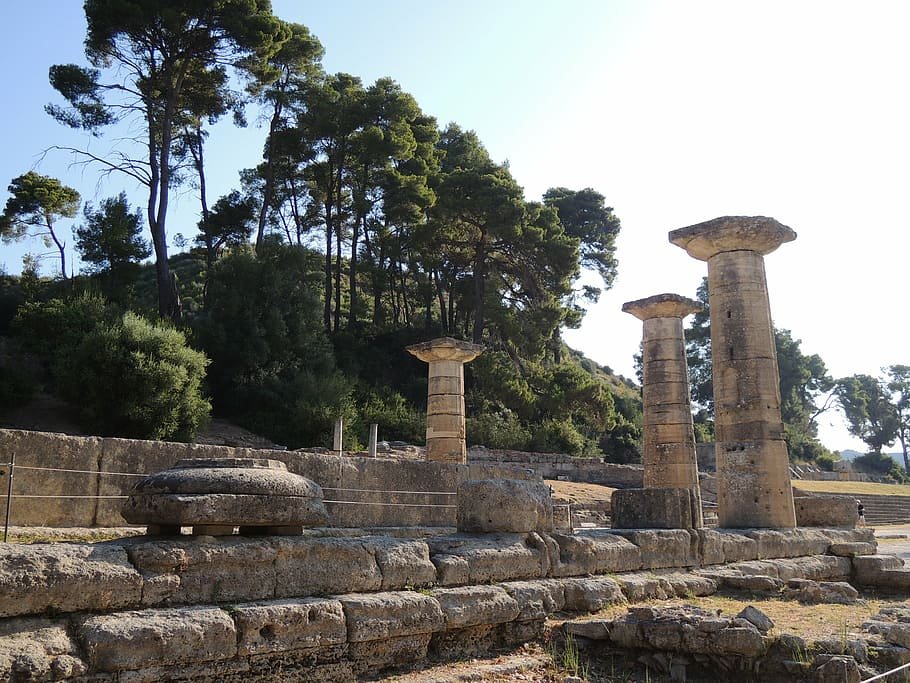
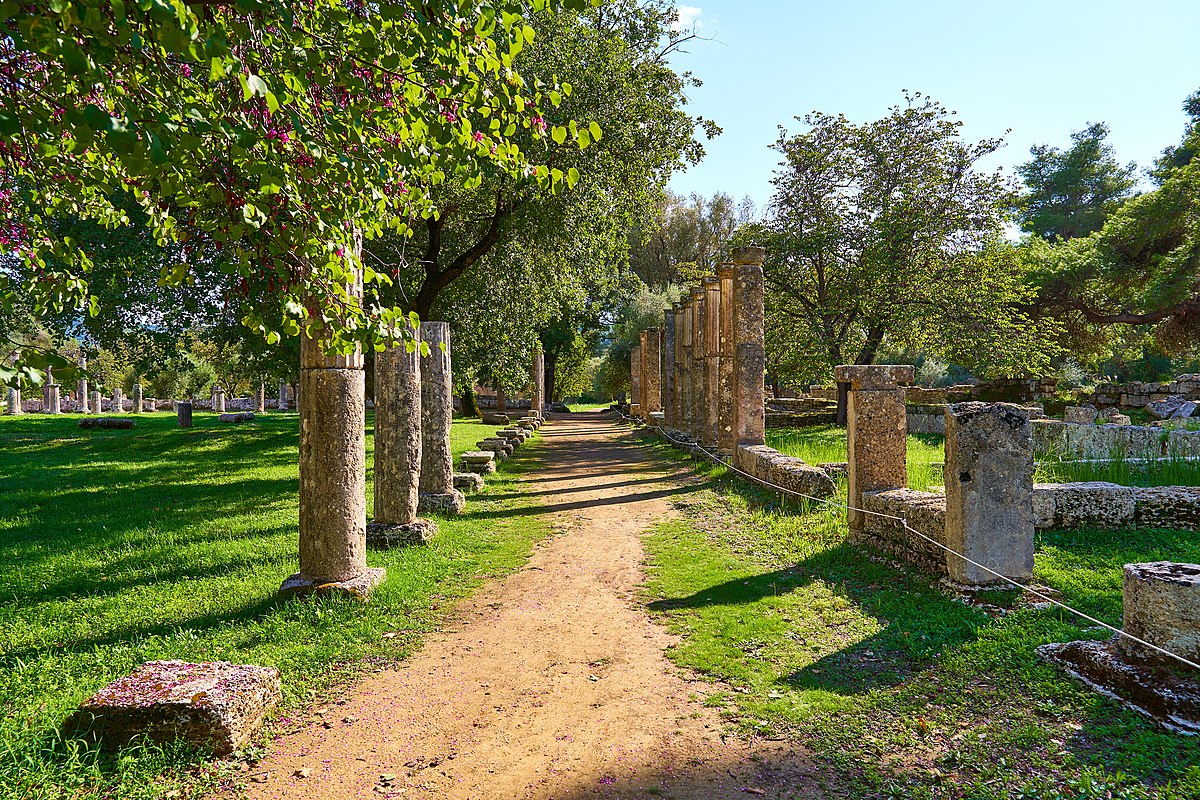
There, in archaic and classical times, travelers saw buildings, sculptures, and paintings. Later on, during the Hellenistic and Roman periods, Olympia and other sports centers became an obligatory stop of the Greek and Roman elites.
Sports, religion, and cultural tourism in ancient Greece
In a comprehensive essay on the subject, Fernando Garcıa Romero, professor of Ancient Greek at the Universidad Complutense de Madrid, noted that spectators and tourists had diverse motivations for attending the Games. For many, religion was the prime motive for traveling to Olympia since the main sports games were held there. They were vital centers of pilgrimage throughout antiquity.
Secondly, Olympia, Delphi, Isthmia, and Nemea were also the main centers of sports tourism in ancient Greece, and there appears to be no doubt that such tourism existed there in the strictest sense.
Moreover, the Games attracted cultural tourists who came not only for the athletic contests but also to admire the architectural, sculptural, and artistic treasures of Olympia. Cultural tourism at sanctuaries like Olympia and Delphi encompassed architecture, sculpture, painting, literature, and philosophy. The presence of poets, writers, orators, and philosophers added another layer of appeal to the Games, making them both athletic and intellectual gatherings.
“Olympia was the most important meeting point for literary and intellectual activities in Ancient Greece, because authors and thinkers gave publicity to their works and ideas there, exploiting the fact that the Olympic Games gathered together the greatest crowd of Greeks,” Romero said.
Famous orators, writers, and philosophers—such as Anaxagoras in the fifth century BC, Plato and the mathematician Euclides in the fourth century BC, or the Pythagorean Apollonius of Tyana in the first century AD—often stirred great excitement among spectators. Romero wrote:
“One could hear crowds of wretched sophists around Poseidon’s temple shouting and reviling one another, and their disciples, as they were called, fighting with one another, many writers reading aloud their stupid works, many poets reciting their poems while others applauded them, many jugglers showing their tricks, many fortune-tellers interpreting fortunes, lawyers innumerable perverting judgement, and peddlers not a few peddling whatever they happened to have.”

Overcrowding and tour guides in Olympia and Delphi
By antiquity’s later centuries, Olympia and Delphi had become such prominent destinations for cultural tourism that we even have records indicating the existence of tour guides—individuals tasked with explaining the artistic and architectural marvels to visitors.
Some ancient sources, however, criticize these guides for being overly verbose and rigidly attached to their scripts. In his treatise On the Oracles of the Pythia complained:
“The guides were going through their prearranged [program], paying no heed to us who begged that they would cut short their harangues and their expounding of most of the inscriptions.”
Beyond the tours, Olympia and other great sanctuaries took on the atmosphere of bustling markets. In the third century BC, the comic poet Menander famously summed it up in five words: “Crowd, market, thieves, dice games, chatters.”
Pausanias, the 2nd-century traveler and geographer, also noted the commercial frenzy:
“The small traders make themselves booths of reeds or other improvised material. On the last of the three days they hold a fair, selling slaves, cattle of all kinds, clothes, silver and gold.”
In short, as historian Romera observed, Pythagoras was right when he said that Olympia, during the Games, was the ideal time and place to observe human nature in all its complexity.
Class division among tourists at the Games

Visitors to Olympia during the Games did not escape the inconveniences of mass gatherings. The massive influx of spectators, all eager to leave at the same time, created logistical chaos—especially when it came to securing transportation.
Lucian noted the frustration of departure delays:
“Soon the Olympic Games were ended, the most splendid Olympics that I have seen, though it was then the fourth time that I had been a spectator. As it was not easy to secure a carriage, since many were leaving at the same time, I lingered against my will’.
Accommodation at Olympia was also a challenge. Facilities were extremely limited, forcing most visitors to camp in makeshift huts or cloth tents scattered around the sanctuary. The comfort and luxury of these shelters varied drastically depending on the economic status of their occupants. Fine meals and proper bathing were luxuries enjoyed only by the affluent few.
The historian Diodorus of Sicily (1 BC) described the luxurious tents where the tyrant Dionysius I of Syracuse was lodged during his stay in the sanctuary for the Games of the year 388 B.C. These lavish tents were finally sacked and destroyed by an angry crowd that, driven by the democratic politician Lysias, protested against the presence of the tyrant in Olympia and his unbearable ostentation—including his highly decorated pavilions, four-horse chariot teams, and reciters.
A similar critique is found in a speech by the orator Andocides (5th century BC), who condemned the excessive display of Alcibiades at Olympia:
“Then again, look at the arrangements which he made for his stay at Olympia. For
Alcibiades, the people of Ephesus erected a Persian pavilion twice as large as that of the Athenian official deputation; Chios furnished him with animals for sacrifice and with fodder for his horses; while he requisitioned wine and everything else necessary for his maintenance from Lesbos.”
Plutarch made a similar point:
“The Ephesians equipped Alcibiades with a tent of magnificent adornment; the Chians furnished him with provender for his horses and with innumerable animals for sacrifice; the Lesbians with wine and other provisions for his unstinted entertainment of the multitude.”
In stark contrast, the overwhelming majority of visitors endured far more modest conditions—often forced to share tents with strangers. Comforts were scarce, while inconveniences were many.
Inconveniences endured by tourists
Ancient sources frequently highlight the discomforts spectators faced amid the overwhelming crowds and stifling heat of the Greek summer. Olympia, in particular, is repeatedly singled out as a place where physical hardship was part of the experience.
In the second century AD, the satirical writer Lucian of Samosata drew a direct comparison between the relative comfort of athletic festivals in Macedonia and the challenging conditions in Olympia:
“In a very fine city of Macedonia, so different, thank goodness, from Olympia with its lack of space, its tents and huts, its stifling heat’”
Some accounts even turned these discomforts into the stuff of jokes or hyperbolic threats. Claudius Aelianus, writing a little later, recounted a humorous anecdote about a man from the island of Chios who threatened his servant with what he considered the worst imaginable punishment:
“A man from Chios was annoyed with his servant and said: ‘I will not put you in the treadmill, but I’ll take you to Olympia’“
Not surprisingly, the biographer of philosophers Diogenes Laertius told us that, in the sixth century BC, the famous Thales of Miletus, the father of philosophy, “died as he was watching an athletic contest from heat, thirst, and the weakness incident to advanced age.”
Still, despite the heat, crowding, and basic accommodations, Olympia and the other great festival sanctuaries continued to draw massive audiences. Their appeal lay in the uniqueness of the experience and the unparalleled prestige of the Games.
As the philosopher Epictetus observed in the second century AD:
“And do they not happen at Olympia? Do you not swelter? Are you not cramped and crowded? Do you not bathe with discomfort? Are you not drenched whenever it rains? Do you not have your fill of tumult and shouting and other annoyances? But I fancy that you bear and endure all this by balancing it off against the memorable character of the spectacle.”
No doubt Olympia and the other major athletic sanctuaries where the Games were held offer some of the richest insights into the phenomenon of tourism in Graeco-Roman antiquity. Apart from the great urban centers like Athens, Alexandria, and Rome, few places could rival the magnetic pull of these sacred sporting venues.
The Olympic, Pythian, Isthmian, and Nemean Games not only gathered tens of thousands of visitors from across the Greek—and later Graeco-Roman—world but also brought together people from all walks of life. As historian Javier Gómez Espelosín Romero noted, these festivals provide a rare and vivid opportunity to understand the scope and texture of ancient tourism.