
A new archaeometric study has identified a Roman wall painting technique using “red gold” never documented before, offering rare insight into elite life and artistic innovation in ancient southeastern Spain.
The research focuses on Carthago Nova, today’s Cartagena, one of the most important ports in Roman Hispania. Scientists found that painters working in the Domus of Salvius, a high-status urban residence, developed an advanced method for applying cinnabar, the vivid red pigment known in antiquity as “red gold.”
Cinnabar was among the most expensive and dangerous pigments in the Roman world. Its careful use was closely tied to wealth, power, and elite display. The findings were published in Scientific Reports and are based on detailed material analysis of wall paintings preserved in exceptional condition.
A rare opportunity to study intact Roman frescoes
The Domus of Salvius is one of the best-preserved Roman houses in Cartagena. Built in the late 1st and early 2nd centuries AD, the residence reflects the prosperity and cultural ambition of local elites during the High Empire.
Domus of Salvius in Cartagena.#ancientCartagena #Spain #redgold #cinnabar pic.twitter.com/2ZXQos8ipN
— Tom Marvolo Riddle (@tom_riddle2025) February 27, 2026
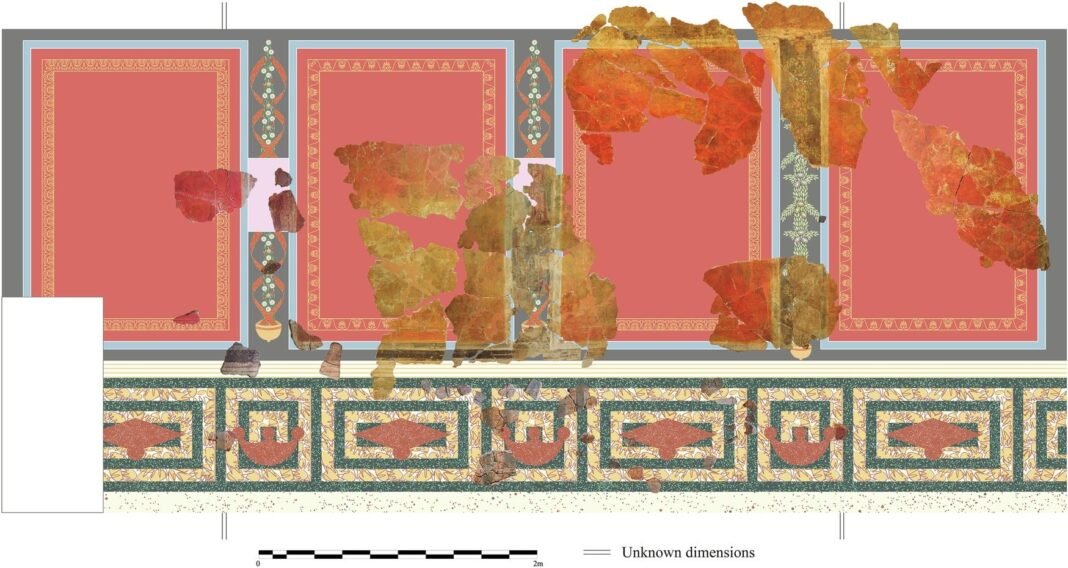
Researchers concentrated on Room 3, identified as a biclinum, or formal dining room, based on the shape of its mosaic floor. Unlike most Roman wall paintings, which are often found collapsed or fragmented, the frescoes in this room remain fully intact and attached to the walls.
This rare preservation allowed researchers to reconstruct the complete decorative program. It also made it possible to extract microscopic samples with a level of precision seldom available in Roman archaeology.
Hidden complexity beneath the painted surface
Scientific analysis revealed that the paintings rested on a carefully engineered plaster system. What appeared to be a simple structure was actually composed of four distinct layers.
Chemical testing showed the mortar was lime-based but made from micritic lime, a mechanically strong material likely sourced from local quarries in the surrounding mountains. The plaster also contained aggregates such as marble, quartzite, schist, limestone, and dolomite.
The presence of marble fragments points to high-quality craftsmanship. The absence of marine bioclasts, common in coastal construction, suggests that the workshop followed a specialized sourcing strategy.
A refined and deliberate color palette
Pigment analysis revealed a technically sophisticated palette. White areas were made from calcium carbonate, ensuring strong bonding with wet plaster. Black tones came from vegetal charcoal, produced by burning plant material under controlled conditions.
A new study reveals a previously unknown Roman painting technique in ancient Cartagena, Spain. Researchers found that elite artists used a layered method to apply cinnabar, or “red gold,” combining artistry with chemistry to preserve color and reduce cost. pic.twitter.com/2ZU5CNpCMz
— Tom Marvolo Riddle (@tom_riddle2025) February 27, 2026
Yellow hues derived from goethite, or yellow ochre, are a stable pigment well suited to fresco painting. Painters used it both decoratively and as a base layer beneath red areas. It also helped create imitations of luxury marbles such as giallo antico.
Green areas were produced using green earth, specifically glauconite. In several sections, researchers detected traces of blue pigment mixed into the green, showing deliberate blending to adjust tone and depth.
Egyptian blue and elite visual contrast
Raman spectroscopy confirmed the presence of Egyptian blue, the earliest known synthetic pigment. Made by heating sand, lime, and copper compounds, it produced an intense and durable color.
In the Domus of Salvius, painters applied Egyptian blue both in pure form and mixed with green earth. Pure blue appeared in decorative bands separating painted panels, creating a sharp visual contrast. Its use signaled wealth, as the pigment was costly and technically demanding to produce.
A breakthrough in cinnabar application
The most significant discovery involved the red pigments. Cinnabar, known as minium in antiquity, had previously been documented in Cartagena mainly in earlier decorative phases. Its presence in this later renovation shows that elite households retained access to rare materials longer than previously believed.
More striking was how the pigment was applied. Using scanning electron microscopy and elemental mapping, researchers found that painters first laid down a yellow goethite layer. Over this, they applied a blended mixture of cinnabar and hematite.
This layered technique has rarely been observed in the Roman world. Comparable evidence exists only in distant locations such as Ephesus, suggesting shared technical knowledge among elite workshops.
Rethinking Roman painting in Hispania
Researchers believe the method served both economic and technical goals. Mixing cinnabar with hematite reduced costs while preserving visual impact. The yellow underlayer likely helped stabilize the pigment, slowing the chemical processes that cause cinnabar to darken over time.
The findings challenge the view that Roman wall painting in Hispania was static or imitative. Instead, the evidence points to innovation, experimentation, and a deep understanding of material behavior.
In the glowing red panels of this ancient dining room, researchers see more than an elite display. They see skilled craftsmen who combined artistry with chemistry and engineering, transforming “red gold” into decoration built to endure.