

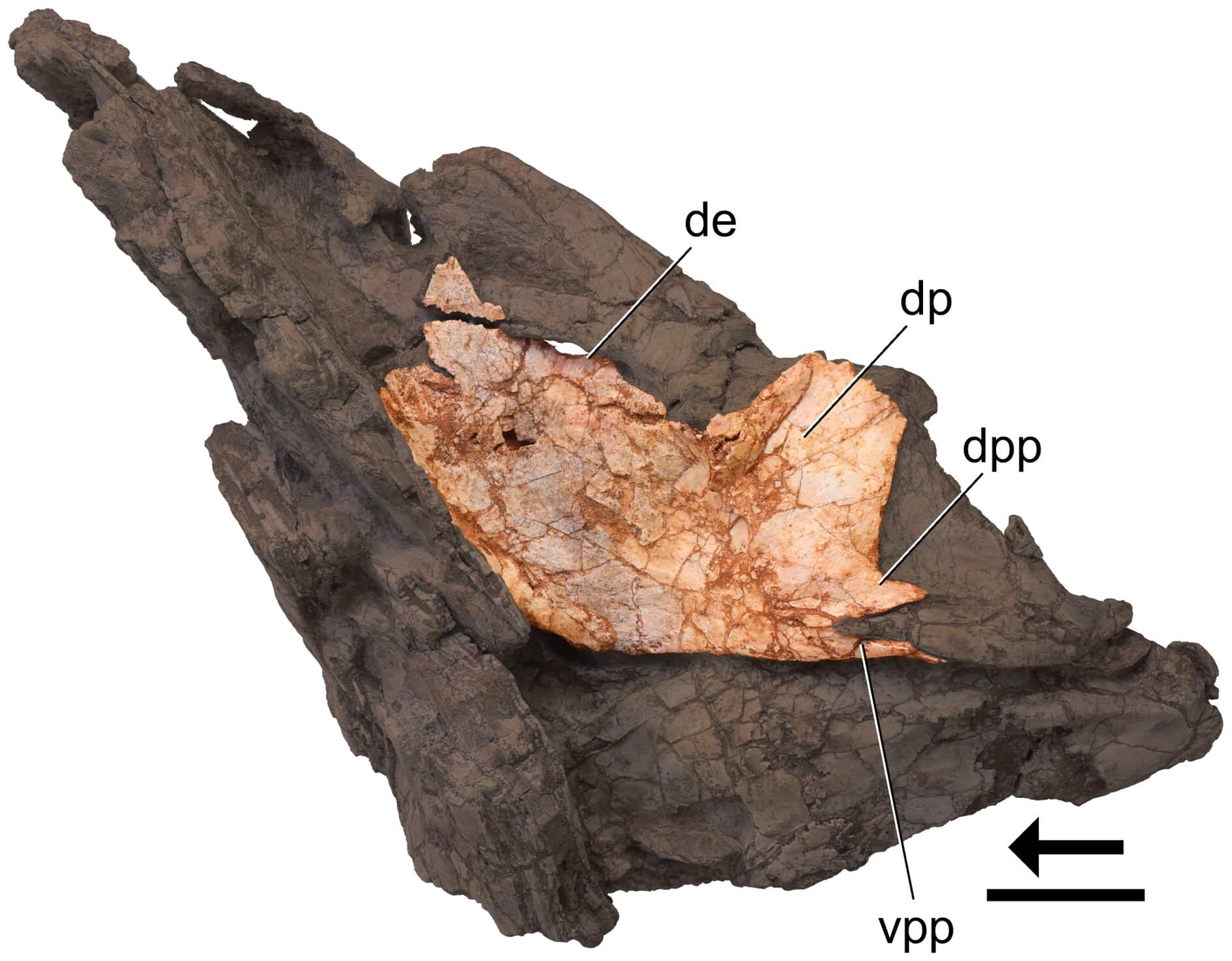
A damaged dinosaur skull once considered unusable has been now identified as a new species, providing fresh clues about how early dinosaurs evolved and rose to dominance.
The fossil was studied at Virginia Tech by undergraduate student Simba Srivastava. Despite its poor condition, the skull became the focus of a two-year reconstruction project. The findings were published in Papers in Palaeontology.
The specimen was first discovered in 1982 by a team from the Carnegie Museum of Natural History at Ghost Ranch. It remained largely unstudied for decades before paleontologist Sterling Nesbitt rediscovered it in storage and brought it to Virginia Tech for analysis.
Reconstructing a rare fossil
Researchers used computed tomography scans to study the fragile skull. The scans allowed Srivastava to digitally separate crushed bones and rebuild missing sections. A 3D-printed model helped reveal the original shape of the animal’s head.
The fossil belongs to a newly identified carnivorous dinosaur species named Ptychotherates bucculentus. The name means “folded hunter with full cheeks,” referring to its unusual skull structure.
The animal lived during the Triassic period, more than three times earlier than Tyrannosaurus rex. At that time, dinosaurs were still emerging and competed with other reptiles and early mammal relatives.
A key moment in dinosaur history
The study places the species within Herrerasauria, one of the earliest groups of predatory dinosaurs. Researchers say it may have been among the last surviving members of this lineage.
A damaged dinosaur skull once thought unusable has revealed a new species and fresh clues about early evolution. pic.twitter.com/BFDZZwVTsx
— Tom Marvolo Riddle (@tom_riddle2025) April 15, 2026
The fossil comes from rock layers dating close to the mass extinction at the end of the Triassic. Scientists believe this event eliminated many competing species and allowed dinosaurs to become dominant in the following Jurassic period.
The discovery suggests the extinction may have also wiped out some early dinosaur groups, including herrerasaurians. This challenges earlier views that dinosaurs mainly benefited from the extinction without suffering major losses themselves.
Unique features and lasting impact
Despite being distorted, the skull revealed key features. Researchers identified large cheekbones, a broad braincase, and a short, deep snout. These traits had not been documented before in early dinosaurs and suggest more complex evolution during this period.
No other specimen like this has been found. Scientists say the fossil may represent one of the final records of its group. The region that is now the American Southwest could have been one of their last refuges.
Researchers say the study shows how even a single, damaged fossil can reshape scientific understanding. In this case, it offers rare insight into the final chapter of one of the earliest dinosaur lineages and the events that helped shape their rise.


