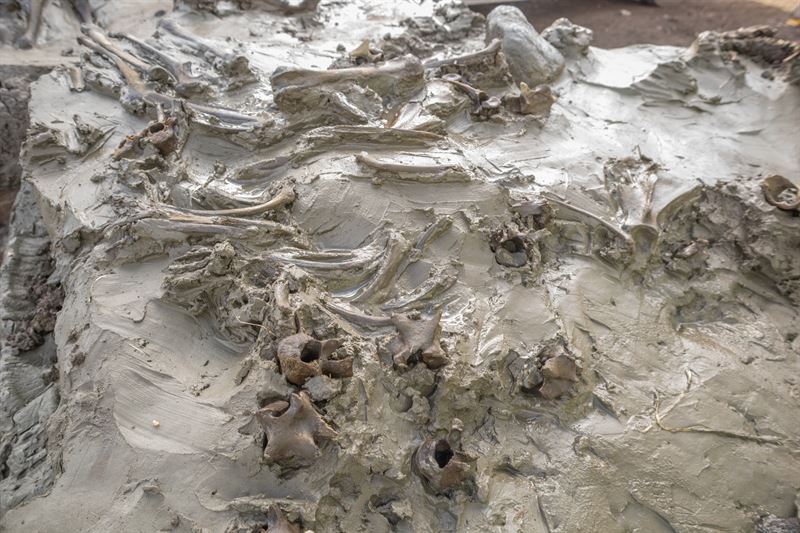
In southern Sweden, archaeologists have uncovered a 5,000-year-old burial that is reshaping how researchers understand the bond between humans and dogs during the Neolithic period. The discovery was made in the wetlands of Logsjömossen near Järna, southeast of Stockholm, during excavations linked to the construction of the Ostlänken railway.
Researchers found the remarkably well-preserved remains of a dog, deliberately placed on the former lakebed and buried with a finely crafted dagger made of bone. Archaeologists date the burial to the Late Neolithic period, between about 3300 and 2600 BCE.
A burial placed with care and intent
The dog was discovered about 1.5 meters (5 feet) below the surface, roughly 30 to 40 meters (100 to 130 feet) from what would once have been the shoreline. Archaeologists say the location rules out accidental disposal.
Evidence suggests the animal was wrapped in a hide or skin, weighted with stones, and carefully lowered into the water. The skull was crushed, a detail that researchers interpret as a deliberate killing rather than a natural death.
Beside the dog’s paws lay a dagger measuring about 25 centimeters (10 inches) in length. The blade was carved from elk or red deer bone and shows a high level of craftsmanship.
A weapon that likely held symbolic meaning
Archaeologists say the dagger was unlikely to have been an everyday tool. Its refined shape and careful placement suggest it held symbolic or ceremonial value.
Oxygen-poor conditions in the wetland preserved both the skeleton and the dagger in exceptional condition. Researchers say the blade is so well-crafted and intact that it could easily be mistaken for a modern reproduction.
An active animal with a working life
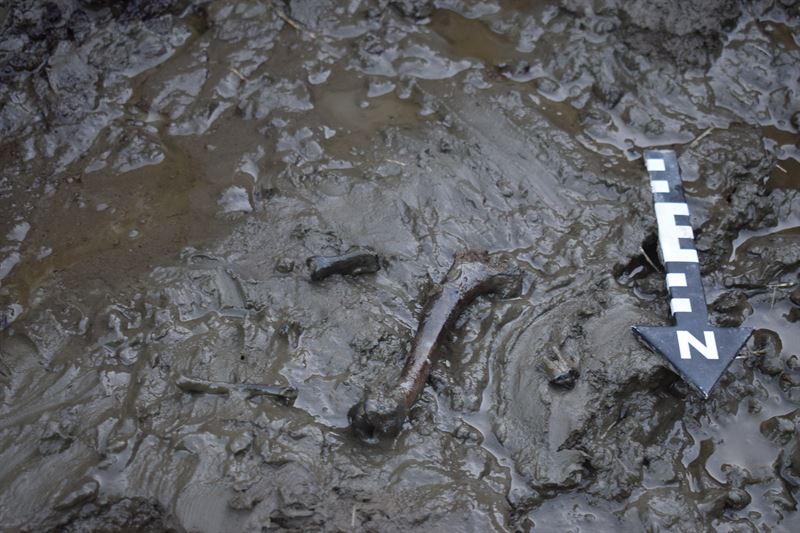
Analysis shows the dog was a large, powerfully built male. It stood about 50 to 52 centimeters (20 to 21 inches) at the shoulder and was between three and six years old when it died.
The bones indicate an active life. Archaeologists believe the dog may have helped with hunting, guarded camps, or worked near fishing installations that once dominated the lakeside site.
“Finding an intact dog from this period is highly unusual,” said Linus Hagberg, archaeologist and project leader at Arkeologerna, part of the Swedish National Historical Museums. “That it was deposited together with a bone dagger makes the discovery almost unique.”
Ritual practices tied to water landscapes
Archaeologists are cautious about assigning a single meaning to the burial, but the evidence strongly suggests a ritual act. In many prehistoric cultures, wetlands and lakes were viewed as liminal spaces—places between worlds where offerings were made to forces beyond everyday human life.
Similar, though far less complete, finds have been documented elsewhere in northern Europe, including dog skulls deposited near fishing structures during excavations connected to the Fehmarn Belt tunnel. A complete dog burial accompanied by a finely crafted object, however, sets Logsjömossen apart.
Recovering a find beneath the water
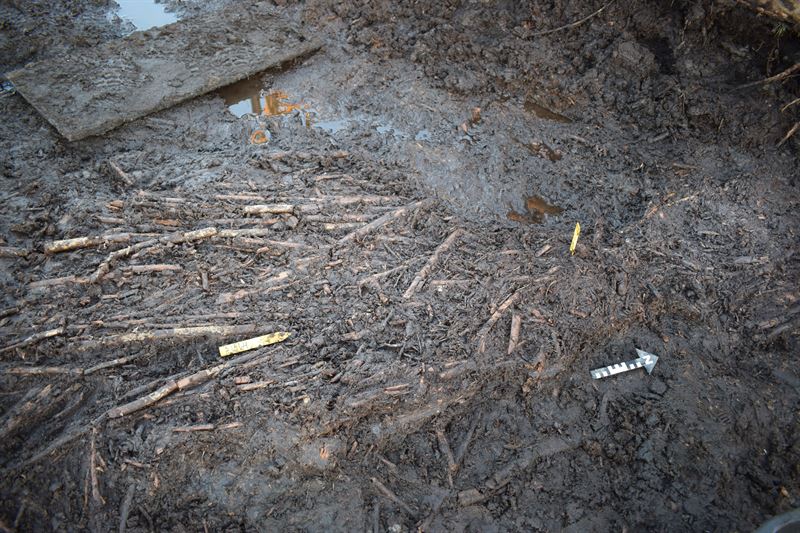
Excavating the site posed major technical challenges. The area covered roughly 2,500 square meters (27,000 square feet) and was divided into five-by-five-meter grids. Thick, waterlogged peat made movement difficult.
Archaeologists laid about 200 timber mats to support heavy machinery, while six pumps ran continuously to control flooding. The entire site was documented using photogrammetry, producing high-resolution 3D models of each find in its original position.
“It has been a demanding fieldwork environment,” said Magnus Johansson, project manager for the Ostlänken Archaeology Project. “But the collaboration between archaeologists and construction teams worked extremely well.”
What the dog may still reveal
The dog, the dagger, and associated finds have now been transferred to conservation laboratories. Radiocarbon dating, DNA sequencing, and isotope analysis are underway to determine when the dog lived, what it ate, and whether it was local or brought from elsewhere.
Researchers say the results will offer insight not only into the animal itself, but also into the people who lived along the lake—how they organized their economy, how they viewed animals, and how ritual was woven into everyday survival.
With this discovery, Logsjömossen has become a rare window into the emotional and symbolic world of prehistoric Scandinavia, showing that humans and dogs shared bonds that extended far beyond work and utility.