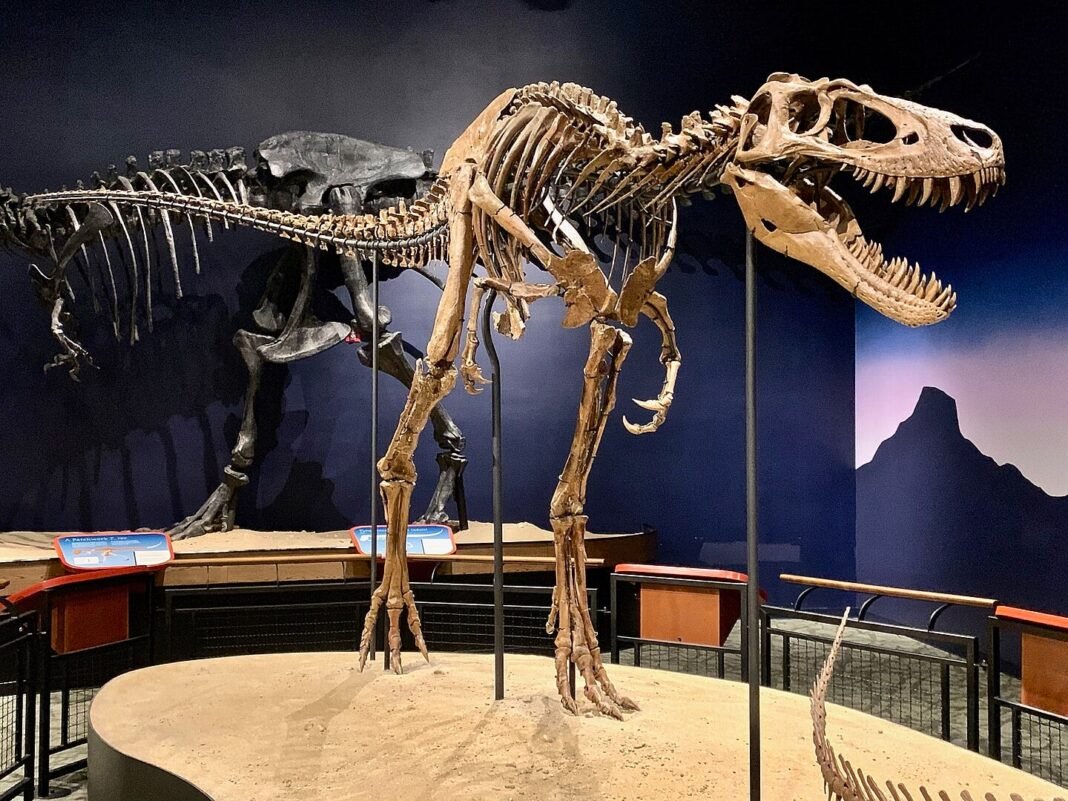

A fossil long debated among paleontologists has confirmed that the Nanotyrannus dinosaur was not a juvenile Tyrannosaurus rex but a fully distinct species, potentially reshaping scientific understanding of predator diversity in the late Cretaceous period.
The breakthrough comes from the “Dueling Dinosaurs” fossil, a rare find from Montana that preserved a Triceratops and a smaller tyrannosaur locked in what appears to be a fatal encounter. Researchers have now verified that the smaller skeleton is a mature Nanotyrannus lancensis, challenging decades of assumptions that it was an immature T. rex.
Lindsay Zanno, a paleontologist at North Carolina State University and the North Carolina Museum of Natural Sciences, said the fossil doesn’t just close a long-standing debate but upends years of research on how Tyrannosaurus rex grew and evolved.
The study, published in Nature, presents new data from growth rings, spinal development and skeletal features to show the animal was around 20 years old at the time of death and had reached full maturity.
Fossil evidence points to fully grown Nanotyrannus
Key physical traits such as a higher tooth count, fewer tail vertebrae, larger forelimbs and distinct cranial nerve patterns formed early in its development. Researchers concluded that these features are inconsistent with known T. rex anatomy, supporting the argument that it belongs to a separate species.
NANOTYRANNUS IS NOT ONLY VALID, BUT GETS A NEW SPECIES!!
[Nanotyranus lethaeus sp. nov]https://t.co/XKqWOYarashttps://t.co/uuWakicB3X pic.twitter.com/NrbrckKcVd
— Dactylioceras🇵🇸 (@Dinoh555) October 30, 2025
James Napoli, an anatomist at Stony Brook University and co-author of the study, said that for this dinosaur to be a young T. rex, it would need to violate everything scientists currently understand about how vertebrates grow. He called that idea not just unlikely but impossible.
For years, scientists relied on Nanotyrannus fossils to model the growth stages and behavior of T. rex. The new findings suggest that much of that research was based on incorrect assumptions, as the specimens represented two different animals.
New species identification and ecosystem implications
In addition to analyzing the Dueling Dinosaurs fossil, Zanno and Napoli reviewed more than 200 tyrannosaur specimens. In doing so, they identified another skeleton — once thought to be a teenage T. rex — as a new species of Nanotyrannus.
They named it Nanotyrannus lethaeus, referencing the River Lethe from Greek mythology to reflect how the species had been overlooked for decades.
The confirmation of Nanotyrannus as its own species also suggests that the ecosystems leading up to the mass extinction event were more diverse and competitive than previously believed.
Zanno explained that while T. rex dominated with its size and strength, Nanotyrannus was built for speed and agility, revealing a more dynamic predator landscape at the end of the dinosaur era.