
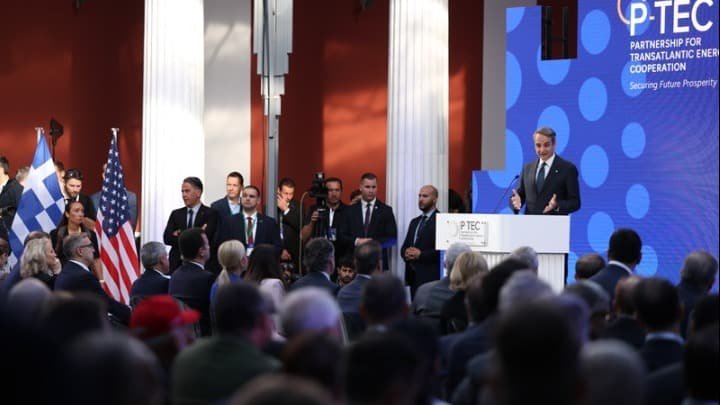
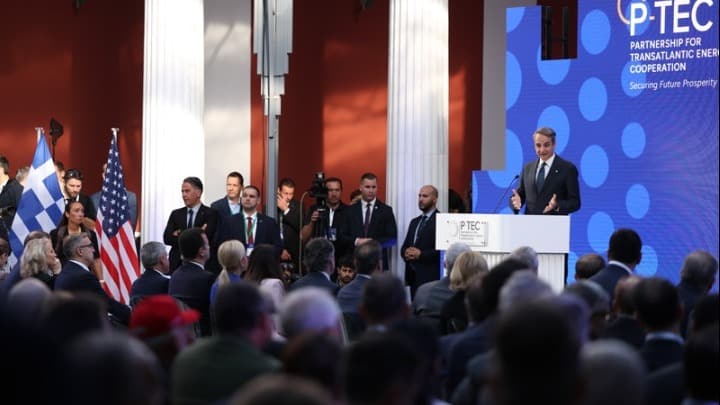
Speaking at the Partnership for Transatlantic Energy Cooperation (P-TEC) summit on Friday morning, Prime Minister Kyriakos Mitsotakis underscored the potential for significantly deeper energy collaboration between Greece and the United States.
Mitsotakis asserted that the Greek-US partnership is built on substantive foundations and shared strategic objectives.
“Both Greece and the US share a fundamental responsibility to provide affordable energy to our citizens and businesses,” he stated, adding that the goal is to ensure energy and raw material supplies are insulated from geopolitical tensions.
He welcomed competition, innovation, and technological development while emphasizing the commitment to reducing emissions.
The Prime Minister detailed Greece’s “new energy path” over the past six years. He recalled the strategic 2019 decision to phase out lignite—which had accounted for 60% of the country’s electricity—not only for environmental reasons but because it was economically costly.
Investments in solar and wind power have resulted in RES currently covering over 50% of Greece’s electricity needs. Consequently, Greece became a net electricity exporter in 2024, shifting from spending €75 million on imports in 2023 to earning €112 million from exports last year.
Significant investment has also gone into natural gas to ensure a secure and flexible energy supply for the future. This includes new power plants, grid improvements, and the ongoing €6 billion project to connect all Greek islands to the mainland grid.
He also spoke about prioritizing energy storage and establishing Greece as a stable, low-cost supplier of hydrogen.
Greece becomes a regional energy hub, Mitsotakis says
Mitsotakis confirmed the government’s renewed focus on hydrocarbon research during its second term, congratulating the Energy Minister for securing the agreement with ExxonMobil, Energean, and Hellenic Energy for the first exploratory drilling in four decades. He argued this is critical because “Europe will need natural gas for many, many years into the future.”
He positioned Greece as an energy security provider for Southeast Europe, citing projects like the Greece-Bulgaria interconnector and the Alexandroupoli FSRU terminal.
He highlighted the country’s transformation: “Six years ago, we were a footnote… simply importing gas to cover our domestic needs. In 2024, we saw a pivot, with 17 billion cubic meters of gas exported from Greece.”
The Prime Minister sent a strong message regarding the continent’s energy future: “Russian gas cannot enter Europe through the back door, meaning Turkey.”
He stressed that Greece is the essential gateway for gas to replace Russian imports, particularly via the Vertical Corridor project connecting Greece, Bulgaria, Hungary, Slovakia, Slovenia, and eventually Ukraine.


